
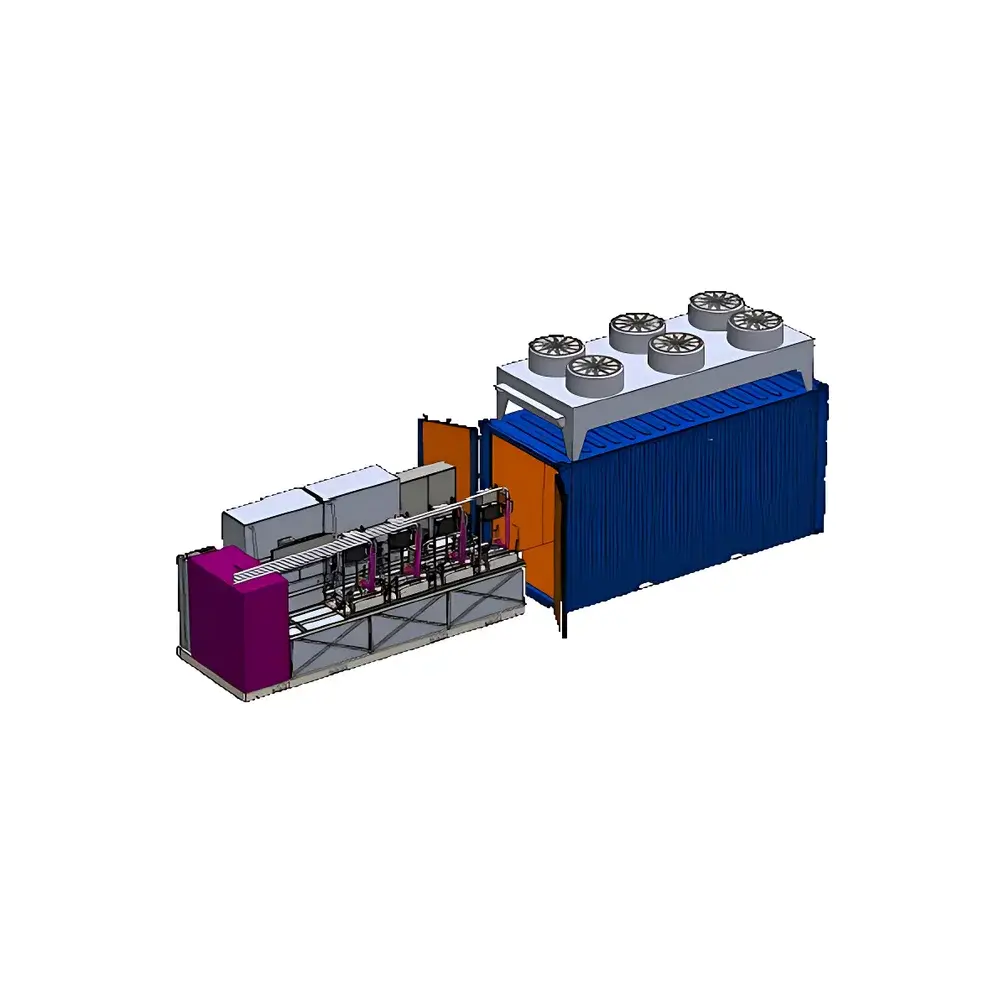
RuboLab DASH-1 Integrated Hydrogen-Powered Generator System
| Brand | RuboLab |
|---|---|
| Origin | Switzerland |
| Manufacturer Type | Authorized Distributor |
| Import Status | Imported |
| Model | DASH-1 |
| Hydrogen Generation Principle | Rare-Earth Alloy-Based Solid-State Hydrogen Storage & Release |
| Output Flow Rate | 150 L/min |
| Output Pressure Range | 0–70 MPa |
| Hydrogen Purity | 99.9999% |
| Power Consumption | Application-Dependent (Typical System-Side Electrical Input for Compression/Control: <5 kW) |
Overview
The RuboLab DASH-1 Integrated Hydrogen-Powered Generator System is a turnkey, containerized energy conversion platform engineered for stationary power generation using hydrogen as the primary energy carrier. Unlike conventional electrolyzer-only or fuel-cell-only systems, the DASH-1 integrates three core subsystems into a single ISO 20-foot shipping container: (1) solid-state hydrogen storage based on proprietary rare-earth metal hydride alloys developed from ETH Zurich’s 25-year research legacy in thermal hydrogen management; (2) automotive-grade proton exchange membrane (PEM) fuel cell stacks certified to ISO 14687-2:2019 for hydrogen fuel quality; and (3) real-time power conditioning, grid-synchronization, and thermal recovery modules. The system operates on a closed-loop hydrogen cycle: external electricity—whether from grid, solar PV, or wind—drives water electrolysis (via externally connected electrolyzers), producing hydrogen that is absorbed, compressed, and stored at near-ambient temperature within the alloy matrix. Upon demand, hydrogen is thermally desorbed, purified to ≥99.9999% (measured by GC-TCD per ISO 8573-8 Class 1), regulated to 0–70 MPa, and fed into the fuel cell stack to generate clean, synchronous AC power with peak electrical efficiency of 48–52% (LHV basis). This architecture eliminates high-pressure gaseous storage vessels and avoids cryogenic handling—reducing both safety risk and infrastructure footprint.
Key Features
- Modular 1 MWe scalable architecture: Standard DASH-1 unit delivers up to 1 MW nominal AC output with 4.5 MWh usable energy storage capacity in a single 20-ft ISO container (external dimensions: 6.058 × 2.438 × 2.591 m).
- Reversible solid-state hydrogen storage: Utilizes patented LaNi5-based intermetallic hydride alloys with >10,000 full charge/discharge cycles demonstrated under accelerated aging tests (per ASTM E2919-21), exhibiting no measurable capacity fade or structural degradation.
- Intrinsically safe operation: Hydrogen remains chemically bound below 80°C; no free H2 gas is present during storage—enabling indoor installation without explosion-proof zoning (compliant with IEC 60079-10-1 Zone 2 and NFPA 50A Annex B).
- Grid-support functionality: Equipped with IEEE 1547-2018-compliant inverters supporting reactive power injection (Q(V) and Q(f) modes), frequency-watt response, and black-start capability.
- Low lifecycle carbon intensity: Embodied energy payback time <1.8 years (based on EU average grid mix); total cradle-to-grave CO2e footprint ≤12 g/kWh (excluding upstream electrolyzer emissions).
Sample Compatibility & Compliance
The DASH-1 is designed for integration with third-party PEM or AEM electrolyzers (e.g., ITM Power, Nel Hydrogen, or McPhy units) delivering hydrogen at ≤30 bar and ≤40°C. Its inlet gas train includes dual-stage palladium membrane purification (removing CO, O2, H2O, and hydrocarbons to sub-ppb levels) and meets ISO 8573-1:2010 Class 0 (for particles, water, and oil) and Class 1 (for total hydrocarbons) requirements. All pressure-containing components are ASME Section VIII Div. 1 certified; control software complies with IEC 62443-3-3 SL2 for industrial cybersecurity. Full documentation package supports GMP-compliant validation (IQ/OQ/PQ) and FDA 21 CFR Part 11 audit trails for regulated energy applications.
Software & Data Management
The embedded RuboOS v4.2 supervisory control system provides local HMI (7″ touchscreen) and remote access via TLS 1.3-secured web interface or MQTT API. Real-time telemetry includes stack voltage/current, alloy bed temperature gradients, hydrogen mass balance, efficiency KPIs (kWhel/kgH2), and predictive maintenance alerts based on electrochemical impedance spectroscopy (EIS) trend analysis. Historical data is stored locally (32 GB industrial SSD) and optionally synced to private cloud instances compliant with GDPR and HIPAA data residency rules. Firmware updates follow IEC 62443-2-4 change management protocols with dual-signature verification.
Applications
- Microgrid stabilization: Providing inertia emulation, ramp-rate control, and synthetic inertia for solar/wind-dominant grids (validated in Swissgrid pilot projects).
- Industrial backup power: Replacing diesel generators in pharmaceutical cleanrooms and semiconductor fabs where ultra-high-purity hydrogen and zero NOx/SOx emissions are mandated.
- Hydrogen refueling station buffer: Serving as dynamic pressure booster between low-pressure electrolysis output and 70 MPa vehicle dispensing lines.
- Research infrastructure: Enabling long-duration (>72 h) continuous power supply for cryogenic labs, particle accelerators, and radioisotope production facilities requiring uninterrupted uptime.
FAQ
Does the DASH-1 include an integrated electrolyzer?
No—the DASH-1 is a hydrogen-to-electricity conversion system only. It requires external hydrogen supply from certified electrolyzers or pipeline sources.
What maintenance intervals are required for the solid-state storage module?
No scheduled replacement is needed; annual calibration of temperature sensors and quarterly verification of purge gas purity are the only preventive tasks (per RuboLab Maintenance Manual Rev. 3.1).
Can the system operate in ambient temperatures ranging from −25°C to +50°C?
Yes—the alloy thermal management subsystem maintains optimal absorption/desorption kinetics across this range using passive heat exchangers and optional electric trace heating (−25°C to 0°C operation).
Is remote firmware update capability validated for use in regulated utility environments?
Yes—over-the-air updates are performed via signed, encrypted packages with rollback support and require dual operator authentication, meeting NIST SP 800-53 RA-5 and EN 50128 SIL2 requirements.
How is hydrogen purity verified during continuous operation?
On-line gas chromatography (Agilent 490 Micro GC) with thermal conductivity detection performs automated 15-minute cycle analysis, logging results to the audit trail with timestamped digital signatures.



