
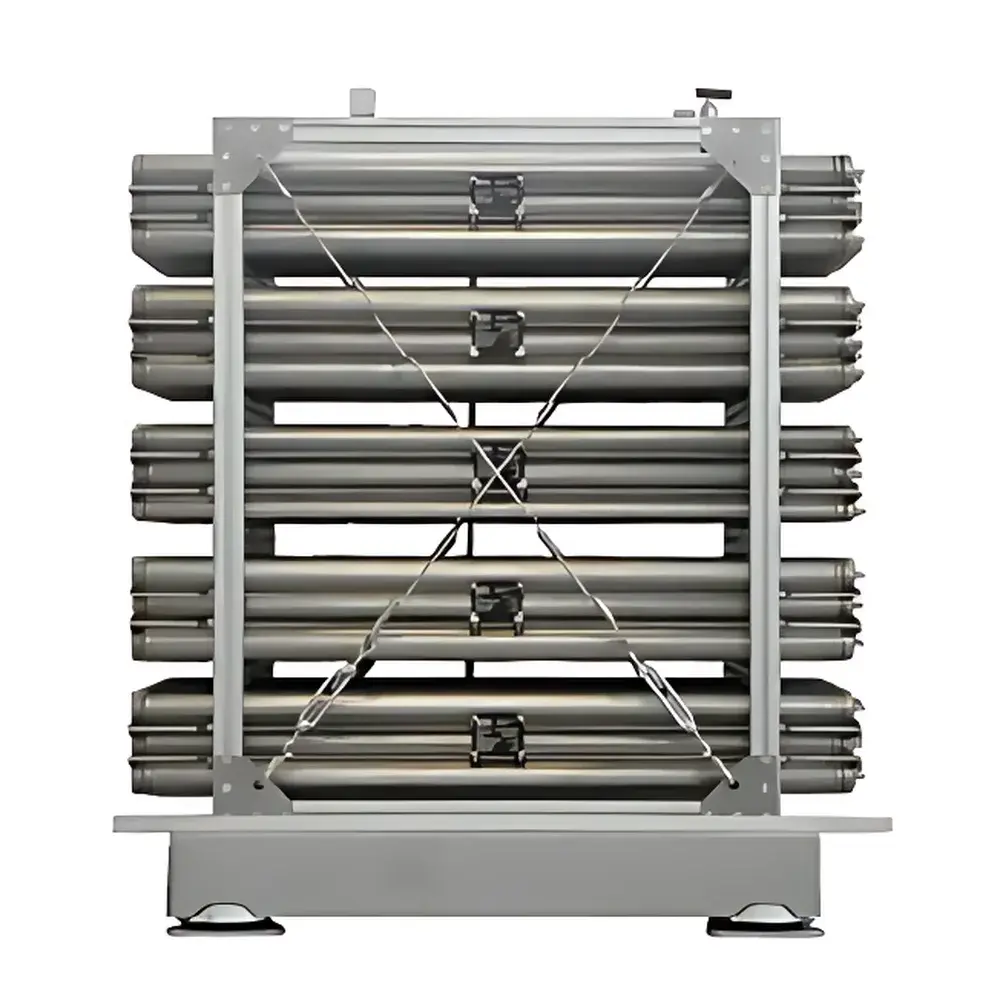
RuboLab DASH Industrial-Grade Solid-State Hydrogen Storage System
| Brand | RuboLab |
|---|---|
| Origin | Switzerland |
| Manufacturer Type | Authorized Distributor |
| Origin Category | Imported |
| Model | DASH |
| Hydrogen Generation Principle | Rare-Earth Alloy-Based Reversible Hydride Absorption/Desorption |
| Output Flow Rate | 150 L/min (STP) |
| Output Pressure Range | 0–20 MPa |
| Hydrogen Purity | 99.9999% (v/v) |
| Power Consumption | Application-Dependent — Typically <1 kW for thermal management during desorption cycles |
| Compliance | CE, PED 2014/68/EU, ASME BPVC Section VIII Div. 2 (design basis), ISO 16111:2017 (Hydrogen Technologies – Gaseous Hydrogen Storage) |
Overview
The RuboLab DASH Industrial-Grade Solid-State Hydrogen Storage System is an engineered solution for high-density, intrinsically safe hydrogen storage and on-demand release in laboratory, pilot-scale, and industrial hydrogen infrastructure applications. Unlike conventional high-pressure gas cylinders or cryogenic liquid hydrogen systems, the DASH system employs reversible metal hydride (RMH) chemistry—specifically, a proprietary rare-earth-based alloy matrix—to chemisorb hydrogen atoms into interstitial lattice sites at near-ambient temperatures and moderate pressures. This mechanism enables volumetric hydrogen storage densities exceeding 40 g H₂/L (at system level), surpassing both 700-bar gaseous storage and competing solid-state alternatives in gravimetric and volumetric efficiency under operational conditions. The system operates without external compression stages, eliminating mechanical compressors, associated leakage risks, and parasitic energy losses. Its core function is not hydrogen generation per se—but rather controlled, pressure-regulated hydrogen release from a stable, non-pyrophoric solid-phase reservoir. Designed for integration with PEM electrolyzers, fuel cells, and catalytic test benches, DASH delivers ultra-high-purity hydrogen (99.9999%) with minimal dew point variation (<−60 °C) and negligible impurity carryover (O₂ < 0.1 ppm, H₂O < 1 ppm).
Key Features
- Intrinsically safe operation: No flammable vapor cloud formation; no risk of catastrophic rupture or jet fire—hydrogen remains chemically bound until thermally activated.
- Modular stack architecture: Individual hydride modules are assembled into scalable pressure vessels (ASME-certified), enabling custom capacity configurations from 5 kg to >500 kg H₂ per installation.
- Low-system-pressure operation: Stores hydrogen at ≤5 MPa during charging and releases at up to 20 MPa without mechanical compression—reducing sealing complexity and fatigue loading.
- Thermal management integration: Built-in heat exchange channels support rapid, uniform heating/cooling during absorption/desorption cycles, ensuring reproducible kinetics and cycle life >5,000 full charge/discharge cycles.
- No pre-conditioning required: Operates across ambient temperature range (5–40 °C); no cryogenic cooling or pre-heating infrastructure needed.
- Non-toxic, recyclable hydride material: Alloy composition complies with EU REACH Annex XIV exclusions and ISO 14001 handling guidelines; end-of-life material recovery is commercially supported by RuboLab.
Sample Compatibility & Compliance
The DASH system is compatible with standard hydrogen interface protocols used in analytical instrumentation (e.g., GC carrier gas supply), fuel cell test stations (e.g., Horizon, FuelCellStore), and catalytic reactor feed systems. All pressure boundary components conform to PED 2014/68/EU and ASME BPVC Section VIII Div. 2. Material certifications include EN 10204 3.1 for vessel steels and ISO 16111:2017 for gaseous hydrogen storage performance validation. Hydrogen purity meets ISO 8573-1 Class 1:1:1 (for particles, water, oil) and ASTM D7157–22 Grade A specifications. Full traceability documentation—including material test reports (MTRs), weld procedure specifications (WPS), and factory acceptance test (FAT) records—is provided with each unit.
Software & Data Management
DASH integrates with optional RuboLab ControlSuite™ v3.2—a secure, audit-ready software platform supporting local HMI and remote SCADA integration via Modbus TCP or OPC UA. Real-time monitoring includes stack temperature gradients, pressure differentials, cumulative H₂ mass balance, and cycle-count tracking. Data logging complies with FDA 21 CFR Part 11 requirements (electronic signatures, audit trails, role-based access control) when configured for GLP/GMP environments. Export formats include CSV, PDF reports, and time-stamped SQLite databases for third-party analysis tools. Firmware updates are delivered via signed OTA packages with SHA-256 verification.
Applications
- On-site hydrogen supply for PEM fuel cell durability testing and polarization curve mapping.
- Continuous-feed hydrogen source for catalytic hydrogenation reactors requiring ppm-level impurity control.
- Buffer storage between intermittent renewable-powered electrolyzers and steady-load consumers (e.g., lab-scale ammonia synthesis).
- Mobile or indoor hydrogen infrastructure where high-pressure gas storage is prohibited by building codes (e.g., university research buildings, pharmaceutical QC labs).
- Calibration gas standard generation for FTIR, RGA, and residual gas analyzers requiring certified ultra-high-purity H₂.
FAQ
Does the DASH system generate hydrogen, or does it only store and release it?
DASH is a pure storage and delivery system—it does not produce hydrogen. It requires an external hydrogen source (e.g., PEM or alkaline electrolyzer) for charging.
What is the typical response time from standby to full-rated flow output?
From cold start (25 °C), full 150 L/min flow at 20 MPa is achieved within 90 seconds following activation signal; thermal pre-conditioning reduces this to <30 seconds.
Is the system suitable for use in explosion-hazardous zones (ATEX Zone 1/2)?
Yes—the entire system is designed to ATEX Directive 2014/34/EU Category 2G (gas) and carries full IECEx certification (Ex db IIB T3 Gb) for installation in classified areas.
How is long-term stability verified during commissioning?
Each unit undergoes 72-hour continuous pressure hold testing at 1.5× MAWP, followed by 100-cycle accelerated life validation under representative load profiles prior to FAT.
Can multiple DASH stacks be synchronized for load balancing or redundancy?
Yes—via RuboLab’s MasterStack Controller, up to 8 stacks can be daisy-chained with automatic pressure equalization and failover sequencing.



