
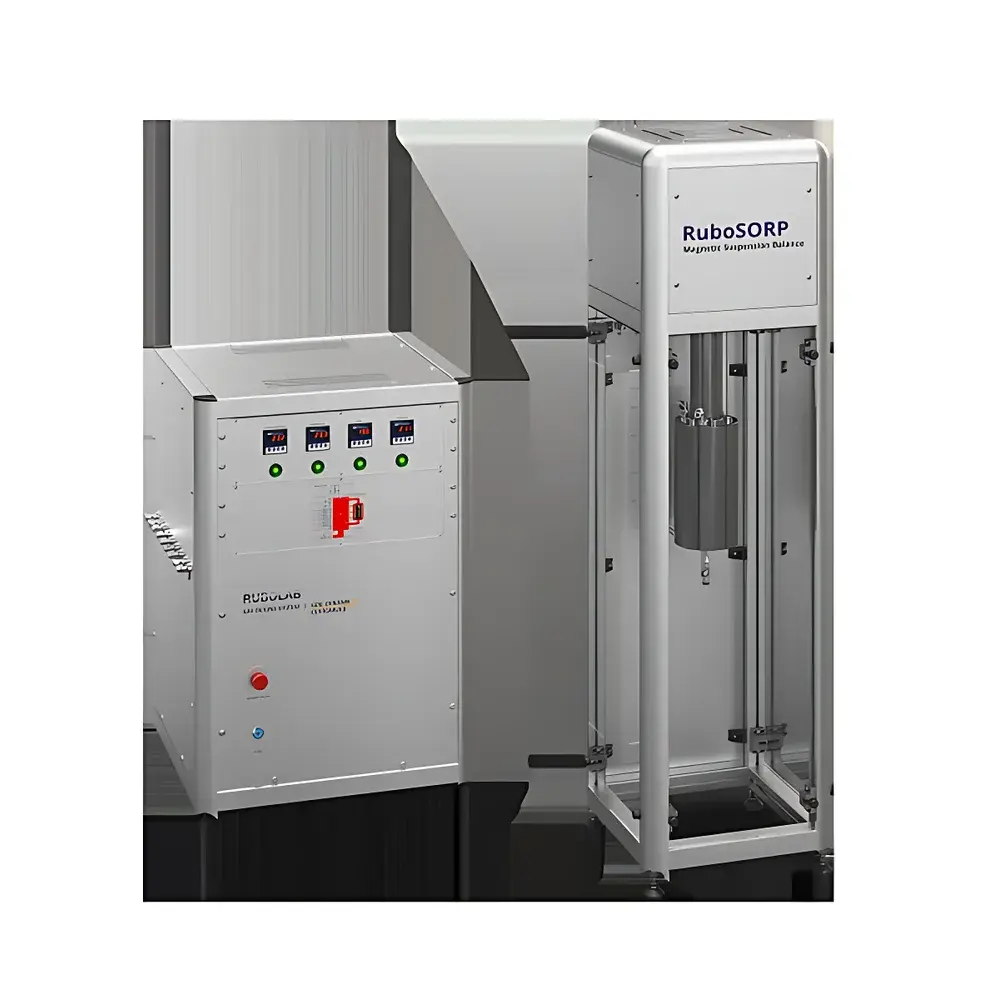
RuboLab RuboSORP Series Magnetic Suspension Balance Gravimetric Adsorption Analyzer
| Brand | RuboLab |
|---|---|
| Origin | Germany |
| Model | RuboSORP 50 / 150 / 350 / 700 |
| Measurement Principle | Magnetic Suspension Balance (Gravimetric) |
| Temperature Range | −196 °C to 500 °C |
| Pressure Range | 0–700 bar |
| Ultimate Vacuum | 1 × 10⁻⁷ mbar |
Overview
The RuboLab RuboSORP Series Magnetic Suspension Balance Gravimetric Adsorption Analyzer is an advanced, high-precision instrument engineered for quantitative measurement of mass change under extreme thermodynamic conditions. It employs a contactless magnetic suspension balance principle—where the sample pan is levitated and isolated from the weighing sensor via controlled electromagnetic fields—enabling true separation between the measurement zone (sample reactor) and the sensitive weighing unit. This architecture eliminates mechanical load transmission, thermal conduction, and pressure-induced stress coupling that compromise conventional microbalances in high-pressure or cryogenic environments. Designed specifically for adsorption, desorption, and thermogravimetric analysis (TGA) of solid sorbents—including MOFs, activated carbons, zeolites, and metal oxides—the system operates across an unparalleled temperature range (−196 °C to 500 °C) and pressure envelope (0–700 bar), with ultimate vacuum capability down to 1 × 10⁻⁷ mbar. Its fully metallic, hermetically sealed reactor ensures compatibility with aggressive media such as H₂S, NH₃, Cl₂, SO₂, and supercritical CO₂, making it suitable for both fundamental research and industrial process development in carbon capture, hydrogen storage, and catalytic material screening.
Key Features
- Contactless Magnetic Suspension Weighing: Eliminates physical linkage between sample and balance; prevents thermal drift, vibration transfer, and pressure-induced zero-shift.
- Automatic Load Decoupling & In-Situ Calibration: Integrated electromechanical actuation disengages the sample from the balance during zeroing or calibration—then re-engages it without manual intervention—ensuring continuous metrological traceability over multi-day experiments.
- Dual-Sample Capability with Density Determination: A second calibrated inert float (with known volume) serves as reference for real-time gas density measurement at high pressure and elevated temperature via Archimedean buoyancy correction—critical for accurate multicomponent gas adsorption quantification without requiring offline GC or FTIR analysis.
- Modular Thermal Management System: Supports interchangeable temperature control modules: liquid nitrogen Dewar (for cryogenic operation), continuous low-temperature controller (LN₂ + heater), thermostatic oil bath, and resistive electric furnace—each fully enclosing the metallic adsorption cell without breaking vacuum or gas integrity.
- Zero-Drift Compensation Architecture: The only commercially available gravimetric adsorption platform offering hardware-level automatic zero-point stabilization during extended isothermal holds, ramped TGA cycles, or multi-step pressure cycling—validated per ISO 11885 and ASTM D3874 protocols.
Sample Compatibility & Compliance
The RuboSORP series accommodates powders, pellets, monoliths, and thin-film samples (up to 2 g nominal capacity) in chemically resistant, all-metal (Inconel 718, Hastelloy C-276) sample cells with metal-gasketed flange seals. All wetted surfaces meet ASME B31.3 process piping standards for high-pressure service. The system complies with EU Machinery Directive 2006/42/EC and Pressure Equipment Directive 2014/68/EU (PED Category IV). Data acquisition and audit trails conform to FDA 21 CFR Part 11 requirements when configured with optional electronic signature and user access control modules. Instrument qualification documentation (IQ/OQ/PQ) is provided per GLP and GMP laboratory practice guidelines.
Software & Data Management
RuboLab’s proprietary SorptionStudio software provides full instrument control, real-time data visualization, and thermodynamic modeling integration. It supports automated method sequencing—including multi-step isotherms, isobars, and temperature-programmed desorption (TPD)—with configurable dwell times, pressure ramps, and thermal profiles. Raw mass, temperature, and pressure signals are recorded at ≥10 Hz with timestamped metadata. Export formats include CSV, Excel, and ASTM E1457-compliant XML. Optional modules enable integration with third-party thermodynamic databases (e.g., NIST REFPROP, Thermo-Calc) and kinetic modeling tools (e.g., MATLAB Simulink, Python-based PyMC3). Audit trail logging includes operator ID, parameter changes, calibration events, and system error codes—all retained for ≥10 years on encrypted local SSD storage.
Applications
- High-pressure CO₂, CH₄, H₂, and N₂ adsorption isotherms for CCS and energy storage material evaluation
- Cryogenic adsorption of O₂, N₂, Ar, and noble gases for air separation and isotopic enrichment studies
- Corrosive gas sorption (H₂S, SO₂, NH₃) on desulfurization and denitrification catalysts
- In-situ density determination of binary and ternary gas mixtures under reservoir conditions (e.g., CO₂–CH₄–N₂)
- Long-term stability testing of sorbents under cyclic adsorption/desorption conditions
- Thermodynamic characterization of physisorption vs. chemisorption mechanisms via van’t Hoff and isosteric heat analysis
FAQ
How does the magnetic suspension balance eliminate zero-point drift?
By decoupling the sample mechanically from the weighing sensor using electromagnetic levitation, thermal expansion, pressure-induced deformation, and long-term creep effects are removed from the transduction path. The system performs autonomous zeroing by retracting the sample from the field and recalibrating the balance in situ—without interrupting vacuum or gas environment.
Can the RuboSORP measure gas density independently of equation-of-state models?
Yes. Using a calibrated inert float as a secondary sample, the system directly measures buoyant force under defined P–T conditions, enabling absolute gas density determination per Archimedes’ principle—essential where EOS predictions fail (e.g., near critical points or for polar/hydrogen-bonding mixtures).
Is dual-sample operation limited to density measurement?
No. Dual-sample mode also enables comparative adsorption kinetics (e.g., reference vs. test material), blank subtraction for reactor wall effects, or simultaneous measurement of two different sorbents under identical conditions.
What validation standards apply to RuboSORP calibration procedures?
Calibration follows ISO/IEC 17025:2017 requirements for testing laboratories. Mass calibration uses NIST-traceable weights; temperature is verified with ITS-90 platinum resistance thermometers; pressure is referenced to dead-weight testers certified to ISO 3382. Full calibration certificates are issued with each instrument shipment.
Does the system support unattended overnight or multi-week experiments?
Yes. With redundant safety interlocks (pressure relief valves, thermal cut-offs, leak detection), continuous monitoring, and scheduled auto-recovery routines, the RuboSORP is routinely deployed for 720+ hour continuous runs in academic and industrial labs worldwide.



