
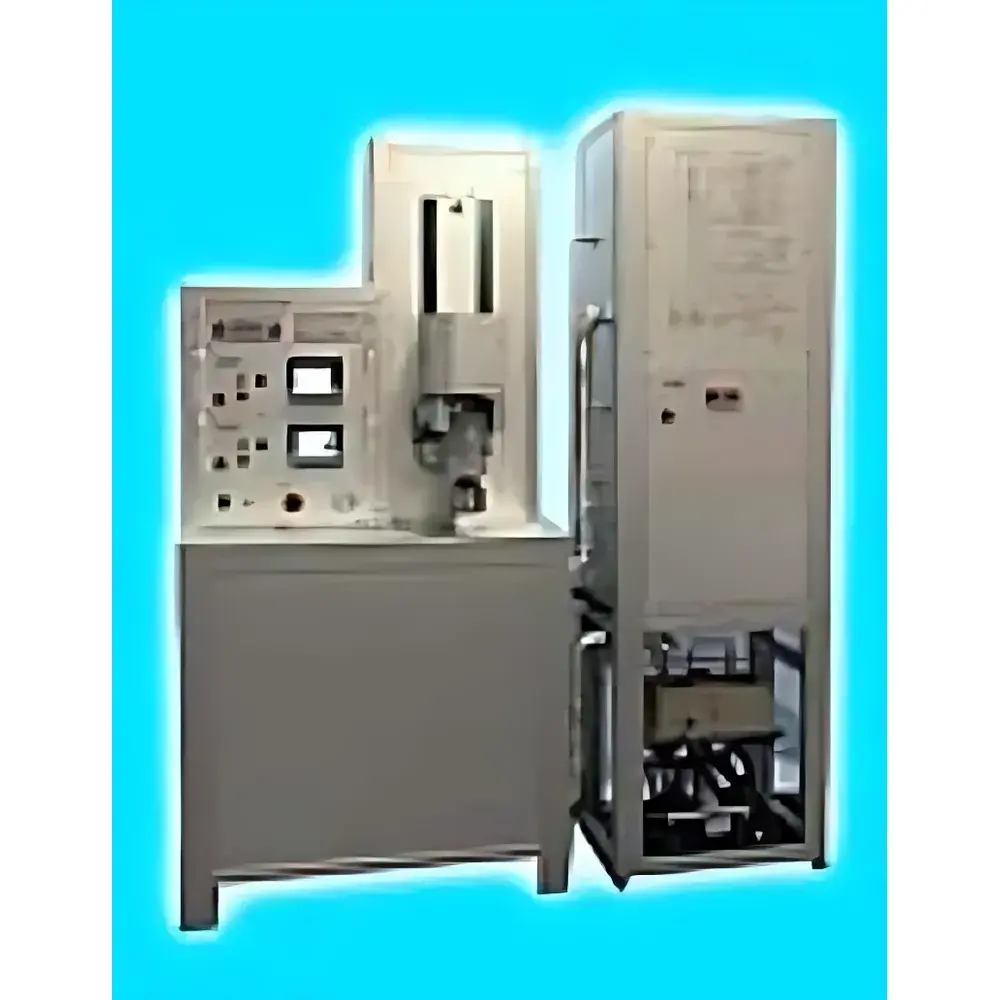
Rubotherm DynTHERM High-Vacuum High-Pressure Thermogravimetric Analyzer
| Origin | Germany |
|---|---|
| Manufacturer Type | Authorized Distributor |
| Origin Category | Imported |
| Model | Rubotherm-DynTHERM |
| Price | Upon Request |
Overview
The Rubotherm DynTHERM High-Vacuum High-Pressure Thermogravimetric Analyzer (TGA) is an advanced, magnetically levitated microbalance-based thermal analysis system engineered for precision mass change measurement under rigorously controlled thermodynamic conditions—spanning ultra-high vacuum (UHV, down to 10−9 mbar) to extreme pressures up to 500 bar and temperatures from ambient to 1800 °C. Unlike conventional TGA systems relying on mechanical suspension or quartz spring balances, the DynTHERM employs a contactless magnetic suspension principle: the sample holder is affixed to a diamagnetic or ferromagnetic “floating magnet,” stably levitated within the reaction chamber by a feedback-controlled electromagnetic coil mounted on the external balance baseplate. This decoupling eliminates mechanical drift, thermal conduction artifacts, and gas buoyancy errors—enabling true long-term stability (<±2 μg over 100+ hours) and sub-microgram resolution (down to 0.001 mg). The instrument operates on fundamental principles of magnetic force transduction and closed-loop position stabilization, making it uniquely suited for quantitative studies of adsorption, desorption, catalytic surface reactions, oxidative corrosion, pyrolytic decomposition, and phase transitions in aggressive chemical environments—including H2S, Cl2, NH3, HF, supercritical CO2, and syngas mixtures.
Key Features
- Contactless magnetic suspension microbalance with real-time zero-point auto-correction and dynamic calibration during operation
- Modular architecture supporting field-upgradable configurations: LP (low-pressure), HP (high-pressure), and UHV variants
- Extended operational envelope: pressure range from UHV (10−9 mbar) to 500 bar (customizable); temperature range up to 1800 °C at ambient pressure, 1200 °C at 40 bar, and 1100 °C at 50 bar
- High heating rates up to 7000 K/min—optimized for rapid pyrolysis kinetics of coal, biomass, and polymer feedstocks
- Corrosion-resistant construction: all-welded Inconel 625/718 reactor vessels, sapphire viewports, Hastelloy C-276 gas lines, and chemically inert ceramic furnace insulation
- Integrated gas handling manifold with mass flow controllers (MFCs), back-pressure regulators (BPRs), and automated leak-check protocols compliant with ISO 14040 and ASTM E1131
Sample Compatibility & Compliance
The DynTHERM accommodates solid powders, granules, monoliths, fibers, and thin-film catalysts (up to 80 g gross load; standard 10 g active zone). It supports heterogeneous catalysis studies under realistic process conditions—e.g., Fischer–Tropsch synthesis, hydrodesulfurization (HDS), CO2 methanation, and metal–organic framework (MOF) stability testing. All configurations comply with ISO 11358-1:2014 (thermogravimetry terminology), ASTM E1131-20 (standard test method for compositional analysis by TGA), and EU Directive 2014/34/EU (ATEX Zone 1 compatibility for explosive atmospheres). Data acquisition meets FDA 21 CFR Part 11 requirements via optional audit-trail-enabled software with electronic signatures, role-based access control, and raw-data immutability—supporting GLP/GMP validation in pharmaceutical, energy, and materials R&D laboratories.
Software & Data Management
Control and analysis are performed using Rubotherm’s proprietary TG-Suite Pro software, running on Windows OS with deterministic real-time kernel extensions. The platform provides synchronized acquisition of mass, temperature, pressure, gas composition (via optional integrated QMS or FTIR coupling), and differential thermal signal (if equipped with DTA module). Raw data files (.tdf) are stored in vendor-neutral HDF5 format with embedded metadata (ISO/IEC 11179-compliant), enabling traceable export to MATLAB, Python (via h5py), or LIMS systems. Advanced analysis modules include kinetic modeling (Friedman, Ozawa–Flynn–Wall, Kissinger–Akahira–Sunose), adsorption isotherm fitting (Langmuir, BET, Toth), and PVT equation-of-state regression (Peng–Robinson, Soave–Redlich–Kwong).
Applications
- Carbon capture material screening: CO2 adsorption capacity, cyclic stability, and regeneration energy under flue-gas-relevant partial pressures
- Biomass and coal gasification kinetics: char reactivity, ash melting behavior, and tar cracking efficiency at elevated pressure
- Catalyst deactivation studies: sulfur poisoning, coking, sintering, and redox cycling under industrially representative gas atmospheres
- Chemical vapor deposition (CVD) precursor decomposition pathways and film growth stoichiometry
- PVT property determination for high-pressure fluid systems: density, compressibility, and phase boundaries of supercritical solvents
- Thermal stability assessment of energetic materials, battery cathodes, and nuclear fuel cladding alloys
FAQ
What distinguishes the DynTHERM from conventional high-pressure TGA systems?
The magnetic suspension eliminates mechanical linkages between the sample and balance, removing thermal drift, gas buoyancy effects, and vibration coupling—enabling microgram-level stability over multi-day experiments.
Can the system operate under reducing, oxidizing, and corrosive gas environments simultaneously?
Yes. Dual-gas manifolds with independent MFCs and ATEX-certified components allow precise blending of H2/H2O, O2/N2, SO2/CO2, or halogenated vapors without cross-contamination.
Is calibration traceable to national standards?
All mass calibrations are NIST-traceable via certified reference weights; temperature calibration follows ASTM E2550 and uses ITS-90 fixed points (In, Sn, Zn, Al).
How is long-term measurement drift mitigated during extended runs?
Continuous real-time zero-tracking and periodic in-situ calibration pulses maintain baseline integrity—verified by internal reference mass checks every 30 minutes.
Does the system support coupling to downstream analytical tools?
Yes. Standard quadrupole mass spectrometer (QMS) and Fourier-transform infrared (FTIR) interfaces enable evolved gas analysis (EGA) with time-resolved speciation and quantification.



