
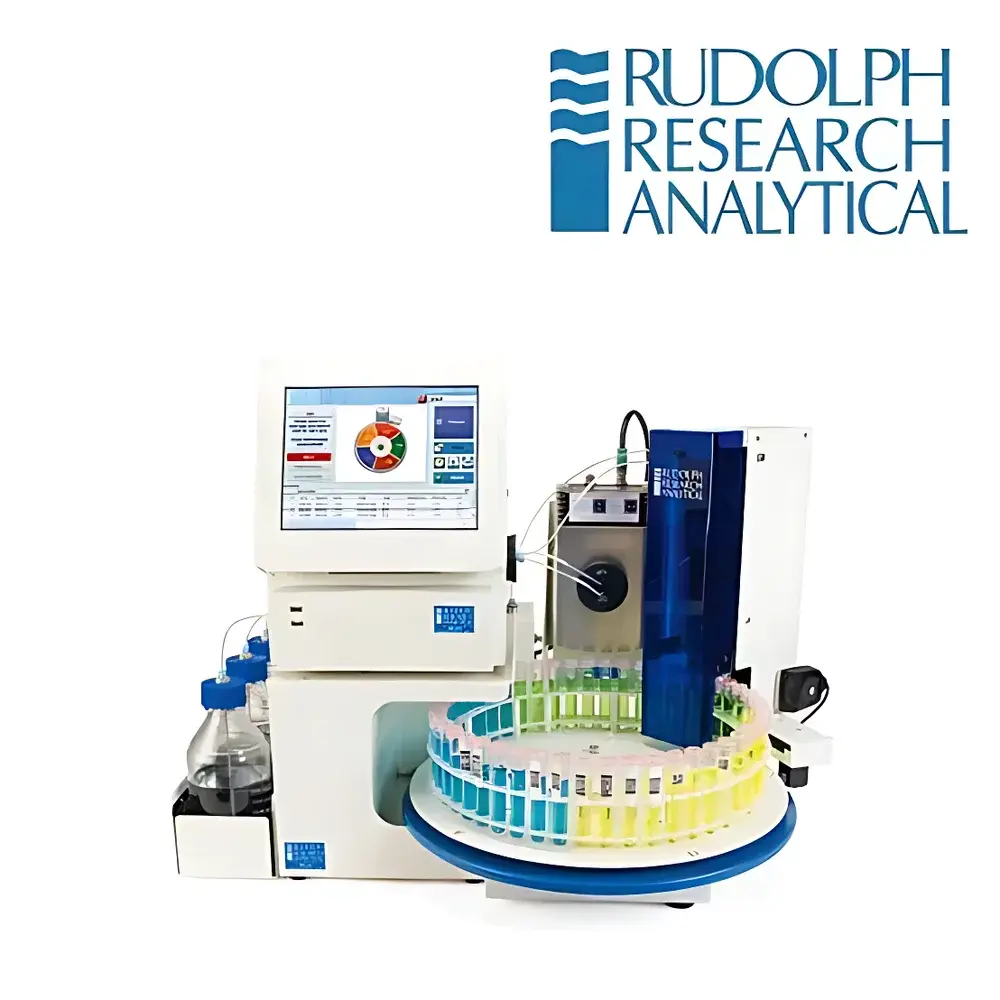
Rudolph Autoflex R837 Automated Sample Handler
| Brand | Rudolph |
|---|---|
| Origin | USA |
| Model | Autoflex R837 |
| Sample Capacity | Up to 96 vials (2–50 mL) |
| Interface | RS-232, Ethernet, USB |
| Compatibility | DDM2911 Density Meter, J-Series Refractometers, Autopol Polarimeters |
| Compliance | FDA 21 CFR Part 11, GLP/GMP-ready |
| Operating Temperature Range | 15–35 °C |
| Dimensions | 420 × 520 × 380 mm (W×D×H) |
| Weight | 22 kg |
| Power Supply | 100–240 VAC, 50/60 Hz |
| Software Integration | Rudolph WinCT-Density v5.0+ |
Overview
The Rudolph Autoflex R837 Automated Sample Handler is a precision-engineered sample introduction system designed exclusively for integration with Rudolph’s high-accuracy analytical instruments—including the DDM2911 digital density meter, J-Series refractometers, and Autopol series polarimeters. Built on a modular, low-vibration platform, the Autoflex R837 enables unattended sequential analysis of up to 96 liquid or low-viscosity samples per run, significantly enhancing throughput and inter-operator reproducibility in regulated laboratory environments. Its operation is grounded in deterministic robotic fluid handling: a programmable XYZ gantry positions a PTFE-coated stainless-steel probe over each vial, followed by controlled aspiration, dispensing, and purge cycles—ensuring minimal carryover (<50 nL) and consistent fill volume in the U-tube cell of the host density meter. The system does not perform measurement itself; rather, it serves as a validated, audit-trail-capable front-end to Rudolph’s core metrology platforms, supporting traceable, multi-parameter characterization (density, refractive index, optical rotation, Brix, purity, color index) from a single sample aliquot.
Key Features
- Full 21 CFR Part 11 compliance: Electronic signatures, role-based user access control, immutable audit trail logging (including method parameters, timestamps, operator ID, and instrument response), and secure data encryption.
- Integrated Video View™ technology (U.S. Patent No. 7,437,909): Real-time 10× magnified imaging of the U-tube cell during filling—enabling visual verification of bubble-free sample introduction and meniscus stability prior to measurement initiation.
- Automatic viscosity correction: Dynamically adjusts density calculation using real-time flow-rate monitoring and preloaded viscosity-density correlation models per ASTM D7777 and ISO 12185 Annex C.
- Modular thermal equilibration: Optional Peltier-controlled sample tray (±0.1 °C stability) maintains samples within ±0.5 °C of target temperature prior to injection—critical for high-precision density work per ASTM D4052 and ISO 12185.
- Factory-validated IQ/OQ/PQ documentation package: Includes installation qualification protocols, operational qualification test scripts (e.g., positional accuracy ±0.1 mm, pipetting CV <0.3%), and performance qualification against NIST-traceable standards.
- Multi-instrument protocol synchronization: Enables coordinated execution across DDM2911 + J45 + Autopol V plus Autoflex R837 in a single method file—eliminating manual reconfiguration between density, refractive index, and optical rotation measurements.
Sample Compatibility & Compliance
The Autoflex R837 accommodates standard 12 × 75 mm, 16 × 100 mm, and 20 × 120 mm glass or polypropylene vials, as well as custom tube formats via configurable tray inserts. It handles aqueous solutions, organic solvents (including acetone, ethanol, chloroform), glycerol-water mixtures (up to 85% w/w), and pharmaceutical formulations (e.g., syrups, injectables, buffer solutions) without cross-contamination. All wetted components—including probe tips, tubing, and valve manifolds—are constructed from chemically inert borosilicate glass, PTFE, and 316L stainless steel. The system meets ISO/IEC 17025:2017 requirements for testing laboratories and supports full GxP validation workflows. It is routinely deployed in QC labs operating under USP , ICH Q2(R2), and EU Annex 11 frameworks, with documented evidence of successful FDA pre-approval inspections at global pharmaceutical facilities.
Software & Data Management
Controlled exclusively via Rudolph WinCT-Density v5.2 or later, the Autoflex R837 operates within a unified software environment that enforces method-driven analysis. Each method defines vial mapping, rinse cycles (up to 3 solvents), aspiration volume (100–2000 µL), dwell time, and pass/fail criteria for Video View™ bubble detection. Raw data—including timestamped images, pressure transducer logs, and motor encoder feedback—is stored in encrypted SQLite databases with SHA-256 hashing. Export options include CSV (ASTM E1955-compliant), PDF reports with embedded digital signatures, and direct transmission to LIMS via HL7 or ASTM E1461-compliant XML. Audit trails are exportable in tamper-evident PDF/A-2 format with embedded cryptographic hashes for long-term archival.
Applications
- Pharmaceutical QC: Release testing of active pharmaceutical ingredients (APIs) and finished dosage forms per USP density specifications; excipient identity verification via density-refractive index correlation.
- Fine chemical synthesis: In-process monitoring of reaction progress through real-time density shifts (e.g., esterification, polymerization, hydrogenation).
- Food & beverage: Brix/density correlation modeling for juice authenticity (ISO 2173), alcohol content determination (OIML R 22), and honey adulteration screening (AOAC 981.12).
- Petrochemical QA: Hydrocarbon blend composition verification (ASTM D1298), biodiesel purity assessment (EN 14214), and lubricant base stock classification (ASTM D4052).
- Academic research: High-throughput screening of ionic liquid libraries, polymer solution thermodynamics, and chiral compound enantiomeric excess quantification via coupled polarimetry-density workflows.
FAQ
Does the Autoflex R837 require dedicated software licensing beyond WinCT-Density?
No—the Autoflex R837 is fully integrated into WinCT-Density v5.2+; no separate license or dongle is required.
Can it be retrofitted to legacy Rudolph instruments (e.g., DDM 2910)?
Yes, provided the host instrument has RS-232 or Ethernet connectivity and firmware revision ≥3.12; retrofit kits include updated interface boards and calibration adapters.
What is the maximum allowable sample viscosity for reliable aspiration?
Up to 250 mPa·s at 20 °C when using the optional high-viscosity probe kit (part #AF-R837-HV); standard configuration supports ≤50 mPa·s.
Is remote monitoring supported?
Yes—WinCT-Density includes a web-based dashboard (HTTPS/TLS 1.2) enabling real-time status viewing, queue management, and alarm notification via SMTP/SNMP.
How frequently must the system undergo preventive maintenance?
Rudolph recommends quarterly PM service including probe tip inspection, syringe calibration verification, and Video View™ optical alignment check—documented in accordance with ISO/IEC 17025 Clause 6.4.2.



