
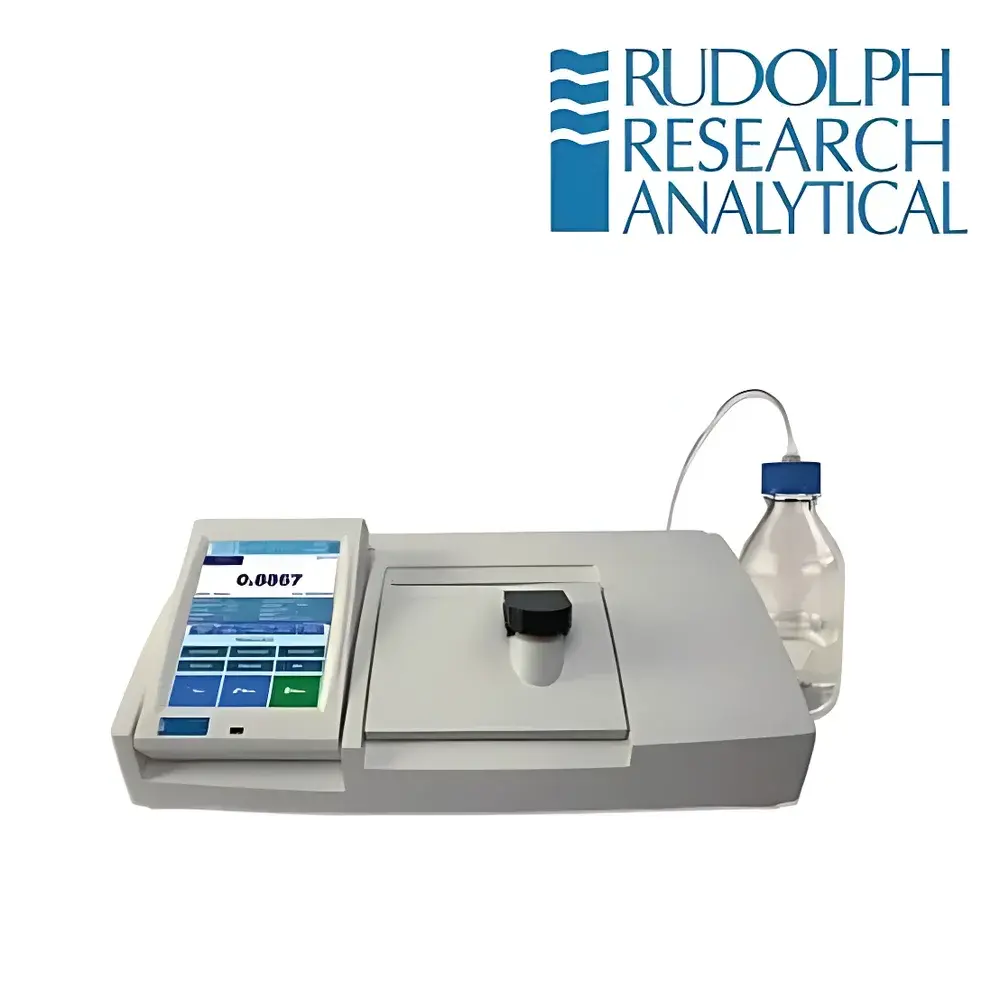
Rudolph Autopol V Plus AutoFill Automatic Polarimeter
| Brand | Rudolph |
|---|---|
| Origin | USA |
| Manufacturer Type | Authorized Distributor |
| Origin Category | Imported |
| Model | Autopol V Plus AutoFill |
| Product Type | Automatic Polarimeter |
| Temperature Control | Yes (Peltier-controlled sample chamber) |
| Digital Display | Yes (Integrated high-contrast capacitive touchscreen) |
| Light Source | Tungsten-halogen lamp (589.3 nm nominal, Na-D line stabilized) |
| Measurement Range | ±89° arc (optical rotation), 0–99.9% w/w concentration (for sucrose or user-defined calibration) |
| Measurement Precision | ±0.001° arc (repeatability, std. dev.) |
| Measurement Accuracy | ±0.002° arc (full-scale traceable to NIST-certified quartz control plates) |
| AutoFill Function | Integrated pneumatic/hydrostatic sample handling with bubble-free filling, automated rinse (solvent-selectable), and dry-air purge cycle |
Overview
The Rudolph Autopol V Plus AutoFill is a high-precision, fully automated polarimeter engineered for regulated laboratory environments where reproducibility, audit readiness, and operator-independent measurement integrity are critical. Based on the fundamental principle of optical rotation—where chiral compounds rotate the plane of linearly polarized light—the Autopol V Plus employs a double-beam, null-balance optical architecture with real-time feedback stabilization. Its core measurement engine utilizes a thermally stabilized tungsten-halogen light source centered at 589.3 nm (aligned with the sodium D-line), coupled with a high-resolution photoelectric detector array and a precision motorized analyzer. The system achieves ±0.001° arc repeatability under GLP-compliant conditions and maintains ±0.002° arc accuracy across its full ±89° arc range, verified against NIST-traceable quartz reference standards. Designed for routine QC in pharmaceutical, fine chemical, and food-grade applications, the instrument integrates Peltier-based temperature regulation (±0.1°C stability) directly into the sample cell compartment—ensuring thermal equilibrium prior to and during measurement without external water baths.
Key Features
- AutoFill Sample Handling System: Fully automated, programmable sample introduction using positive-pressure fluidics; eliminates manual pipetting, bubble formation, and solvent evaporation artifacts during fill cycles.
- Peltier-Controlled Temperature Module: Integrated solid-state temperature regulation (10–40°C range, ±0.1°C stability) with real-time sensor feedback and user-definable equilibration delay.
- Capacitive Touch Interface: 10.1-inch industrial-grade touchscreen running embedded Windows 7 Professional (long-term support compliant), with glove-compatible operation and corrosion-resistant front panel.
- Dual-Mode Operation: Supports both single-point optical rotation (α) and concentration determination via built-in calibration curves (sucrose, glucose, fructose, or user-defined matrices).
- Robust Optical Path Design: Sealed, alignment-free optical train with anti-vibration mounting and UV-stabilized optics; no field recalibration required under normal operating conditions.
- Compliance-Ready Architecture: Firmware supports 21 CFR Part 11-compliant user access levels, electronic signatures, and immutable audit trails for all measurement, calibration, and maintenance events.
Sample Compatibility & Compliance
The Autopol V Plus AutoFill accommodates standard 100 mm and 200 mm pathlength cells (including jacketed and micro-volume variants), with optional accessories for viscous or volatile samples. All wetted components—including fluidic manifolds, valves, and rinse lines—are constructed from chemically inert PTFE, PEEK, and 316 stainless steel. The system meets ISO 17025 requirements for testing laboratories and supports validation protocols aligned with USP , Ph. Eur. 2.2.7, and ASTM E1255-16. Full IQ/OQ documentation packages are available upon request, including installation verification, operational boundary testing, and performance qualification using certified reference materials.
Software & Data Management
Control and data acquisition are managed through Rudolph’s proprietary PolaWin v5.x software, installed locally on the instrument’s embedded PC. The software provides method-driven workflows with configurable pass/fail limits, statistical process control (SPC) charting, and batch-level reporting. Raw data—including timestamped rotation values, temperature logs, cell identification, and operator ID—are stored in encrypted SQLite databases with SHA-256 hashing. Export options include CSV, PDF (with digital signature), and XML formats compatible with LIMS integration. Audit trail records capture every parameter change, calibration event, and result modification—including who made the change, when, and why—meeting FDA and EMA expectations for data integrity.
Applications
This instrument is routinely deployed in pharmaceutical quality control labs for assay of active pharmaceutical ingredients (APIs) such as levodopa, chloramphenicol, and penicillin derivatives; in biotechnology for monitoring enzymatic resolution reactions; in food and beverage for sucrose content verification in syrups, juices, and confectionery; and in academic research for kinetic studies of asymmetric synthesis. Its AutoFill capability significantly reduces analyst-to-analyst variability in high-throughput settings—particularly where multiple operators perform daily assays across shifts.
FAQ
Does the Autopol V Plus AutoFill support multi-wavelength measurements?
No. It operates exclusively at 589.3 nm, optimized for compliance with pharmacopoeial monographs requiring sodium D-line measurement.
Can I use non-aqueous solvents with the AutoFill system?
Yes—provided they are compatible with PTFE/PEEK fluidics; common solvents include ethanol, methanol, chloroform, and ethyl acetate. Rinse protocol parameters are fully customizable.
Is temperature calibration traceable to national standards?
Yes—the integrated Pt100 sensor is factory-calibrated against NIST-traceable references, and certificate of calibration is provided with each instrument.
What validation documentation is included out-of-the-box?
Each unit ships with Factory Acceptance Test (FAT) report, IQ checklist, and OQ test protocol templates compliant with GMP Annex 15 and ASTM E2500-07.
How often does the halogen lamp require replacement?
Typical lamp lifetime exceeds 2,000 hours; system monitors usage time and alerts users prior to end-of-life.





