
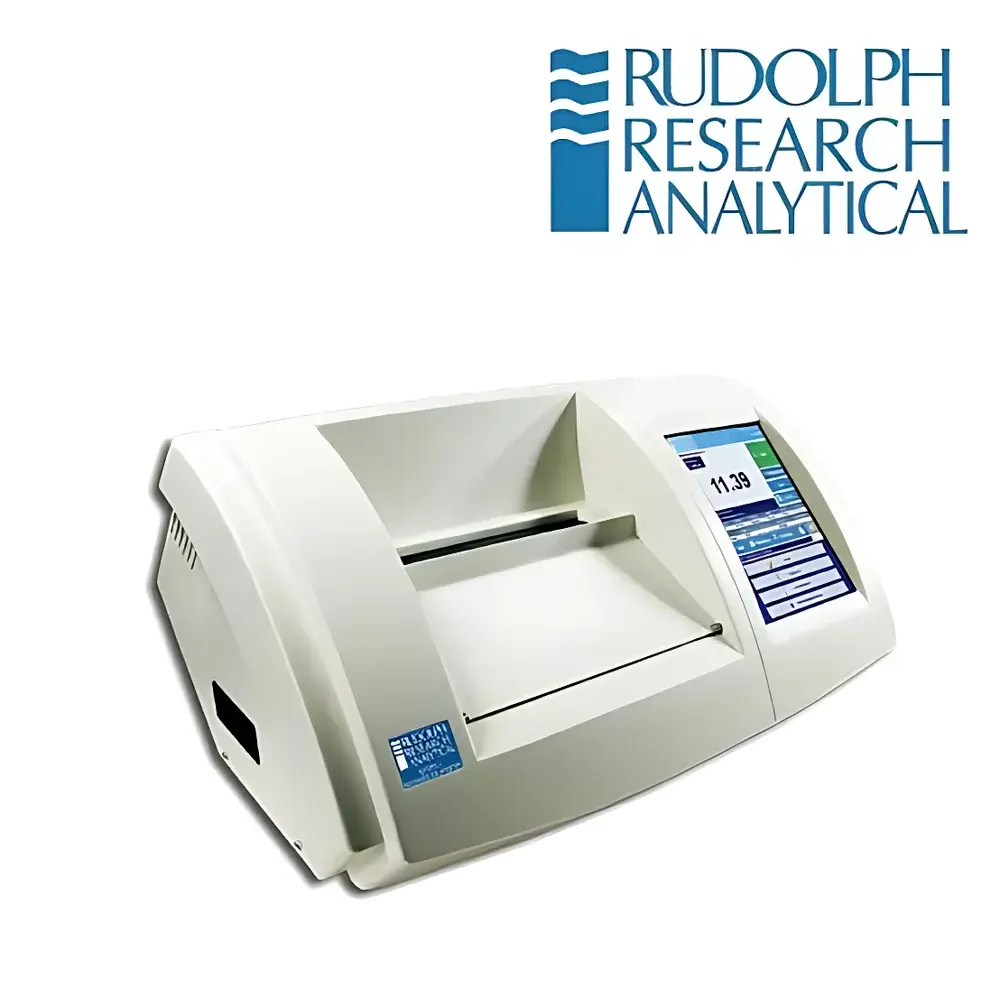
Rudolph Autopol I Automatic Polarimeter
| Brand | Rudolph |
|---|---|
| Origin | USA |
| Manufacturer Type | Authorized Distributor |
| Product Category | Imported Instrument |
| Model | Autopol I |
| Product Type | Automatic Polarimeter |
| Temperature Control | Yes (Integrated Peltier or Ambient Compensation) |
| Digital Display | Yes |
| Light Source | Halogen Lamp |
| Measurement Range | ±89.99° arc (Optical Rotation), ±999.99° arc (Specific Rotation), 0–99.9% (Concentration) |
| Measurement Resolution | 0.001° arc |
| Measurement Accuracy | ±0.004° arc |
| Wavelength Options | 365, 405, 436, 546, 589, 633 nm (Custom Wavelengths Available) |
Overview
The Rudolph Autopol I Automatic Polarimeter is a precision optical instrument engineered for high-reproducibility measurement of optical rotation — a fundamental chiroptical property used to characterize optically active substances such as sugars, amino acids, pharmaceuticals, and natural products. Based on the principle of plane-polarized light transmission through chiral media, the Autopol I employs a robust dual-beam optical architecture with a high-stability halogen lamp and natural calcite polarizers, ensuring long-term stability across varying ambient temperature and humidity conditions. Designed for routine QC/QA laboratories and research environments, it delivers traceable, ISO/IEC 17025-compatible measurements in compliance with pharmacopeial standards including USP , EP 2.2.7, and JP 2.05. Its fixed-wavelength configuration (standard 589 nm sodium D-line, with optional mercury or LED-based spectral lines) supports both classical polarimetric analysis and method-specific validation protocols.
Key Features
- True automatic operation powered by an embedded microprocessor — no manual nulling or mechanical adjustment required
- High-stability halogen light source with >2000-hour operational lifetime and consistent spectral output
- Natural calcite polarizing optics — immune to thermal drift and hygroscopic degradation, ensuring long-term angular fidelity
- Integrated temperature sensor for real-time sample or ambient temperature monitoring; automatic temperature compensation to 20 °C or 25 °C reference per pharmacopeial requirements
- Full-color Windows 7-based touchscreen interface with intuitive navigation, multi-language support, and on-device data review
- Built-in calibration routine using NIST-traceable quartz control plates spanning –80° to +80° arc
- Modular cell holder accommodating standard and custom-length cells (10–200 mm pathlength; 0.02–15 mL volume)
Sample Compatibility & Compliance
The Autopol I supports aqueous, organic, and viscous solutions across pharmaceutical, food, and fine chemical applications. It meets critical regulatory expectations for instrument qualification: IQ/OQ documentation packages are available, and its firmware architecture supports audit trails, user access levels, and electronic signature readiness — foundational elements for FDA 21 CFR Part 11 and EU Annex 11 compliance in GMP environments. All measurements adhere to internationally recognized definitions of optical rotation (α), specific rotation ([α]), and concentration-derived values, with results directly exportable to LIMS or validated spreadsheet templates. The system is routinely deployed in national drug control laboratories (e.g., China Institute for Food and Drug Control) and global API manufacturers for identity testing, purity assessment, and batch release.
Software & Data Management
Data acquisition, processing, and reporting are handled via the native Autopol Control Software — a Windows-based application supporting method storage, result trending, statistical analysis (mean, SD, RSD), and customizable report generation (PDF/CSV). Raw angular data is timestamped and tagged with operator ID, cell ID, wavelength, temperature, and calibration status. Audit trail functionality records all parameter changes, measurement initiations, and calibration events — essential for GLP and GMP traceability. Export formats include ASTM E1382-compliant structured data files, enabling seamless integration into enterprise quality systems.
Applications
- Pharmaceutical QC: Identity confirmation and enantiomeric purity verification of chiral APIs (e.g., ibuprofen, levodopa, antibiotics)
- Sugar analysis: Brix-equivalent concentration determination in sucrose, glucose, and fructose solutions per ICUMSA and AOAC methods
- Essential oil and flavor chemistry: Quantification of optical activity in limonene, menthol, and camphor derivatives
- Academic research: Kinetic studies of enzymatic hydrolysis, racemization, and asymmetric synthesis
- Regulatory submissions: Generation of validated polarimetric data for ANDA, NDA, and DMF dossiers
FAQ
What wavelength options are standard on the Autopol I?
The instrument ships with six factory-aligned wavelengths: 365 nm, 405 nm, 436 nm, 546 nm, 589 nm (Na-D line), and 633 nm. Additional wavelengths may be implemented via optional interference filters.
Does the Autopol I support temperature-controlled sample measurement?
It includes real-time temperature sensing and software-based temperature correction to standard reference temperatures (20 °C or 25 °C), but does not integrate active Peltier cell cooling/heating. For precise thermostatted measurements, external circulation baths are recommended.
Is the Autopol I compliant with 21 CFR Part 11?
While the base firmware provides audit trail logging and user authentication, full Part 11 compliance requires implementation of a validated software environment, documented SOPs, and administrative controls — all supported through Rudolph’s IQ/OQ/PQ service package.
How is calibration verified on this instrument?
Calibration is performed using certified quartz control plates traceable to NIST SRM 8500 series, covering the full angular range from –80° to +80° arc. Daily verification is recommended prior to regulated testing.
Can the Autopol I measure samples with high turbidity or coloration?
The halogen source and dual-beam design improve signal-to-noise ratio in moderately absorbing or scattering media, though highly turbid or deeply colored samples may require dilution or alternative analytical methods (e.g., HPLC-chiral).






