
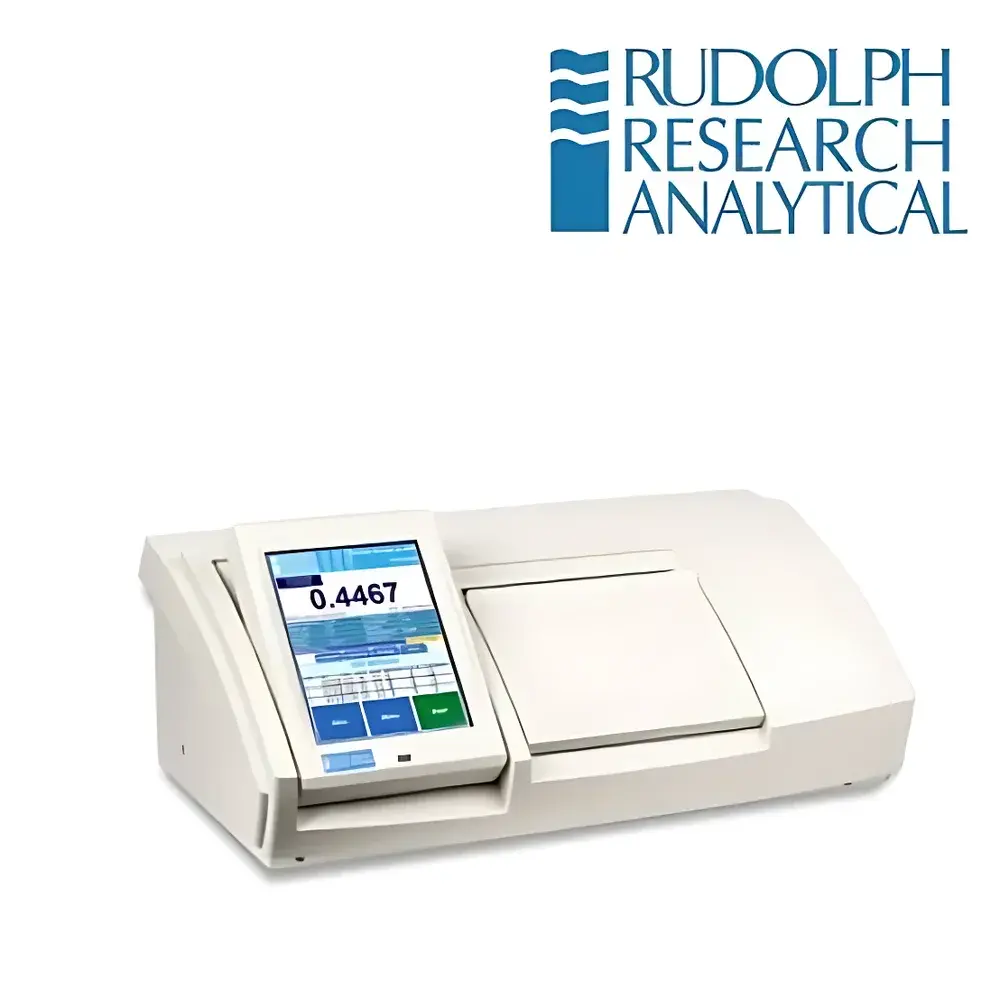
Rudolph AUTOPOL V Plus High-Precision Automatic Polarimeter
| Brand | Rudolph |
|---|---|
| Origin | USA |
| Model | AUTOPOL V Plus |
| Product Type | Automatic Polarimeter |
| Temperature Control | Built-in semiconductor Peltier control (10–40 °C) |
| Display | 10.4″ capacitive touchscreen |
| Light Source | Halogen lamp (≥2000 h lifetime) |
| Polarizer | Natural calcite crystal |
| Measurement Range | ±89.99° arc |
| Concentration | 0–99.9% |
| Accuracy | ±0.002° arc (full scale) |
| Resolution | 0.001° arc |
| Wavelength Options | 365, 405, 436, 546, 589, 633 nm (8 wavelengths configurable) |
| Sample Transmittance Limit | Down to 0.01% |
| Calibration Standards | NIST-traceable quartz control plates (−80° to +80° arc) |
| Compliance | 21 CFR Part 11–ready with electronic signature, audit trail, and secure user authentication |
| Cell Material | Hastelloy™ (acid/alkali resistant) |
| Thermostatic Chamber | SilcoSteel™-coated |
| Interfaces | 4× USB, 2× RS-232, 1× CAT5 Ethernet |
| Storage | 2 GB internal memory |
| Software | Windows-based method management, cGMP/GLP-compliant reporting (PDF/Excel export), customizable templates with logo/company metadata |
Overview
The Rudolph AUTOPOL V Plus is a high-precision, fully automated polarimeter engineered for rigorous optical rotation measurement in regulated pharmaceutical, fine chemical, food, and academic laboratories. It operates on the fundamental principle of plane-polarized light interaction with optically active chiral compounds—measuring the angular deviation (in degrees arc) induced as polarized light passes through a sample solution. Unlike conventional polarimeters relying on manual vernier scales or low-stability LEDs, the AUTOPOL V Plus employs a thermally stable halogen light source coupled with a natural calcite polarizer—ensuring long-term angular reproducibility unaffected by ambient humidity or temperature fluctuations. Its full-scale accuracy of ±0.002° arc across the entire ±89.99° range meets or exceeds ASTM E1252 and ISO 13871 requirements for high-fidelity chiral analysis. The instrument integrates semiconductor-based Peltier temperature control (10–40 °C, ±0.1 °C stability), enabling precise thermal correction of specific rotation values per ICH Q5C and USP . Designed for compliance-critical environments, it supports 21 CFR Part 11–compliant data integrity via role-based access control, immutable audit trails, and electronic signatures—all embedded within its native Windows OS architecture.
Key Features
- Calcite-based polarization optics: Eliminates drift from hygroscopic or thermally sensitive polymer films; delivers intrinsic angular stability over time and environmental variation.
- Multi-wavelength capability: Six factory-installed wavelengths (365, 405, 436, 546, 589, 633 nm) with optional expansion to eight—enabling wavelength-specific validation per pharmacopoeial monographs (e.g., USP , Ph. Eur. 2.2.7).
- Hastelloy™ sample cells and SilcoSteel™ thermostatic chamber: Chemically inert construction validated for repeated exposure to concentrated acids (e.g., HCl, H₂SO₄) and strong bases (e.g., NaOH), critical for API purification monitoring.
- Intelligent sensitivity adaptation: Automatically adjusts detector gain to accommodate samples with transmittance as low as 0.01%, supporting highly absorbing or turbid formulations without manual intervention.
- Pre-calibrated NIST-traceable quartz standards: Certified reference plates covering −80° to +80° arc at any selected wavelength—enabling on-site verification and traceable calibration without external service dispatch.
- Modular connectivity: Four USB ports (keyboard, mouse, barcode scanner, USB storage), dual RS-232 for legacy peripherals, and CAT5 Ethernet for LIMS integration, remote diagnostics, and centralized firmware updates.
Sample Compatibility & Compliance
The AUTOPOL V Plus accommodates standard 100 mm, 200 mm, and custom-length cells—including microvolume (0.1 mL) and high-pressure configurations. Its robust optical path tolerates suspensions, emulsions, and viscous solutions when paired with appropriate cell cleaning protocols. Regulatory alignment includes full support for cGMP/GLP workflows: all measurement records contain timestamped operator ID, method name, cell serial number, temperature log, wavelength setting, and raw angular readout. Audit trails are write-protected and exportable in CSV format for QA review. IQ/OQ documentation packages—aligned with ASTM E2500 and Annex 11—are provided for installation and operational qualification under FDA, EMA, and PMDA inspection frameworks.
Software & Data Management
Rudolph’s proprietary Windows-based software enables comprehensive method lifecycle management. Users define up to 30 named assay protocols—each storing cell length, concentration factor, reference temperature, wavelength, and pass/fail limits—accessible via dedicated touchscreen soft-keys. Statistical evaluation tools compute mean, standard deviation, min/max, and %RSD across batches of up to 999 measurements. Reports export natively to Excel (.xlsx) or PDF with customizable headers (company logo, address, QA stamp) and full metadata embedding. All data resides in encrypted local storage (2 GB) with optional network backup; no cloud dependency ensures data sovereignty. Electronic signatures comply with 21 CFR Part 11 Subpart C requirements—including biometric or token-based authentication—and enforce mandatory reason-for-change entries during result editing.
Applications
- Pharmaceutical QC: Identity testing and assay of chiral APIs (e.g., levofloxacin, ibuprofen, atenolol) per USP monographs requiring optical rotation limits.
- Sugar analysis: Direct determination of sucrose, glucose, and fructose concentrations using International Sugar Scale (ICUMSA) at 589 nm.
- Biopolymer characterization: Monitoring enzymatic hydrolysis kinetics of chiral polysaccharides (e.g., cellulose, dextran) via real-time rotation decay.
- Academic research: Wavelength-dependent Cotton effect studies in circular dichroism (CD) precursor experiments.
- Food & beverage: Authenticity verification of natural flavor extracts (e.g., limonene enantiomeric ratio in citrus oils).
FAQ
Does the AUTOPOL V Plus support IQ/OQ documentation for FDA-regulated facilities?
Yes—Rudolph provides vendor-validated IQ/OQ protocols compliant with ASTM E2500 and ICH Q9, including test scripts, acceptance criteria, and completion sign-offs for GxP audits.
Can the instrument perform temperature-corrected specific rotation calculations automatically?
Yes—users input reference temperature and observed rotation; the software applies the standardized formula [α]ₜᴰ = α / (c × l) and corrects to 20 °C or 25 °C using built-in polynomial coefficients per USP .
Is calibration traceable to NIST standards?
All supplied quartz control plates carry individual NIST-traceable certificates with uncertainty budgets stated at k=2, valid for two years under proper storage conditions.
What is the minimum detectable transmittance for low-clarity samples?
The adaptive photodetector system maintains resolution down to 0.01% transmittance, enabling reliable measurements of deeply colored or particulate-containing solutions without dilution.
How is data security enforced under 21 CFR Part 11?
Three-tier security: (1) Role-based login with password complexity rules, (2) Immutable audit trail recording every action (including parameter changes), and (3) Electronic signatures requiring re-authentication for critical operations like result deletion or method modification.





