
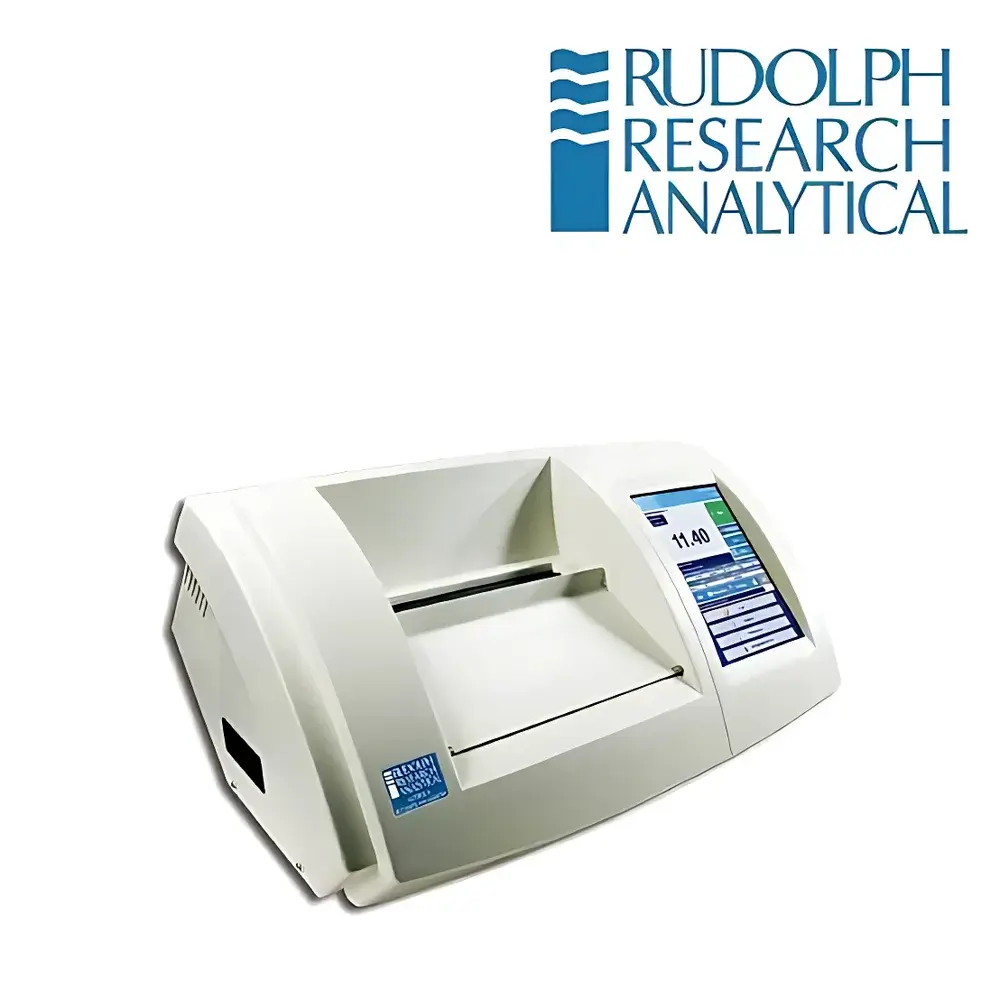
Rudolph Autopol II Automatic Polarimeter
| Brand | Rudolph |
|---|---|
| Origin | USA |
| Manufacturer Type | Authorized Distributor |
| Product Category | Imported Instrument |
| Model | Autopol II |
| Product Type | Automatic Polarimeter |
| Temperature Control | Yes (Integrated Peltier-based thermal regulation) |
| Digital Display | Yes (Color LCD touchscreen interface) |
| Light Source | Tungsten-halogen lamp (≥2000 h lifetime) |
| Measurement Range | Optical Rotation ±89.99° arc, Specific Rotation ±999.99° arc, Concentration 0–99.9% w/w |
| Measurement Precision | 0.001° arc |
| Measurement Accuracy | ±0.003° arc |
| Wavelength Options | 365, 405, 436, 546, 589, and 633 nm (custom wavelengths available on request) |
| Polarizer Material | Natural calcite crystal |
| Calibration | Internal automated calibration routine with NIST-traceable quartz control plates (–80° to +80° arc) |
| Sample Cell Compatibility | 10–200 mm pathlength, 0.02–15 mL volume |
Overview
The Rudolph Autopol II Automatic Polarimeter is a precision optical instrument engineered for high-reproducibility measurement of optical rotation—fundamental to chiral compound characterization in pharmaceutical, chemical, food, and academic laboratories. Based on the principle of plane-polarized light interaction with optically active substances, the Autopol II quantifies the angular deviation (in degrees arc) induced by chiral molecules in solution. Its core optical architecture employs a natural calcite polarizer, ensuring long-term stability independent of ambient temperature or humidity fluctuations—a critical advantage over polymer-based alternatives. The system integrates a tungsten-halogen light source with selectable monochromatic wavelengths (365–633 nm), enabling method-specific compliance with pharmacopeial standards such as USP , EP 2.2.7, and JP 2.07. Designed and assembled in the United States, the Autopol II conforms to ISO 9001 manufacturing protocols and supports GLP/GMP documentation requirements through audit-ready data handling.
Key Features
- True automatic operation via embedded microprocessor controlling polarization modulation, signal acquisition, and real-time compensation algorithms
- High-stability calcite polarizer and analyzer pair—immune to thermal drift and photodegradation
- Integrated Peltier temperature sensor and feedback loop for sample- or ambient-temperature monitoring; optional temperature-controlled cell holders available for ASTM D1747-compliant measurements
- Windows-based color LCD touchscreen interface (compatible with Windows 7 OS) providing intuitive navigation, multi-language support, and on-screen method setup
- Automated internal calibration using NIST-traceable quartz control plates spanning –80° to +80° arc, eliminating manual zeroing procedures
- Multi-wavelength capability with six factory-installed spectral lines (365, 405, 436, 546, 589, 633 nm); additional wavelengths configurable per user-defined SOPs
- Comprehensive measurement modes: optical rotation (α), specific rotation ([α]), concentration (% w/w), and International Sugar Scale (ISS) output
Sample Compatibility & Compliance
The Autopol II accommodates a broad range of sample formats via interchangeable cells—standard pathlengths from 10 mm to 200 mm, volumes from 0.02 mL to 15 mL—including microcells for precious or low-volume samples. All cell interfaces comply with ISO 17025 traceability guidelines when used with certified reference materials. The instrument meets regulatory expectations for analytical instrumentation under FDA 21 CFR Part 11 when paired with validated software extensions (e.g., Autopol Data Manager v3.x). It is routinely deployed in QC labs supporting USP monographs for antibiotics, amino acids, sugars, and synthetic chiral intermediates—particularly where enantiomeric purity verification is mandated.
Software & Data Management
Data capture, processing, and reporting are managed through Rudolph’s proprietary Autopol Software Suite. Each measurement includes timestamp, operator ID, wavelength, temperature, cell ID, and raw signal metadata. Export formats include CSV, PDF, and XML for LIMS integration. Audit trails record all parameter changes, calibration events, and result modifications—fully compliant with ALCOA+ principles. Optional 21 CFR Part 11 modules provide electronic signatures, role-based access control, and immutable archive logging. Raw data files retain full spectral context for retrospective reprocessing without loss of fidelity.
Applications
- Pharmaceutical QC: Enantiomeric excess determination of APIs per ICH Q5B and Q6A guidelines
- Sugar analysis in food and beverage labs per ICUMSA and AOAC Official Methods
- Essential oil authentication and adulteration screening in flavor & fragrance R&D
- Process monitoring of asymmetric synthesis reactions in fine chemical manufacturing
- Educational use in university chemistry curricula for stereochemistry instruction
- Reference standard certification in national metrology institutes and pharmacopoeial laboratories
FAQ
What is the typical warm-up time required before measurement?
The tungsten-halogen lamp achieves thermal and spectral stability within 15 minutes of power-on; full system readiness (including thermal equilibrium of optical components) is achieved after 30 minutes.
Can the Autopol II be integrated into an automated lab workflow?
Yes—RS-232 and USB device interfaces support SCADA and MES integration; optional Ethernet module enables remote command execution via TCP/IP.
Is temperature correction applied automatically during measurement?
Yes—the built-in Pt100 sensor measures sample temperature in real time, and results are mathematically corrected to 20 °C or 25 °C per user-defined protocol.
How often does the instrument require recalibration?
Annual recalibration is recommended; however, daily verification using quartz control plates satisfies most GxP audit requirements.
Does the system support non-standard wavelengths beyond the six preinstalled options?
Yes—custom filter wheels or external monochromators can be interfaced upon request, subject to optical alignment validation and wavelength certification.




