
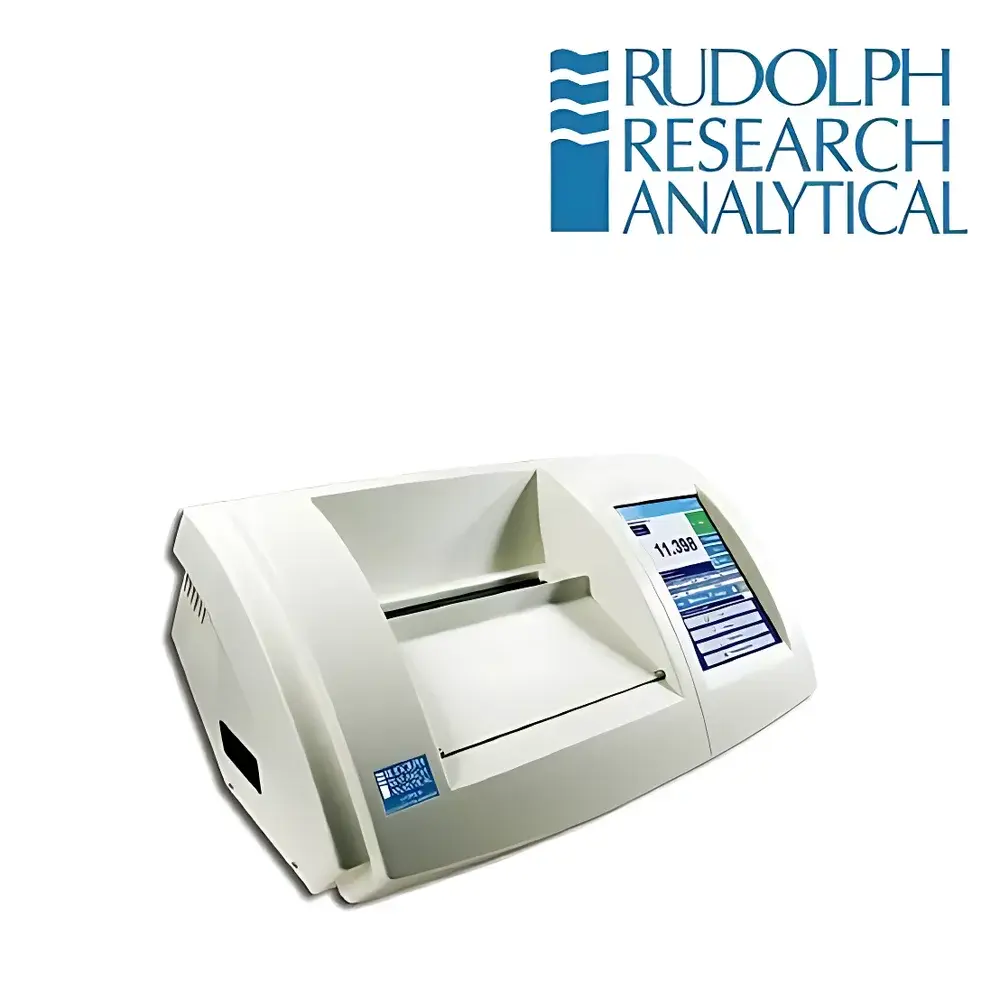
Rudolph Autopol III Automatic Polarimeter
| Brand | Rudolph |
|---|---|
| Origin | USA |
| Model | Autopol III |
| Product Type | Automatic Polarimeter |
| Temperature Control | Yes (Integrated Peltier-controlled sample compartment) |
| Display | High-resolution color LCD touchscreen (Windows Embedded OS) |
| Light Source | Tungsten-halogen lamp (≥2000 h lifetime) |
| Optical Elements | Natural calcite polarizer and analyzer (thermally stable, humidity-insensitive) |
| Measurement Modes | Optical rotation (α), specific rotation ([α]), concentration (% w/v), International Sugar Scale (ISS) |
| Measurement Range | Optical rotation ±89.99° arc, specific rotation ±999.99° arc, concentration 0–99.9% w/v |
| Accuracy | ±0.002° arc |
| Standard Resolution | 0.001° arc (0.0001° arc optional with high-stability mode) |
| Wavelength Options | 365, 405, 436, 546, 589 (Na-D), 633 nm (additional wavelengths available on request) |
| Calibration | Fully automated internal calibration using certified quartz control plates (–80° to +80° arc) |
| Sample Cell Compatibility | Standard cells from 10 mm to 200 mm pathlength |
| Compliance | Designed for GLP/GMP environments |
Overview
The Rudolph Autopol III Automatic Polarimeter is a precision optical instrument engineered for high-reproducibility measurement of optical rotation in chiral compounds—critical for quality assurance in pharmaceuticals, fine chemicals, food & beverage, and academic research laboratories. Operating on the fundamental principle of plane-polarized light interaction with optically active substances, the Autopol III quantifies the angular deviation (in degrees arc) induced by asymmetric molecular structures. Its robust optical architecture integrates a thermally stabilized natural calcite polarizer/analyzer pair, eliminating drift caused by ambient temperature or humidity fluctuations—a key differentiator from polymer-based or photoelastic alternatives. The system employs a high-intensity tungsten-halogen lamp with spectral filtering to deliver stable, monochromatic illumination across six standard wavelengths (including the pharmacopeial 589 nm sodium D-line), enabling wavelength-dependent characterization required by USP , EP 2.2.7, and JP 2.06.
Key Features
- Fully automated operation driven by an embedded microprocessor—no manual nulling or iterative adjustment required.
- Integrated Peltier-controlled temperature regulation of the sample cell compartment, with real-time monitoring and automatic thermal compensation to 20 °C or 25 °C per ICH Q5C and USP .
- High-resolution color LCD touchscreen running Windows Embedded OS, supporting intuitive navigation, multi-language UI, and direct method storage.
- Factory-calibrated quartz control plates traceable to NIST standards, covering –80° to +80° arc for routine verification and linearity validation.
- Modular cell holder accommodating standardized tubes from 10 mm to 200 mm pathlength, including microcells (0.02 mL) and large-volume cells (up to 15 mL) for diverse sample matrices.
- Optional ultra-high-resolution mode delivering 0.0001° arc resolution for applications demanding extreme angular sensitivity, such as low-concentration enantiomeric excess determination.
Sample Compatibility & Compliance
The Autopol III accommodates clear, homogeneous liquid samples—including aqueous solutions, organic solvents, syrups, essential oils, and API suspensions—with minimal preparation. Turbid or highly absorbing samples may require dilution or wavelength selection outside the visible range (e.g., 365 nm UV). All measurements adhere to ISO 13873:2020 (optical rotation instrumentation) and support regulatory submissions under FDA, EMA, and PMDA guidelines. When configured with Autopol Software Suite v5.x, the system provides full 21 CFR Part 11 compliance—including electronic signatures, role-based access control, and immutable audit trails—making it suitable for GMP manufacturing environments and GLP-certified contract laboratories.
Software & Data Management
Autopol Software Suite v5.x (included) enables method development, data acquisition, statistical analysis (mean, SD, RSD, confidence intervals), and export to CSV, PDF, or LIMS-compatible XML formats. Batch processing supports up to 99 samples per run with auto-identification via barcode scanning (optional hardware). Raw data files retain full metadata: timestamp, operator ID, wavelength, temperature, cell pathlength, and calibration status. Audit trail logs all user actions—including parameter changes, calibration events, and report generation—with tamper-proof hashing. Data integrity is further ensured through optional network backup and encrypted local storage.
Applications
- Pharmaceutical QC: Enantiomeric purity testing of chiral APIs per USP monographs (e.g., ibuprofen, levodopa, escitalopram).
- Sugar analysis: Direct determination of sucrose, glucose, and fructose concentrations in juices, syrups, and fermentation broths using ISS calibration.
- Essential oil authentication: Detection of adulteration in citrus, mint, and camphor oils via specific rotation deviation thresholds.
- Academic research: Kinetic studies of enzymatic hydrolysis, asymmetric synthesis monitoring, and configurational stability assessment under thermal stress.
- Food regulatory compliance: Verification of declared sugar content in labeling per EU Regulation No. 1169/2011 and FDA Nutrition Facts requirements.
FAQ
What wavelength is recommended for pharmacopeial compliance?
The 589 nm sodium D-line is mandatory for USP, EP, and JP methods unless otherwise specified.
Can the Autopol III measure samples below 0.1° optical rotation?
Yes—using the optional 0.0001° arc resolution mode and temperature-stabilized acquisition, detection limits approach ±0.0005° arc under controlled conditions.
Is temperature control limited to the sample cell?
The Peltier module actively regulates only the sample compartment; ambient lab temperature must remain within 15–30 °C for optimal long-term stability.
How often must the instrument be calibrated?
Daily verification with quartz control plates is recommended; full recalibration is required after transport, major maintenance, or every 6 months per ISO/IEC 17025.
Does the system support custom calculation formulas?
Yes—users can define and save proprietary equations for derived parameters (e.g., enantiomeric excess, molar rotation) directly in the software method editor.




