
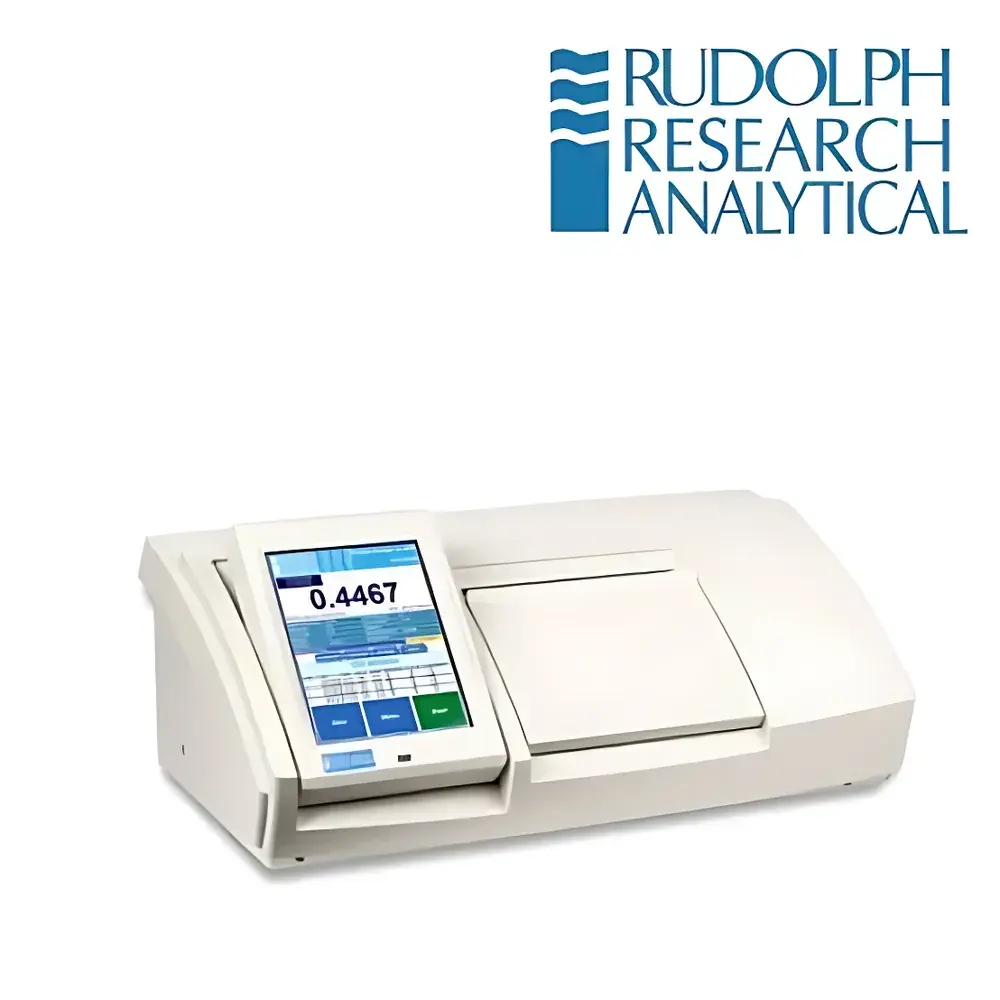
Rudolph AUTOPOL VI High-Precision Automatic Polarimeter
| Brand | Rudolph |
|---|---|
| Origin | USA |
| Model | AUTOPOL VI |
| Product Type | Automatic Polarimeter |
| Temperature Control | Yes (Peltier-based, 10–40 °C, ±0.1 °C) |
| Display | 10.4″ color TFT touchscreen (800×600, Windows 7 embedded) |
| Light Source | Halogen lamp (6 V/20 W, >2000 h lifetime) |
| Measurement Range | Optical Rotation: ±89.99° arc |
| Specific Rotation | ±999.99° arc |
| Concentration | 0–99.9% |
| Resolution | 0.0001° arc (optical rotation) |
| Accuracy | ±0.0003° arc at 589 nm (high-accuracy mode) |
| Wavelength Options | 365, 405, 436, 546, 589, 633 nm (custom wavelengths available) |
| Sample Cell Compatibility | Up to 200 mm pathlength |
| Calibration | NIST-traceable quartz control plates (A700T-2-1, −80 °C to +80 °C), dual-mode auto-calibration with certified standard tubes (0.0001° accuracy) |
| Compliance | Fully compliant with FDA 21 CFR Part 11 (electronic signatures, audit trail, role-based access control), GLP/GMP-ready |
| Interfaces | 4× USB, 2× RS-232, 1× CAT-5 Ethernet (LIMS-integrated) |
| Transmittance Limit | Measures samples down to 0.01% transmittance |
| Certifications | IQ/OQ/PQ documentation included |
| Dimensions | 91.44 × 48.26 × 45.72 cm |
| Weight | Approx. 45 kg |
Overview
The Rudolph AUTOPOL VI is a high-precision, fully automated polarimeter engineered for regulatory-compliant optical rotation measurement in pharmaceutical development, quality control, and academic research laboratories. It operates on the fundamental principle of plane-polarized light interaction with optically active chiral compounds—measuring the angular deviation (in degrees arc) induced as polarized light traverses a sample solution. Unlike manual or semi-automated systems, the AUTOPOL VI integrates real-time Peltier-based temperature regulation, multi-wavelength capability, and NIST-traceable calibration infrastructure to deliver metrologically defensible data under ISO/IEC 17025, USP , and EP 2.2.7 guidelines. Its robust optical architecture employs a calcite prism polarizer—immune to ambient humidity and thermal drift—ensuring long-term baseline stability across extended operational cycles. Designed for 24/7 deployment in GxP environments, the instrument meets stringent requirements for repeatability (≤0.0003° arc), resolution (0.0001° arc), and traceability, making it suitable for identity testing, assay quantification, enantiomeric excess determination, and sugar content analysis per ICUMSA and AOAC protocols.
Key Features
- Integrated semiconductor Peltier temperature control system (10–40 °C, ±0.1 °C) with direct touchscreen adjustment and dual TempTrol verification cells for sensor and chamber accuracy validation
- Multi-wavelength operation at six factory-aligned wavelengths (365, 405, 436, 546, 589, 633 nm), each independently calibrated using NIST-certified A700T-2-1 quartz control plates across −80 °C to +80 °C
- Dual detection modes: high-accuracy mode (±0.0003° arc at 589 nm) for critical release testing and routine mode (±0.002° arc) for high-throughput screening
- Corrosion-resistant silicon-steel alloy sample chamber rated for continuous exposure to 6 M hydrochloric acid—eliminating degradation during aggressive cleaning or acidic API handling
- 10.4″ industrial-grade Windows 7 touchscreen interface with intuitive workflow navigation, on-screen SOP guidance, and real-time pass/fail flagging against user-defined specification limits
- Full 21 CFR Part 11 compliance suite: role-based electronic signatures, immutable audit trail with timestamped operator actions, encrypted data storage on internal 32 GB SSD, and secure LIMS integration via CAT-5 Ethernet
- Optical design optimized for low-transmittance samples (down to 0.01% T), enabling reliable measurement of turbid suspensions, highly concentrated syrups, or deeply colored natural extracts without dilution artifacts
Sample Compatibility & Compliance
The AUTOPOL VI accommodates standard and custom sample cells up to 200 mm pathlength—including the included thermostatted 100 mm/2 mL cell fabricated from chemically inert materials. All sample tubes are ultrasonically cleanable and contain no embedded electronics or fragile optical coatings, ensuring mechanical longevity and cross-contamination control. The instrument’s hardware and firmware architecture support full validation lifecycle management: Installation Qualification (IQ), Operational Qualification (OQ), and Performance Qualification (PQ) documentation is provided pre-installed and field-verifiable. It conforms to ASTM E1254 (standard practice for polarimetric analysis), USP general chapter (Optical Rotation), and ICH Q5C (stability testing of biotechnological products). Temperature calibration is verified per ISO 17025 clause 6.4.3, and wavelength accuracy is traceable to NIST SRM 1920a (quartz rotatory dispersion standards).
Software & Data Management
Embedded Windows 7 OS hosts Rudolph’s proprietary PolaSoft™ v6.x software—a validated, 21 CFR Part 11-compliant application supporting method templates, multi-user permission tiers, and configurable electronic batch records. All measurements are time-stamped with synchronized system clock (NTP-capable) and automatically archived with metadata: operator ID, cell ID, temperature setpoint, wavelength, calibration status, and environmental logs. Data export supports CSV, PDF, XML, and direct SQL insertion into enterprise LIMS via ODBC or HL7. Audit trails record every parameter change, result override, calibration event, or user login—retained for ≥30 years with automatic backup to external USB drives or network shares. Software updates are delivered via signed firmware packages with SHA-256 hash verification to ensure integrity.
Applications
- Pharmaceutical QC/QA: Identity confirmation and assay of chiral APIs (e.g., levofloxacin, escitalopram, L-DOPA) per pharmacopeial monographs
- Sugar industry: Brix and polarization degree measurement in cane/beet juice, syrups, and invert sugar solutions per ICUMSA Method GS4/8-11
- Food & beverage: Quantification of sucrose, fructose, and glucose in juices, wines, and dairy formulations
- Academic research: Kinetic studies of enzymatic racemization, chiral catalyst evaluation, and solvent effect mapping on specific rotation
- Biotechnology: Monitoring optical purity during biocatalytic asymmetric synthesis and downstream purification steps
- Regulatory submissions: Generation of auditable, ALCOA+ compliant data packages for FDA, EMA, and PMDA filings
FAQ
Is the AUTOPOL VI compatible with existing LIMS infrastructure?
Yes—via native CAT-5 Ethernet port supporting TCP/IP, HL7, and ASTM E1384 messaging protocols. Preconfigured drivers enable bidirectional communication with Thermo Fisher SampleManager, LabWare LIMS, and STARLIMS.
Can the instrument perform measurements at non-standard wavelengths?
Custom wavelengths (e.g., 488 nm for laser-based applications) can be added through factory recalibration using NIST-traceable filters and reference plates—subject to optical alignment verification and updated certification.
What validation documentation is included?
Full IQ/OQ/PQ protocols with execution records, as well as a Certificate of Conformance, NIST calibration certificates for all supplied standards, and a 21 CFR Part 11 readiness report.
How often does the halogen lamp require replacement?
Rated for >2000 hours of continuous operation; typical replacement interval is 12–18 months under standard 8-hr/day lab usage. No recalibration is required after lamp replacement due to built-in spectral stabilization.
Does the system support remote diagnostics and service?
Yes—enabled via secure TLS-encrypted remote desktop session initiated only upon authenticated technician request, with full session logging and operator consent requirement per GxP Annex 11.





