
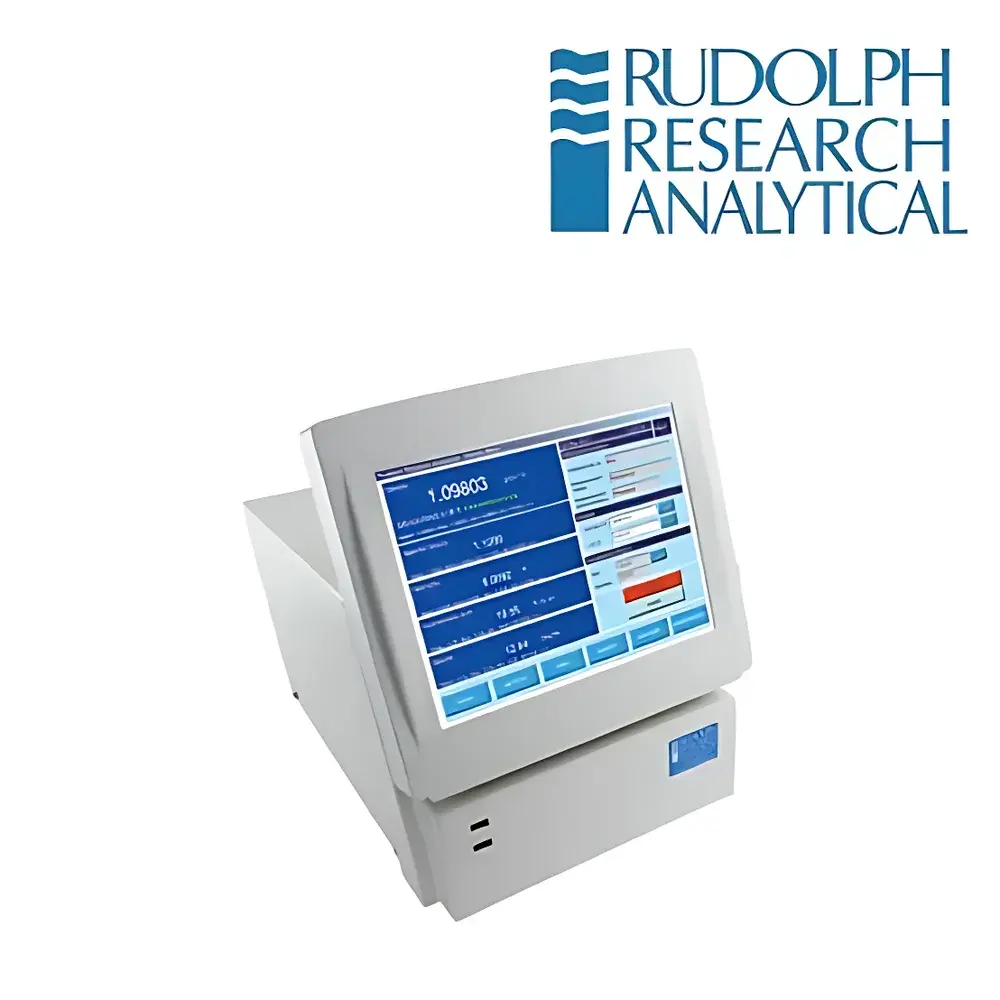
Rudolph DDM 2911 Digital Oscillating U-Tube Density Meter
| Brand | Rudolph |
|---|---|
| Origin | USA |
| Model | DDM 2911 |
| Instrument Type | Oscillating U-Tube Densitometer |
| Form Factor | Benchtop Laboratory Instrument |
| Sample Type | Liquids |
| Density Range | 0–3 g/cm³ |
| Density Resolution | 0.00001 g/cm³ |
| Density Accuracy | ±0.00005 g/cm³ |
| Temperature Range | 0–95 °C (100 °C optional) |
| Temperature Control Accuracy | ±0.01 °C |
| Minimum Sample Volume | 1 mL |
| Compliance | ASTM D4052, ASTM D5002, ASTM D1250, ASTM D5931-96, DIN 51757, ISO 12185 |
| Display | 10.4″ color TFT touchscreen |
| Cell Material | Borosilicate glass with PTFE fittings |
| Interfaces | 5× USB, RS-232, Ethernet (Cat-5) |
| Operating System | Windows 7 Embedded |
| Data Storage | 32 GB internal flash memory |
| Power Supply | 85–260 VAC |
| Video View™ Technology (U.S. Patent No. 7,437,909) | 10× digital zoom for real-time bubble visualization in oscillation tube |
Overview
The Rudolph DDM 2911 is a high-precision benchtop oscillating U-tube density meter engineered for traceable, reproducible liquid density measurements in regulated and research-intensive laboratory environments. Based on the fundamental principle of resonant frequency shift—where the natural oscillation frequency of a filled U-shaped borosilicate glass tube correlates inversely with the mass (and thus density) of the sample—the DDM 2911 delivers metrological-grade results under tightly controlled thermal conditions. Its design adheres to internationally recognized standards including ASTM D4052 (standard test method for density, relative density, and API gravity of crude petroleum and liquid petroleum products by digital density meter), ISO 12185 (petroleum products — determination of density of hydrocarbons by digital density meters), and DIN 51757 (determination of density of petroleum products by oscillating U-tube). The instrument operates across a broad density range (0–3 g/cm³), accommodating aqueous solutions, organic solvents, hydrocarbon blends, molten salts, and highly viscous formulations—making it suitable for QC release testing, formulation development, and raw material verification in pharmaceutical, chemical, petrochemical, food & beverage, and flavor & fragrance laboratories.
Key Features
- Oscillating U-tube measurement principle with temperature-stabilized borosilicate glass sensing cell and PTFE fluidic interfaces for chemical inertness and long-term dimensional stability
- Integrated 10.4″ color TFT touchscreen interface running Windows 7 Embedded OS, enabling intuitive method setup, real-time data visualization, and local result review without external PC dependency
- Video View™ technology (U.S. Patent No. 7,437,909): real-time, 10× digital zoom imaging of the entire U-tube interior to detect and assess air bubbles, meniscus position, and sample homogeneity prior to measurement—critical for method validation and troubleshooting
- Automatic viscosity correction algorithm based on damped oscillation decay analysis, eliminating manual correction factors for non-Newtonian or high-viscosity samples
- Built-in reference cell for continuous drift monitoring and automatic baseline compensation, enhancing long-term measurement stability over multi-hour or multi-shift operation
- Comprehensive connectivity suite: five USB ports (for keyboard/mouse/storage), RS-232 (legacy device integration), and Gigabit Ethernet (Cat-5) for secure network deployment, LIMS interfacing, and remote diagnostics
- Onboard 32 GB flash memory with timestamped audit trail, supporting full electronic record retention per FDA 21 CFR Part 11 requirements—including user authentication, electronic signatures, and immutable data archiving
Sample Compatibility & Compliance
The DDM 2911 accepts liquid samples requiring only 1 mL volume, minimizing reagent consumption and waste generation—particularly valuable when handling high-value APIs, reference standards, or hazardous materials. Its temperature control system maintains setpoints from 0 °C to 95 °C (with 100 °C option), with precision of ±0.01 °C, ensuring compliance with thermal conditioning requirements in pharmacopeial methods (e.g., USP and Ph. Eur. 2.2.39). The instrument supports full GxP alignment: IQ/OQ/PQ qualification protocols are provided, and firmware-level access controls, role-based permissions, and electronic audit trails satisfy GLP and GMP laboratory requirements. Validation documentation includes traceable calibration certificates aligned to NIST-traceable density standards.
Software & Data Management
The embedded software platform supports method-driven workflows, customizable report templates (PDF/CSV), and direct export to network printers or shared drives. All measurement events—including operator ID, timestamp, environmental parameters (temperature, ambient pressure), raw frequency data, viscosity-corrected density, and Video View™ snapshot metadata—are stored with cryptographic integrity. Audit trail logs record every configuration change, data modification, or user login attempt. Integration with enterprise systems is enabled via standard TCP/IP protocols and configurable OPC UA or HL7 interfaces—facilitating seamless data flow into LIMS, MES, or ELN platforms while preserving ALCOA+ (Attributable, Legible, Contemporaneous, Original, Accurate, Complete, Consistent, Enduring, Available) data governance principles.
Applications
- Pharmaceutical: Excipient purity verification, solvent lot release (e.g., ethanol, IPA, acetone), density-based concentration assays for injectables and oral solutions
- Petrochemical: API gravity calculation, biodiesel blend verification (B5–B100), crude assay support, and distillation cut characterization
- Food & Beverage: Brix/density correlation for juice and syrup QC, alcohol content estimation in spirits, and sugar solution standardization
- Chemical Manufacturing: Reaction endpoint monitoring via density shift, catalyst solution concentration tracking, and polymer solution characterization
- Academic & Government Research: Fundamental thermophysical property studies, equation-of-state modeling, and inter-laboratory round-robin density benchmarking
FAQ
What regulatory standards does the DDM 2911 comply with?
The instrument conforms to ASTM D4052, ASTM D5002, ISO 12185, DIN 51757, and ASTM D1250, and its software architecture satisfies FDA 21 CFR Part 11, EU Annex 11, and ICH GCP requirements for electronic records and signatures.
Can the DDM 2911 be integrated with other Rudolph instruments?
Yes—it is fully compatible with Rudolph J-series refractometers, Autopol series polarimeters, and Autosampler robotic modules, enabling synchronized multi-parameter acquisition (density, refractive index, optical rotation) from a single sample injection.
Is external PC hardware required for operation?
No. All core functions—including method execution, data processing, reporting, and system diagnostics—are performed onboard via the integrated Windows 7 Embedded platform and touchscreen interface.
How is temperature calibration verified?
Temperature sensor calibration is traceable to NIST SRM 1750 (certified temperature reference material), and users may perform routine verification using certified thermostatic baths per ASTM E1137.
What maintenance is required for long-term accuracy?
Routine cleaning of the U-tube with appropriate solvents and annual recalibration using certified density standards (e.g., aqueous NaCl solutions or hydrocarbon reference oils) are recommended; no consumable parts require scheduled replacement.
Related Products



