
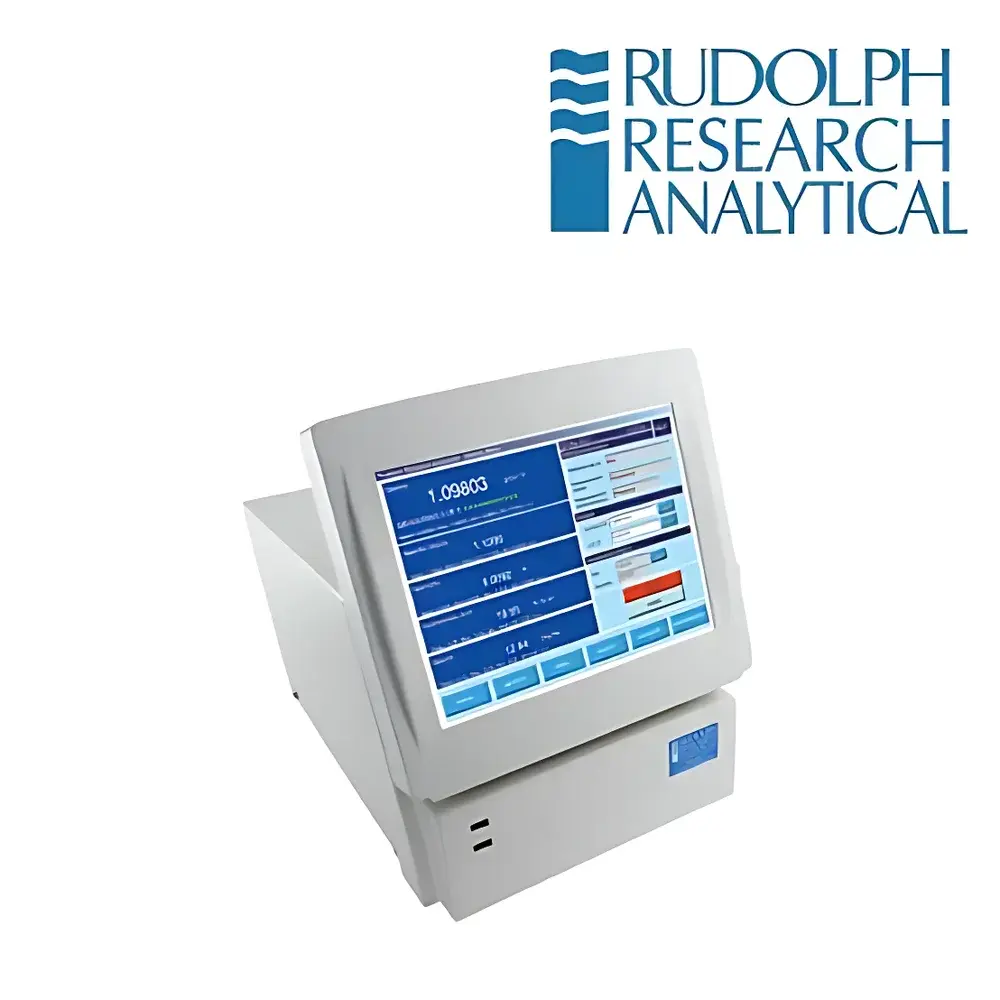
Rudolph DDM2909 Automated Oscillating U-Tube Density Meter
| Brand | Rudolph |
|---|---|
| Origin | USA |
| Model | DDM2909 |
| Instrument Type | Oscillating U-tube Densitometer |
| Form Factor | Benchtop Laboratory Instrument |
| Sample State | Liquid |
| Density Range | 0–3 g/cm³ (operable from 32°F to 212°F) |
| Density Accuracy | ±0.0001 g/cm³ |
| Temperature Accuracy | ±0.05 °C |
| Density Repeatability | ±0.00002 g/cm³ |
| Temperature Repeatability | ±0.02 °C |
| Temperature Control Range | 0–70 °C |
| Minimum Sample Volume | < 1 mL |
| Display | 10.4″ color LCD touchscreen |
| Connectivity | 5× USB, 2× RS232, 2× Ethernet, 1× HDMI |
| Onboard Storage | 32 GB |
| Regulatory Compliance | 21 CFR Part 11 compliant software with audit trail, IQ/OQ documentation support |
| Key Feature | Video View™ technology (U.S. Patent No. 7,437,909) for real-time 10× magnified visualization of bubble formation and settling in the oscillating U-tube |
Overview
The Rudolph DDM2909 is a high-precision, benchtop automated oscillating U-tube density meter engineered for rigorous laboratory environments requiring traceable, reproducible liquid density measurements. Based on the fundamental principle of oscillating tube densitometry—where the resonant frequency of a precisely machined U-shaped glass tube filled with sample correlates directly to its density—the DDM2909 delivers metrological-grade results across a broad operational range (0–3 g/cm³) and temperature span (0–70 °C). Its design adheres to internationally recognized physical measurement standards, including ISO 15212-1 (oscillating U-tube method for liquids), ASTM D4052 (standard test method for density of liquids by digital density meter), and USP (density and specific gravity). The instrument’s core architecture integrates a thermally stabilized oscillator system, a high-resolution temperature-controlled Peltier module, and a proprietary quartz U-tube sensor calibrated against NIST-traceable reference fluids.
Key Features
- Video View™ Technology (U.S. Patent 7,437,909): Real-time, 10× magnified video imaging of the oscillating U-tube enables visual verification of bubble presence, position, and stability—critical for identifying incomplete filling, trapped air, or sample degassing artifacts prior to measurement.
- Integrated Reference Cell: An onboard sealed reference cell continuously monitors thermal drift and provides automatic baseline correction, enhancing long-term measurement stability without manual recalibration.
- Automatic Viscosity Correction: Compensates for damping effects induced by high-viscosity samples using dynamic amplitude analysis, ensuring accuracy across diverse fluid classes—from low-viscosity solvents to viscous syrups and polymer solutions.
- Regulatory-Ready Architecture: Fully compliant with FDA 21 CFR Part 11 requirements, featuring role-based user access control, electronic signatures, immutable audit trails, and secure data encryption. IQ/OQ validation protocols and documentation templates are supplied as standard.
- High-Resolution Touch Interface: A 10.4″ industrial-grade color touchscreen supports intuitive workflow navigation, method editing, and live parameter monitoring—including real-time frequency, temperature, density, and signal-to-noise ratio.
- Robust Data Connectivity: Equipped with dual Ethernet ports for network integration, five USB ports for peripheral expansion (e.g., barcode scanners, external storage), two RS232 interfaces for legacy device linking, and HDMI output for external display mirroring.
Sample Compatibility & Compliance
The DDM2909 is optimized for homogeneous liquid samples with minimal suspended solids or volatile components prone to rapid evaporation. It accommodates aqueous solutions, organic solvents, hydrocarbons, pharmaceutical formulations, food-grade syrups, and electrolyte solutions. Samples requiring temperature equilibration benefit from the instrument’s active Peltier-controlled chamber, which achieves ±0.02 °C thermal stability within ±0.05 °C absolute accuracy. All measurement protocols align with GLP and GMP principles: full traceability of calibration history, operator identity, environmental conditions, and raw oscillation data is retained in the 32 GB internal SSD. The system supports seamless integration into LIMS environments via ASTM E1384-compliant data export formats (CSV, XML) and OPC UA-compatible communication stacks.
Software & Data Management
Rudolph’s proprietary DDM Control Suite provides comprehensive instrument control, method development, and data review capabilities. Software modules include automated method sequencing, multi-point temperature ramping, statistical process control (SPC) charting, and comparative batch analysis. All data entries—raw frequency counts, calculated density values, temperature logs, and operator annotations—are timestamped and digitally signed. Audit trails record every user action, including parameter modification, calibration execution, and report generation. Data integrity is enforced through AES-256 encryption at rest and TLS 1.2+ encryption in transit. Export options include PDF reports with embedded digital signatures, CSV files for statistical analysis, and direct printing to network-enabled thermal or laser printers.
Applications
The DDM2909 serves as a primary density measurement platform in regulated and research-intensive sectors. In pharmaceutical manufacturing, it verifies excipient concentration, monitors API solution density during crystallization, and supports USP compliance for density-based assay validation. In fine chemical synthesis, it quantifies reaction progress via density shifts in condensation or esterification processes. Beverage producers use it for Brix/density correlation in juice standardization; petroleum labs apply it for API gravity determination per ASTM D1298; and academic researchers employ it in thermophysical property studies involving binary or ternary liquid mixtures. When paired with Rudolph’s J257 refractometer and Autopol V polarimeter via Autosample automation, the DDM2909 enables concurrent, single-injection measurement of density, refractive index, and optical rotation—enabling purity assessment, enantiomeric excess calculation, and compositional fingerprinting.
FAQ
What is the minimum required sample volume for accurate measurement?
Less than 1 mL is sufficient for full-range operation, minimizing reagent consumption and enabling high-throughput screening of precious or hazardous samples.
Does the DDM2909 require periodic recalibration with certified reference materials?
Yes—calibration using NIST-traceable density standards (e.g., air and water at defined temperatures) is recommended before critical batches and at intervals aligned with internal quality procedures or regulatory inspection cycles.
Can the instrument measure density at non-standard temperatures outside the 0–70 °C range?
No—the thermal control system is validated only between 0 °C and 70 °C. Operation outside this range may compromise measurement accuracy, sensor longevity, and regulatory compliance.
Is remote monitoring or control supported?
Yes—via Ethernet connection and compatible web browsers or Rudolph’s DDM Remote Client, users can initiate runs, view live status, download data, and receive email/SNMP alerts for completion or error conditions.
How does the system handle viscous or volatile samples?
Viscous samples trigger automatic amplitude compensation; volatile samples should be introduced using sealed syringe injection or inert gas purging to minimize evaporation-induced drift during oscillation.



