
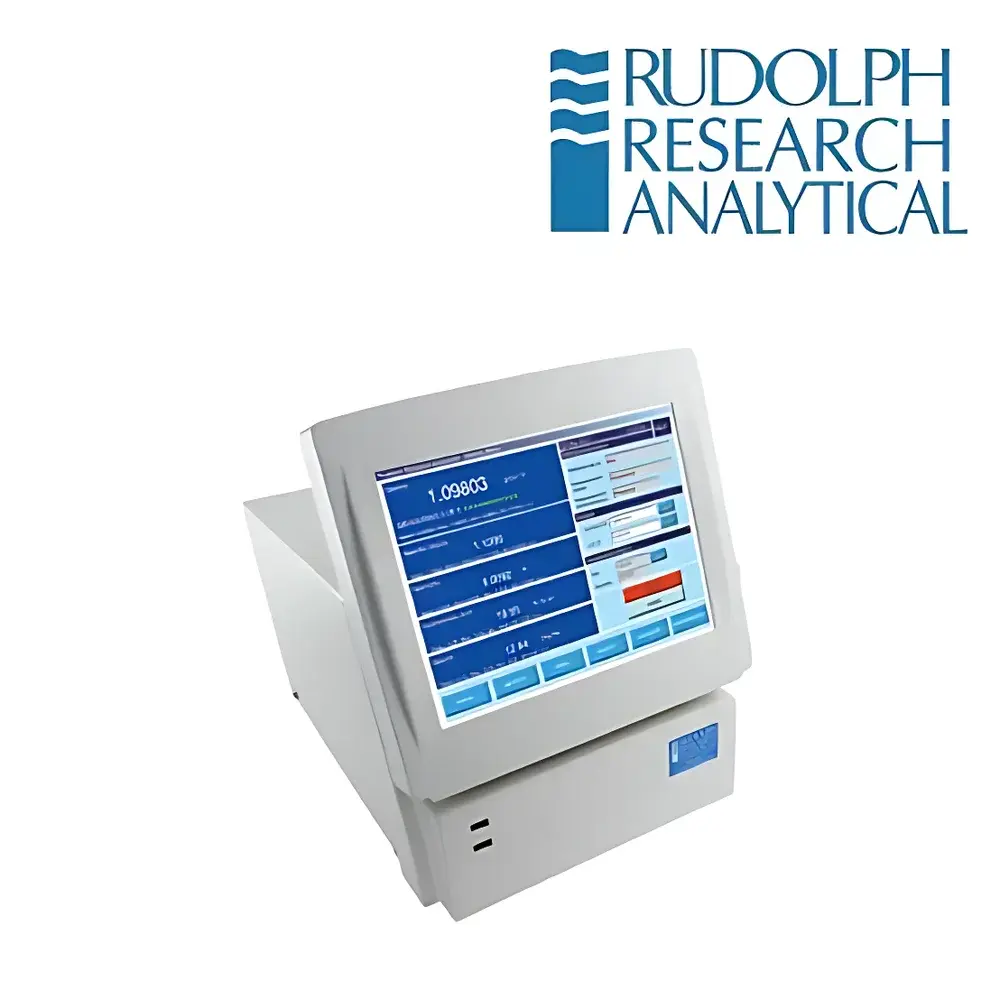
Rudolph DDM2910 Digital Oscillating U-Tube Density Meter
| Brand | Rudolph |
|---|---|
| Origin | USA |
| Model | DDM2910 |
| Instrument Type | Laboratory Benchtop Oscillating U-Tube Densitometer |
| Sample Type | Liquids |
| Density Range | 0–3 g/cm³ |
| Density Accuracy | ±0.00001 g/cm³ |
| Density Repeatability | ±0.00001 g/cm³ |
| Temperature Control Range | 0–100 °C |
| Temperature Accuracy | ±0.03 °C |
| Temperature Repeatability | ±0.02 °C |
| Display Resolution | 0.0001 g/cm³ / 0.01 °C |
| Minimum Sample Volume | 1 mL |
| Viewing System | Video View™ (10× magnification, real-time U-tube bubble monitoring) |
| Compliance | FDA 21 CFR Part 11, GLP/GMP-ready, IQ/OQ documentation available |
| Interface | 5× USB, 2× RS232, 2× Ethernet, 1× HDMI |
| Display | 10.4″ color TFT touchscreen |
| Onboard Storage | 32 GB SSD |
| Viscosity Correction | Automatic, integrated algorithm |
| Reference Cell | Built-in temperature-stabilized reference measurement cell |
Overview
The Rudolph DDM2910 Digital Oscillating U-Tube Density Meter is a high-precision laboratory benchtop instrument engineered for accurate, traceable, and repeatable density determination of liquid samples across pharmaceutical, chemical, food & beverage, petrochemical, and academic research applications. It operates on the fundamental principle of oscillating U-tube densitometry: a precisely machined borosilicate glass U-tube is filled with sample and electromagnetically excited to resonate at its natural frequency; this frequency exhibits an inverse square-root relationship to the mass of the contained liquid, enabling calculation of density via calibrated physical constants. The DDM2910 integrates advanced thermal management—capable of maintaining sample temperature within ±0.03 °C over a full 0–100 °C range—with real-time video monitoring of bubble formation and settling dynamics in the measurement cell. This ensures optimal filling validation and eliminates operator-dependent interpretation of air entrapment, a critical factor in achieving sub-10 µg/cm³ repeatability.
Key Features
- Video View™ Technology (U.S. Patent No. 7,437,909): Real-time 10× digital zoom imaging of the entire U-tube interior, allowing visual confirmation of bubble-free sample filling and meniscus stability prior to measurement initiation.
- Integrated automatic viscosity correction: Compensates for damping effects in high-viscosity liquids without requiring external input or manual calibration tables.
- Built-in reference measurement cell: A thermally isolated, temperature-stabilized reference tube enables continuous drift monitoring and long-term baseline stability—essential for unattended operation and regulatory compliance.
- Full 21 CFR Part 11 compliance architecture: Role-based user access control, electronic signatures, audit trail logging (including parameter changes, measurement events, and system alerts), and secure data encryption for all stored results and method files.
- Modular connectivity suite: Five USB ports support barcode scanners, flash drives, and peripheral HID devices; dual Ethernet interfaces enable redundant network configuration or direct integration into LIMS/SCADA systems; HDMI output permits external display mirroring for training or audit review.
- 32 GB onboard solid-state storage: Retains >1 million measurement records with full metadata (operator ID, timestamp, temperature, raw frequency data, viscosity-corrected density, method name, and instrument status logs).
Sample Compatibility & Compliance
The DDM2910 is validated for use with aqueous solutions, organic solvents, hydrocarbons, molten salts, glycols, syrups, and low-to-moderate viscosity suspensions (up to ~500 mPa·s). Its 1 mL minimum sample volume reduces reagent consumption and waste generation while maintaining metrological integrity. All wetted parts—including the U-tube, inlet tubing, and valve manifolds—are constructed from chemically inert borosilicate glass and PTFE, ensuring compatibility with aggressive media such as concentrated acids, alkalis, and halogenated solvents. The system meets ISO 12084:2021 (density determination by oscillating U-tube method), ASTM D4052-22 (standard test method for density, relative density, and API gravity of liquids by digital density meter), and USP (densitometry). Factory-provided IQ/OQ protocols align with EU Annex 11 and FDA guidance for computerized system validation in GxP environments.
Software & Data Management
The instrument runs Rudolph’s proprietary DDM Control Suite v5.x, a Windows-based application supporting local operation via touchscreen or remote desktop. It provides fully configurable measurement methods—including multi-point temperature ramps, sequential density/temperature profiling, and pass/fail limit checking against user-defined specification ranges. All data exports natively to CSV, PDF, and XML formats compliant with ASTM E1384 and ISO/IEC 17025 reporting requirements. Audit trails are immutable and exportable as signed PDFs with cryptographic hash verification. Network printing is supported via IPP, LPD, and raw TCP/IP protocols; print templates include full traceability fields (instrument ID, calibration due date, analyst signature, environmental conditions).
Applications
- Pharmaceutical QC: Excipient density verification, solvent lot release testing, and formulation density tracking per ICH Q5C stability protocols.
- Fine chemical synthesis: Real-time reaction mixture density monitoring for endpoint detection in esterification, alkylation, and condensation reactions.
- Food & beverage: Brix/density correlation for juice standardization, ethanol content estimation in spirits, and sugar syrup concentration control.
- Petrochemical QA: API gravity calculation for crude fractions, biodiesel blend verification (ASTM D7467), and lubricant base stock characterization.
- Academic research: Thermophysical property studies (density vs. temperature/pressure), ionic liquid characterization, and polymer solution behavior analysis.
FAQ
What calibration standards are required for routine operation?
Certified density reference standards traceable to NIST SRM 1810 (water) and SRM 1811 (benzene) are recommended for daily verification; factory calibration uses a 5-point matrix spanning 0.7–1.8 g/cm³.
Can the DDM2910 be integrated with Rudolph’s J257 refractometer and Autopol V polarimeter?
Yes—via Rudolph’s Unified Platform Interface (UPI), synchronized sample introduction through Autosample enables concurrent acquisition of density, refractive index, and optical rotation in a single workflow.
Is temperature ramping programmable during a single measurement sequence?
Yes—users may define up to 10 discrete setpoints between 0 °C and 100 °C with dwell times from 1 to 300 seconds per step, generating full density–temperature curves.
How is data integrity ensured during power interruption?
The system employs non-volatile memory for active measurement buffers and writes audit trail entries to flash storage before each critical state transition, preventing data loss or corruption.
Does the instrument support remote firmware updates?
Firmware updates are performed via authenticated HTTPS upload through the embedded web server interface; all updates require digital signature verification and generate versioned audit log entries.



