
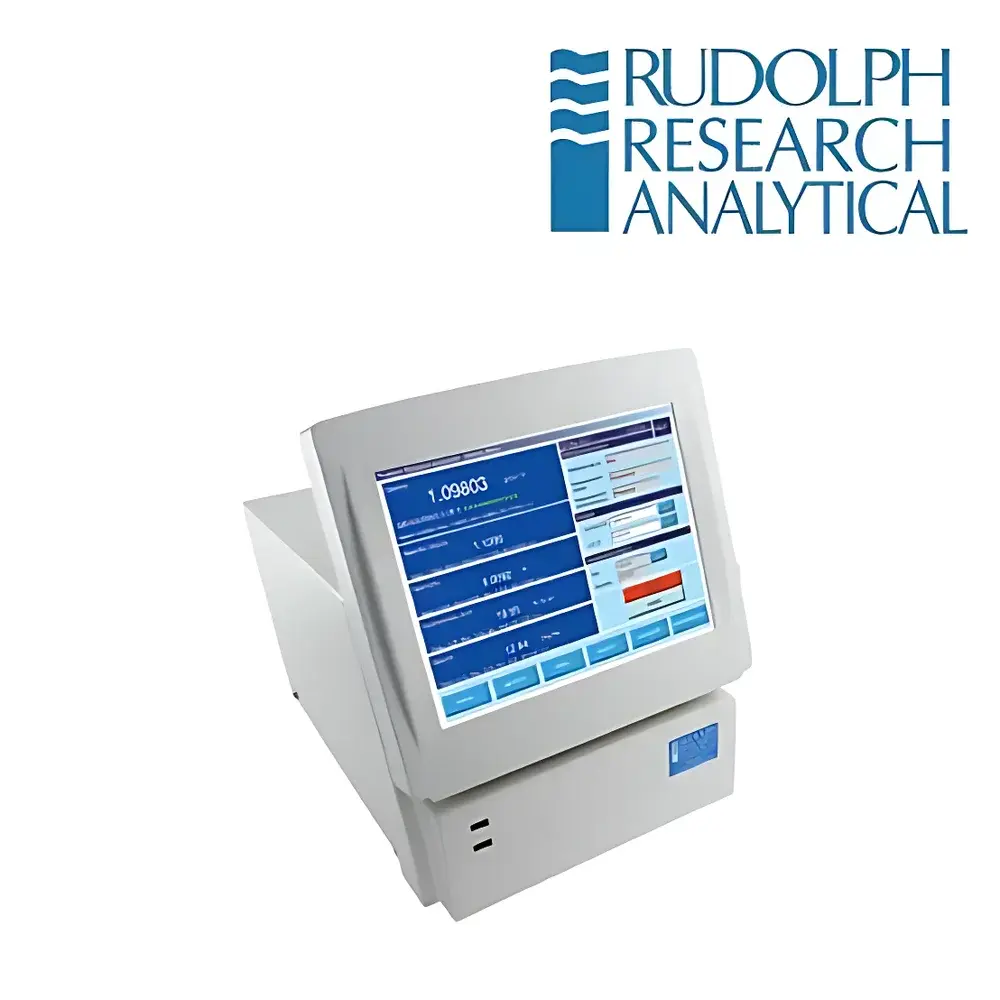
Rudolph DDM2911 Plus Digital Oscillating U-Tube Density Meter
| Brand | Rudolph |
|---|---|
| Origin | USA |
| Model | DDM2911 Plus |
| Instrument Type | Oscillating U-Tube Density Meter |
| Form Factor | Benchtop Laboratory Instrument |
| Sample Type | Liquids |
| Density Range | 0–3 g/cm³ |
| Density Accuracy | ±0.000010 g/cm³ |
| Density Repeatability | ±0.000002 g/cm³ |
| Display Resolution | 0.000001 g/cm³ |
| Temperature Control Range | 0–100 °C |
| Temperature Accuracy | ±0.01 °C |
| Temperature Repeatability | ±0.001 °C |
| Minimum Sample Volume | 1 mL |
| Built-in Reference Cell | Yes |
| Viscosity Correction | Automatic |
| Compliance | FDA 21 CFR Part 11, GLP/GMP-ready |
| Data Interfaces | 5× USB, 2× RS232, 2× Ethernet, 1× HDMI |
| Display | 10.4″ Color TFT Touchscreen |
| Onboard Storage | 32 GB |
| Video View™ Magnification | 10× Real-time U-tube Imaging |
Overview
The Rudolph DDM2911 Plus is a high-precision benchtop digital density meter engineered for laboratories requiring traceable, ISO/IEC 17025-aligned density measurements of liquid samples across pharmaceutical, chemical, food & beverage, petrochemical, and academic research applications. It operates on the oscillating U-tube principle: a precisely manufactured borosilicate glass U-tube is filled with sample and electromagnetically excited to resonate at its natural frequency. This frequency is inversely proportional to the mass of the sample within the tube and directly related to its density via rigorous calibration against certified reference standards (e.g., air and water or NIST-traceable density standards). The instrument’s proprietary temperature-controlled oscillator system maintains thermal equilibrium with sub-millidegree stability, minimizing thermal drift and ensuring compliance with ASTM D4052, ISO 12185, and USP . Its design eliminates operator-dependent variables—no manual meniscus reading, no hydrometer buoyancy corrections—delivering inherently reproducible results independent of operator skill.
Key Features
- Video View™ Technology (U.S. Patent No. 7,437,909): Integrated 10× digital zoom imaging enables real-time visual verification of bubble presence, position, and geometry inside the U-tube—critical for detecting incomplete filling, trapped air, or emulsion instability prior to measurement.
- Automatic Viscosity Correction: Compensates for damping effects in high-viscosity liquids (e.g., syrups, glycerol, polymer solutions) without user intervention, extending reliable measurement range beyond conventional oscillating-tube limits.
- Built-in Reference Measurement Cell: Enables continuous self-validation by alternating between sample and reference (e.g., air or water) measurements, supporting routine performance qualification and trending per ICH Q2(R2) guidelines.
- Regulatory-Ready Architecture: Fully compliant with FDA 21 CFR Part 11 requirements—including electronic signatures, audit trail with immutable timestamps, role-based access control, and secure data export—facilitating GxP validation (IQ/OQ/PQ protocols provided).
- Modular Integration Capability: Designed for seamless interoperability with Rudolph’s J-series refractometers, Autopol series polarimeters, and Autosampler units; single-sample aspiration yields correlated density, refractive index, specific rotation, and derived parameters (e.g., Brix, % w/w, optical purity).
Sample Compatibility & Compliance
The DDM2911 Plus accommodates aqueous solutions, organic solvents, suspensions, and low-to-medium viscosity Newtonian and non-Newtonian liquids (viscosity up to ~200 mPa·s, depending on temperature and fill dynamics). Its 1 mL minimum volume requirement supports resource-constrained analyses—including precious API intermediates, clinical trial formulations, or micro-batch synthesis products. All wetted parts are chemically inert (borosilicate glass, PTFE, sapphire), ensuring compatibility with aggressive media such as concentrated acids, alkalis, and halogenated solvents. The system meets ISO/IEC 17025 clause 6.4.10 (equipment verification), ASTM D4052-22 Annex A1 (precision criteria), and EU GMP Annex 11 (computerized system validation). Calibration traceability is maintained through factory-certified standards with documented uncertainty budgets (<0.000005 g/cm³ k=2).
Software & Data Management
Operating firmware v5.x delivers intuitive touchscreen navigation via a 10.4″ high-resolution display. Measurement data—including raw oscillation frequency, temperature, density, viscosity-corrected value, and Video View™ snapshots—are timestamped and stored locally on the embedded 32 GB SSD. Export options include CSV, PDF reports (with configurable templates), and direct network printing. Data transfer occurs over dual Ethernet ports (one dedicated to lab network, one isolated for instrument management) or USB host/device modes. Audit trails record all user actions (login/logout, method edits, result deletions) with SHA-256 hashing and cannot be disabled or altered. Remote monitoring and configuration are supported via HTTPS-enabled web interface, compatible with enterprise LIMS and ELN systems using standard RESTful API endpoints.
Applications
- Pharmaceutical QC: Density verification of excipient solutions, solvent blends, injectables, and cleaning validation rinse waters per USP and EP 2.2.39.
- Fine Chemical Synthesis: Real-time reaction monitoring via density shifts during esterification, amidation, or hydrogenation processes.
- Food & Beverage: Brix/density correlation for juice authenticity, alcohol content estimation in spirits (via density/temperature tables), and syrup concentration control.
- Petrochemical QA: Hydrocarbon blend verification, biodiesel (FAME) purity assessment, and lubricant base oil classification per ASTM D1298.
- Academic Research: Thermophysical property determination (e.g., partial molar volumes, excess molar volumes) in binary and ternary mixtures under controlled isothermal conditions.
FAQ
What is the recommended calibration frequency for GMP environments?
Per internal SOP guidance and FDA expectations, calibration verification using two-point (air/water or air/reference fluid) checks should be performed daily prior to use; full multi-point calibration with NIST-traceable standards is required after maintenance, relocation, or at intervals not exceeding 6 months.
Can the DDM2911 Plus measure slurries or particulate-containing samples?
Yes—provided particles remain fully suspended during measurement and do not settle or clog the 2.5 mm internal diameter U-tube within the 30–90 second oscillation acquisition window; filtration or centrifugation is advised for heterogeneous systems.
Is temperature equilibration time included in the stated measurement cycle?
No—the reported 30–60 second measurement time begins only after the sample reaches thermal equilibrium within the U-tube cavity, as confirmed by the integrated Pt100 sensor achieving ±0.005 °C stability for ≥5 seconds.
Does Video View™ support image export for audit purposes?
Yes—each measurement event can be configured to automatically save a timestamped JPEG snapshot of the U-tube view, archived alongside analytical data in the same encrypted dataset.
How is viscosity correction validated across different fluid types?
Correction algorithms are empirically derived from >1,200 reference measurements spanning 150+ fluids (including glycerol/water, ethylene glycol, and silicone oils) and are updated via firmware patches aligned with ISO 12185 Annex B guidelines.



