
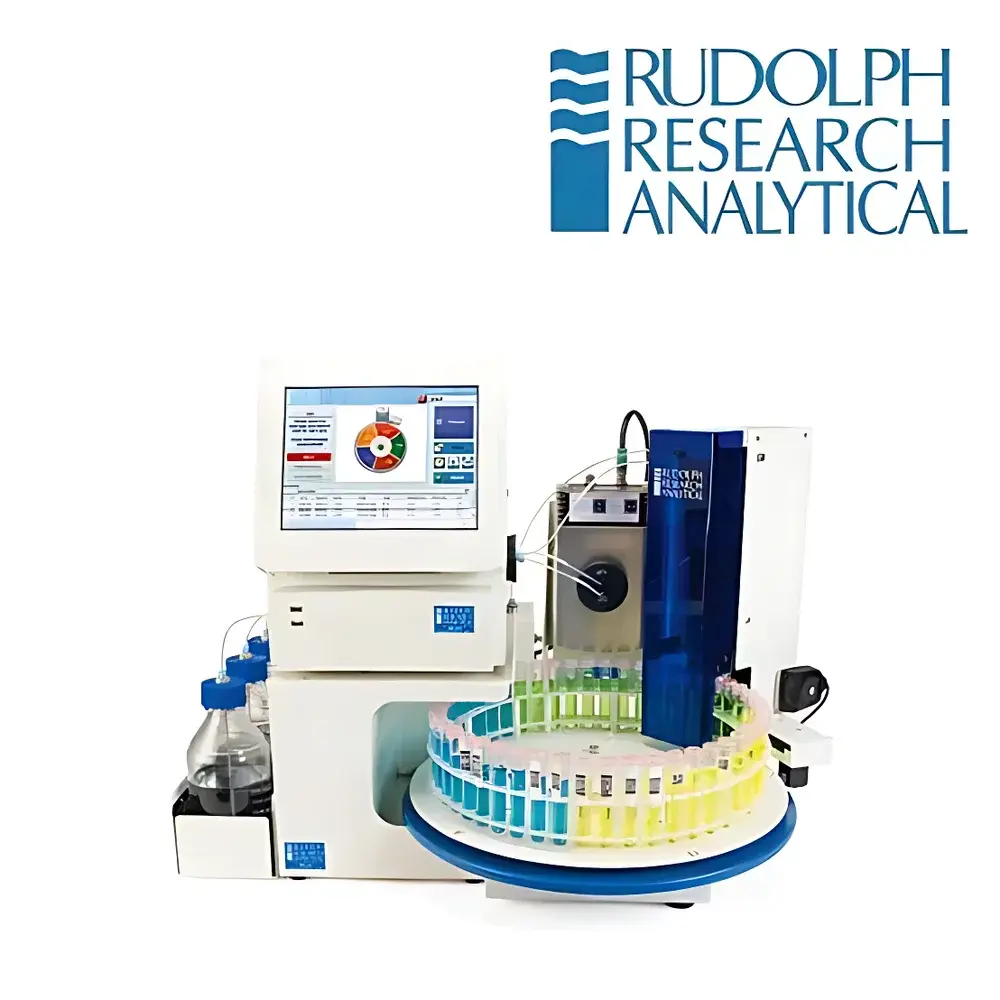
Rudolph DDM2911+Autoflex R837 Oscillating U-Tube Density Meter with Integrated Automated Sample Handler
| Brand | Rudolph |
|---|---|
| Origin | USA |
| Model | DDM2911 + Autoflex R837 |
| Instrument Type | Oscillating U-tube Densitometer |
| Configuration | Benchtop Laboratory System |
| Sample Type | Liquids |
| Density Range | 0–3 g/cm³ |
| Density Resolution | 0.00001 g/cm³ |
| Density Accuracy | ±0.00005 g/cm³ |
| Temperature Control Range | 0–95 °C (100 °C optional) |
| Temperature Stability | ±0.01 °C |
| Minimum Sample Volume | 1 mL |
| Compliance | ASTM D4052, ASTM D5002, ASTM D1250, ASTM D5931-96, ISO 12185, DIN 51757 |
| Interface | USB ×5, RS-232, Ethernet (Cat-5) |
| Display | 10.4″ color TFT touchscreen |
| Construction | Borosilicate glass U-tube, PTFE fluidic interfaces |
| Data Storage | 32 GB internal flash memory |
| Operating System | Windows 7 Embedded |
| VideoView™ Technology (U.S. Patent No. 7,437,909) | 10× digital zoom for real-time bubble visualization across full U-tube length |
| Viscosity Compensation | Automatic in-situ correction |
| Regulatory Support | 21 CFR Part 11 compliant audit trail, electronic signatures, IQ/OQ/PQ documentation package |
| Power Input | 85–260 VAC, 50/60 Hz |
Overview
The Rudolph DDM2911+Autoflex R837 is a high-precision benchtop oscillating U-tube densimeter engineered for traceable, repeatable density determination of liquid samples in regulated and research-intensive laboratory environments. It operates on the fundamental physical principle that the resonant frequency of a filled, oscillating U-shaped glass tube is inversely proportional to the square root of the sample’s density—enabling direct, non-invasive measurement without calibration standards for each analysis. Coupled with the Autoflex R837 automated sample handler, this system delivers unattended sequential analysis of up to 837 samples per run, eliminating manual pipetting, reducing operator variability, and ensuring strict adherence to method-defined thermal equilibration protocols. Designed and manufactured in the United States by Rudolph Research Analytical—a pioneer in optical and physical property instrumentation since 1940—the platform meets the metrological rigor required in pharmaceutical QC, petrochemical QA, food & beverage formulation, and academic physical chemistry labs.
Key Features
- Oscillating U-tube measurement with borosilicate glass sensing cell and PTFE-wetted fluid path for chemical inertness and long-term stability
- VideoView™ optical monitoring system (U.S. Patent No. 7,437,909): 10× digital zoom enables real-time visual verification of bubble presence, position, and morphology within the entire U-tube—critical for detecting entrapped air or incomplete filling prior to measurement
- Integrated automatic viscosity correction algorithm, eliminating need for separate viscometry or manual compensation tables
- High-stability Peltier temperature control (0–95 °C standard; 100 °C optional) with ±0.01 °C accuracy and <0.002 °C short-term drift over 30 minutes
- Full 21 CFR Part 11 compliance: role-based user access, electronic signatures, immutable audit trail, and secure data archiving with timestamped metadata
- Modular expandability: native interoperability with Rudolph Autopol series polarimeters and J-series refractometers for multi-parameter characterization (e.g., density + refractive index + specific rotation) from a single injection
Sample Compatibility & Compliance
The DDM2911+Autoflex R837 accommodates a broad spectrum of liquid matrices—including aqueous solutions, organic solvents, hydrocarbon blends, syrup formulations, ethanol-water mixtures, and viscous pharmaceutical intermediates—provided they are free of suspended solids and non-volatile particulates. Samples as low as 1 mL enable efficient use of high-value reference materials or limited clinical/bioprocess batches. The system conforms to internationally recognized standard methods including ASTM D4052 (standard test method for density, relative density, and API gravity of crude petroleum and liquid petroleum products by digital density meter), ASTM D5002 (for biodiesel), ISO 12185 (crude oil and petroleum products), and DIN 51757 (mineral oils). Its architecture supports GLP and GMP workflows through factory-provided IQ/OQ/PQ validation documentation, instrument qualification templates, and configurable electronic batch records.
Software & Data Management
Controlled via a dedicated Windows 7 Embedded OS interface, the system runs Rudolph’s proprietary Densix software—designed for both routine operation and advanced method development. The software features customizable SOP-driven workflows, dynamic method libraries with parameter locking, real-time trending of density vs. temperature curves, and automatic generation of ASTM-compliant reports. All raw oscillation data, temperature logs, video snapshots, and user actions are stored in encrypted format on the internal 32 GB flash drive. Export options include CSV, PDF/A-2, XML, and LIMS-ready formats via Ethernet or USB. Network printing is supported natively; data can also be pushed to shared network drives or cloud repositories using configured SFTP or HTTPS endpoints. Audit trail entries record operator ID, timestamp, action type, before/after values, and reason-for-change fields—fully traceable during regulatory inspections.
Applications
- Pharmaceutical: Excipient density profiling, solvent purity verification (e.g., IPA, ethanol), density-based concentration assays for injectables, and stability-indicating QC for liquid dosage forms
- Petrochemical: API gravity calculation, blendstock verification, biodiesel (B100) density certification per ASTM D6751, and custody transfer metrology support
- Food & Beverage: Brix/density correlation modeling for juice concentrates, alcohol content estimation in spirits, sugar syrup consistency control, and dairy product standardization
- Chemical Manufacturing: Reaction mixture density tracking for stoichiometric endpoint detection, catalyst solution homogeneity assessment, and quality release of specialty solvents
- Academic Research: Thermophysical property studies (density vs. T, partial molar volumes), binary/multicomponent phase behavior, and validation of molecular simulation outputs
FAQ
What is the minimum sample volume required for a valid measurement?
A minimum of 1 mL is sufficient to fully fill the U-tube and ensure stable oscillation; however, optimal repeatability is achieved with 1.2–1.5 mL to accommodate minor dispensing variance and thermal expansion.
Does the system require daily recalibration with certified density standards?
No—oscillating U-tube technology is inherently absolute; calibration is performed once during installation using air and water at defined temperatures. Subsequent verification uses built-in reference cells and periodic check standards per your lab’s SOP.
Can the Autoflex R837 handle viscous or volatile samples without degradation in accuracy?
Yes—its positive-displacement syringe pump, heated sample lines (up to 60 °C), and programmable rinse cycles minimize carryover and thermal lag. Volatile samples are managed via closed-loop purge and pressure-balanced aspiration.
Is remote monitoring or integration with LIMS possible?
Yes—Ethernet connectivity enables full bidirectional communication via TCP/IP or OPC UA protocols. Rudolph provides documented API specifications and sample scripts for common LIMS platforms.
How does VideoView™ improve measurement reliability compared to conventional systems?
It eliminates subjective “bubble judgment” by providing objective, time-stamped visual evidence of U-tube fill integrity—reducing false rejections, supporting root-cause analysis during deviations, and satisfying ALCOA+ data integrity principles.
Related Products



