
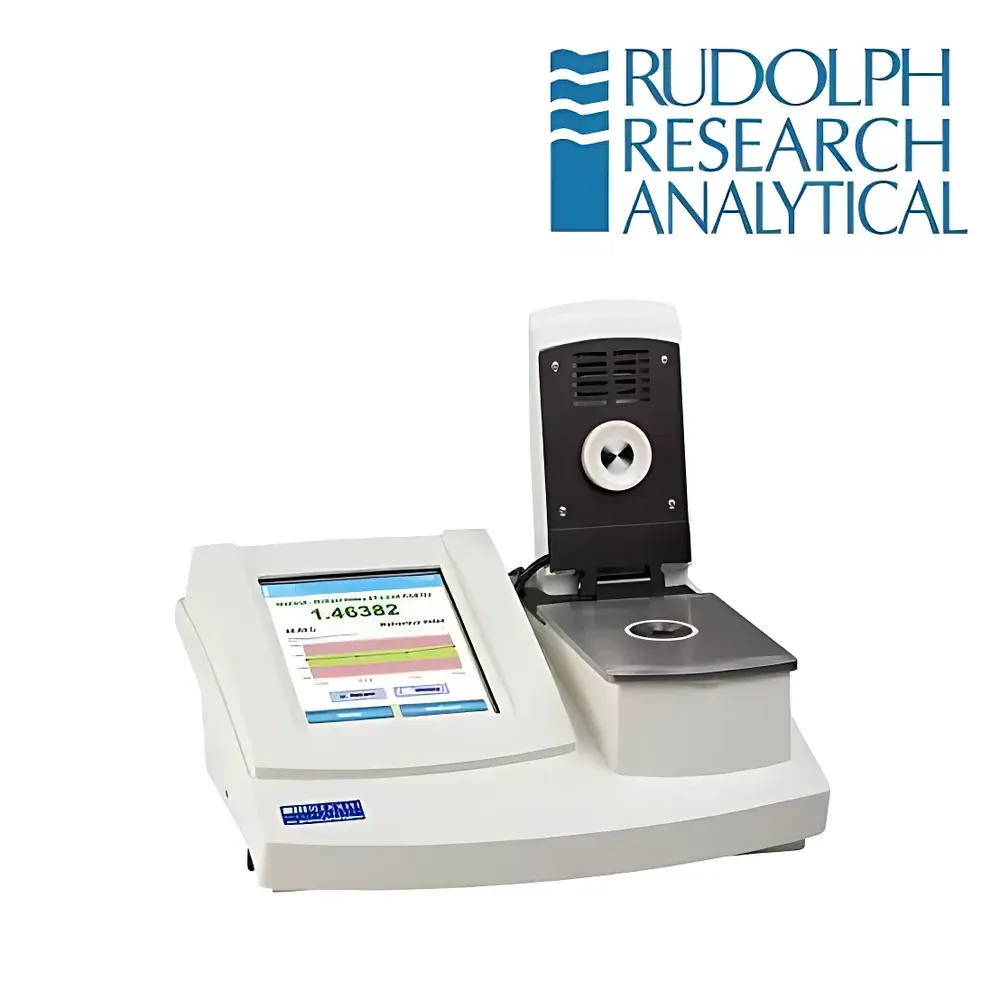
Rudolph J257 Advanced Digital Refractometer
| Brand | Rudolph |
|---|---|
| Origin | USA |
| Model | J257 |
| Type | Benchtop Refractometer |
| Temperature Control | Yes |
| Digital Display | Yes |
| Measurement Range | 1.26–1.72 RI, 0–100 °Brix |
| Measurement Accuracy | ±0.0001 RI, ±0.1 °Brix |
| Resolution | 0.00001 RI, 0.01 °Brix |
| Wavelength | 589.3 nm (Na-D line), optional alternate wavelengths available |
| Temperature Control Range | 10–100 °C (extended range: –5 to 110 °C) |
| Temperature Stability | ±0.01 °C |
| Prism Material | Sapphire (diameter > 20 mm) |
| Interface | RS-232, USB, Cat5 Ethernet |
| Storage | 32 GB internal memory |
| Display | 8-inch color touchscreen |
| Operating System | Windows 7 Embedded |
| Compliance Options | FDA 21 CFR Part 11 audit trail & electronic signature support (optional) |
| Software Features | SmartMeasure™ real-time measurement validation, Load-N-Go™ rapid sample loading, Easy Clean™ flat-cell design, Trend Analysis for QC monitoring, LIMS integration capability |
| Calibration Modes | Single-point, two-point, and multi-point calibration |
| Certified Reference Materials | NIST-traceable standards available |
Overview
The Rudolph J257 Advanced Digital Refractometer is a high-precision benchtop instrument engineered for rigorous refractive index (RI) and %Brix quantification in regulated and research-intensive environments. It operates on the principle of total internal reflection at the prism-sample interface, using a stabilized sodium D-line light source (589.3 nm) to determine RI with traceable metrological integrity. Designed for laboratories requiring compliance with pharmacopeial methods (USP , EP 2.2.24), quality control protocols (ISO 21542, ASTM D1218), and GMP/GLP workflows, the J257 delivers long-term stability, minimal operator dependency, and full data integrity through hardware-enforced temperature control and digital calibration traceability.
Key Features
- Sapphire prism (≥20 mm diameter) offering exceptional scratch resistance, chemical inertness, and thermal homogeneity—critical for repeated measurements of aggressive solvents, viscous oils, or abrasive suspensions.
- Integrated Peltier-based thermostatic system with ±0.01 °C stability across a programmable range of –5 to 110 °C, eliminating ambient drift and enabling method-standardized measurements per ISO 2859 or USP .
- High-resolution detection architecture delivering 0.00001 RI resolution and ±0.0001 RI accuracy—validated against NIST-traceable sucrose and glycerol reference standards.
- Load-N-Go™ optical path design minimizes sample volume requirements (<0.5 mL) while ensuring instantaneous optical coupling and real-time signal convergence visualization.
- Easy Clean™ flat-surface measurement cell prevents residual film formation and cross-contamination between high-viscosity or volatile samples—validated per ICH Q5C cleaning verification guidelines.
- Embedded Windows 7 OS with native RS-232, USB, and Cat5 Ethernet connectivity supports seamless integration into enterprise LIMS, ELN, and MES platforms without middleware.
Sample Compatibility & Compliance
The J257 accommodates aqueous solutions, hydrocarbons, halogenated solvents, polymer melts, essential oils, pharmaceutical syrups, and high-refractive-index specialty chemicals (e.g., silicone fluids, optical resins). Its extended RI range (1.26–1.72) exceeds standard Abbe refractometers, enabling direct analysis of undiluted crude glycerin, concentrated API solutions, and heavy fuel fractions. The instrument complies with FDA 21 CFR Part 11 when configured with optional electronic signature and audit trail modules—supporting ALCOA+ data governance principles (Attributable, Legible, Contemporaneous, Original, Accurate). All firmware and calibration logs are time-stamped, immutable, and exportable in CSV/PDF formats for regulatory inspection.
Software & Data Management
Rudolph’s proprietary software suite provides SmartMeasure™ algorithmic validation—automatically detecting air bubbles, insufficient coverage, or thermal lag before finalizing results. Trend Analysis generates real-time SPC charts (X-bar/R, Cpk) directly from measurement history stored in the onboard 32 GB flash memory. Data export supports .csv, .xlsx, and XML formats with embedded metadata (operator ID, timestamp, calibration ID, temperature log). Audit trails record every parameter change, calibration event, and user login—retained for ≥10 years with configurable auto-archive policies. LIMS integration uses ASTM E1384-compliant messaging for bidirectional sample ID routing and result ingestion.
Applications
- Pharmaceutical QC: Excipient concentration verification (e.g., propylene glycol, sorbitol), syrup density control, and raw material identity testing per USP monographs.
- Chemical manufacturing: Solvent purity assessment (e.g., acetone, THF), monomer conversion tracking in polymer synthesis, and acid/base concentration monitoring.
- Food & beverage: Brix standardization in fruit concentrates, honey adulteration screening, and dairy product solids content validation.
- Petroleum & lubricants: Refractive index correlation with API gravity, additive package consistency checks, and used oil degradation trending.
- Academic & contract research: Method development for novel ionic liquids, nanofluid characterization, and temperature-dependent RI modeling (dn/dT).
FAQ
What wavelength is used for primary measurements, and can it be changed?
The default source is a stabilized 589.3 nm sodium D-line LED. Optional narrowband filters (486 nm, 656 nm) are available for dispersion analysis or specialized pharmacopeial methods requiring alternate wavelengths.
Is multi-point calibration required for full-range accuracy?
Yes—multi-point calibration using ≥3 NIST-traceable standards is recommended for applications spanning >0.2 RI units or demanding ≤±0.00005 RI uncertainty. The system stores calibration curves with polynomial coefficients and residual error mapping.
How does the J257 meet 21 CFR Part 11 requirements?
With the optional compliance module, it enforces role-based access control, electronic signatures with biometric or token authentication, and tamper-evident audit logs—including all data modifications, deletions, and report generations.
Can the instrument measure opaque or turbid samples?
No—the J257 requires optically transparent or semi-transparent samples. Turbid emulsions or particulate suspensions must be centrifuged or filtered prior to analysis to avoid scattering-induced errors.
What maintenance is required beyond routine prism cleaning?
Annual factory recalibration is recommended; no user-serviceable optical alignment is needed. The sapphire prism requires only deionized water and lint-free wipes—no polishing or re-coating over its operational lifetime.



