
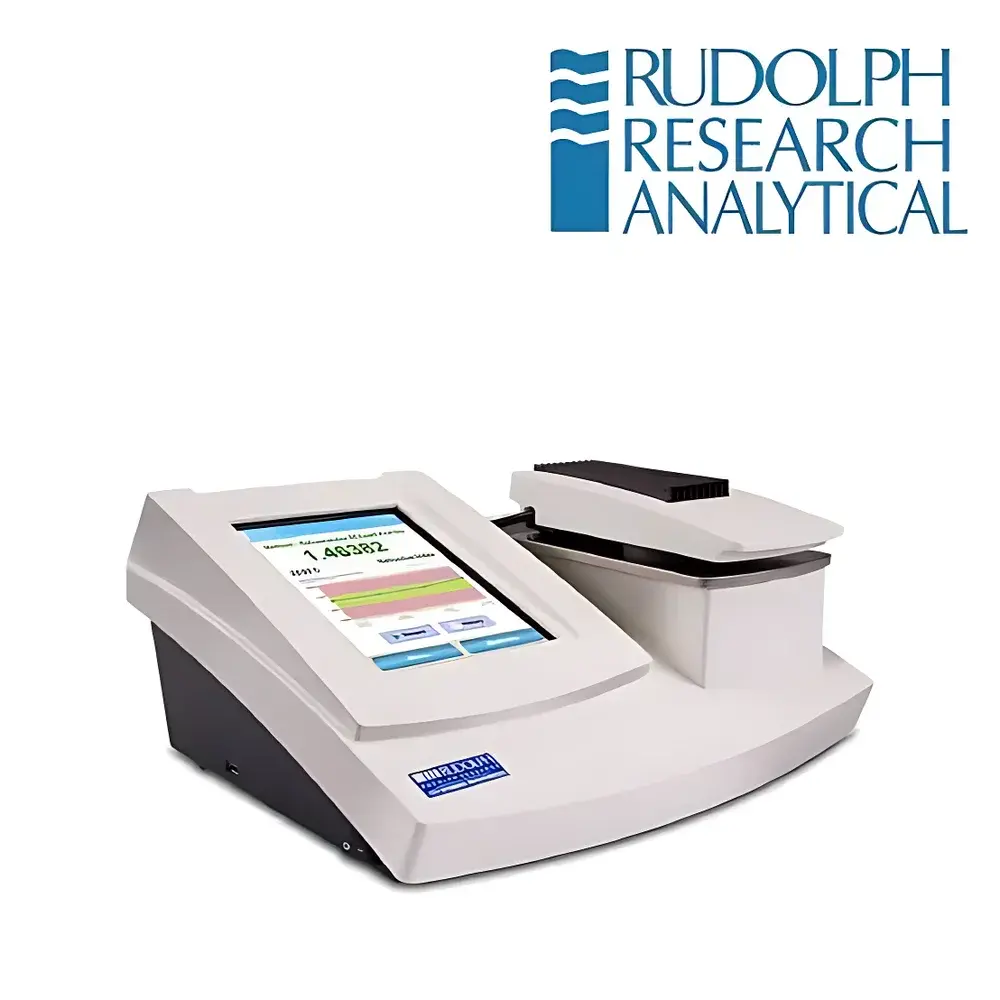
Rudolph J357 Desktop Digital Refractometer
| Brand | Rudolph |
|---|---|
| Origin | USA |
| Model | J357 |
| Instrument Type | Benchtop Refractometer |
| Temperature Control | Yes (Peltier-based, 10–100 °C standard, –5 to 110 °C optional) |
| Digital Display | Yes (8-inch color TFT touchscreen) |
| Measurement Range | 1.26–1.72 RI, 0–100 °Brix |
| Measurement Accuracy | ±0.00002 RI, ±0.015 °Brix |
| Measurement Resolution | 0.00001 RI, 0.01 °Brix |
| Wavelength | 589.3 nm (Na-D line), optional alternate wavelengths available |
| Prism Material | Sapphire (≥20 mm diameter) |
| Calibration Options | Single-, dual-, and multi-point calibration |
| Data Storage | 32 GB internal memory |
| Connectivity | RS-232, USB, Cat5 Ethernet |
| Software Compliance | Optional 21 CFR Part 11 audit trail & electronic signature support |
| Operating System | Windows 7 Embedded |
| LIMS Integration | Yes |
| Smart Measurement Technology | SmartMeasure™ |
| Sample Handling | Load-N-Go™ automated sample introduction |
| Cleaning Design | Easy Clean™ flat-cell geometry |
| Regulatory Standards Support | NIST-traceable reference materials available |
| Trend Analysis | Real-time QC data visualization and statistical trending |
Overview
The Rudolph J357 Desktop Digital Refractometer is a high-precision, temperature-controlled benchtop instrument engineered for rigorous analytical environments in pharmaceutical, petrochemical, food & beverage, and academic research laboratories. It operates on the fundamental principle of critical angle refractometry: measuring the refractive index (RI) of a liquid sample by determining the angle at which light undergoes total internal reflection at the interface between the sample and a high-refractive-index sapphire prism. The instrument employs a stabilized sodium D-line source (589.3 nm) as its primary wavelength, ensuring metrological consistency aligned with international optical standards. With a measurement range spanning 1.26–1.72 RI and 0–100 °Brix, the J357 accommodates highly concentrated, viscous, or optically dense samples—including hydrocarbon blends, polymer solutions, syrups, and active pharmaceutical ingredient (API) suspensions—without dilution or compromise in resolution.
Key Features
- Ultra-high resolution detection: 0.00001 RI and 0.01 °Brix, enabling trace-level concentration monitoring and early-stage process deviation detection.
- Peltier-driven semiconductor temperature control with ±0.01 °C stability across a programmable range of 10–100 °C (–5 to 110 °C optional), eliminating ambient thermal drift and supporting ASTM D1218, ISO 2859, and USP compliant measurements.
- Optical-grade sapphire prism (≥20 mm diameter, Mohs hardness 9), resistant to chemical erosion and mechanical abrasion—critical for aggressive solvents and abrasive suspensions.
- Load-N-Go™ sample introduction system: enables rapid, reproducible loading with real-time display of RI/Brix evolution during equilibration—reducing operator dependency and cycle time.
- Easy Clean™ flat-cell design: minimizes residual volume and eliminates capillary retention, preventing carryover between high-viscosity or particulate-laden samples—validated per ICH Q5C cleaning verification guidelines.
- Integrated 8-inch color TFT touchscreen running Windows 7 Embedded OS, supporting direct method configuration, user-defined SOPs, and on-device data review without external PC dependency.
Sample Compatibility & Compliance
The J357 accommodates aqueous, organic, and mixed-phase liquids—including glycerol, ethylene glycol, crude oil fractions, ethanol-water mixtures, and biopharmaceutical buffers—without requiring solvent-specific calibration. Its wide RI range (1.26–1.72) supports applications from low-density hydrocarbons (e.g., n-hexane, RI ≈ 1.375) to high-refractive-index specialty fluids (e.g., brominated compounds, RI > 1.65). All measurements are traceable to NIST-certified refractive index standards (SRM 1483, 1484), and optional 21 CFR Part 11 compliance includes role-based access control, electronic signatures, full audit trail logging, and secure data archiving—meeting FDA, EMA, and PMDA regulatory expectations for GxP environments. The instrument conforms to ISO/IEC 17025 requirements for calibration laboratories and supports GLP/GMP documentation workflows via configurable report templates.
Software & Data Management
Data acquisition, analysis, and reporting are managed through Rudolph’s proprietary software suite, fully embedded and network-accessible. The system logs every measurement event—including operator ID, timestamp, temperature setpoint, calibration history, and raw sensor output—with immutable timestamps and checksum-verified storage on the internal 32 GB SSD. Trend Analysis functionality delivers real-time Shewhart control charts, moving averages, and capability indices (Cp/Cpk), directly exportable to CSV or PDF. RS-232, USB, and Cat5 Ethernet interfaces enable seamless integration into enterprise LIMS (e.g., LabWare, Thermo Fisher SampleManager) and MES platforms. Method templates can be locked, version-controlled, and deployed across multiple instruments—ensuring inter-laboratory harmonization per ISO 17043 proficiency testing protocols.
Applications
- Pharmaceutical QC: API concentration verification, excipient purity assessment, and syrup formulation consistency per USP and Ph. Eur. 2.2.2.
- Petrochemical analysis: Hydrocarbon blend ratio quantification, biodiesel FAME content estimation, and lubricant base oil classification (ASTM D1218, D1747).
- Food & Beverage: Brix validation in fruit juices, honey adulteration screening, and sugar recovery optimization in cane/beet processing.
- Academic & Materials Research: Polymer solution thermodynamics, nanoparticle dispersion stability indexing, and ionic liquid characterization.
- Chemical Manufacturing: In-process concentration monitoring for batch reactors and continuous flow systems, supporting PAT (Process Analytical Technology) initiatives.
FAQ
What wavelength does the J357 use for refractive index measurement?
The instrument uses a stabilized 589.3 nm sodium D-line source as standard; alternate wavelengths (e.g., 488 nm, 633 nm) are available upon request for specialized dispersion studies.
Is multi-point calibration supported?
Yes—the J357 supports single-, dual-, and multi-point calibration routines using NIST-traceable standards, with automatic linearity verification and residual error reporting.
Can the J357 connect to a laboratory network for centralized data management?
Yes—via Cat5 Ethernet, the instrument supports DHCP, static IP assignment, and integration with LDAP/Active Directory for unified user authentication and audit logging.
How is sample carryover mitigated during high-throughput analysis?
The Easy Clean™ flat-cell geometry, combined with programmable rinse cycles and residue detection algorithms, ensures <0.001% carryover between sequential measurements—even for viscous or particulate samples.
Does the J357 meet regulatory requirements for electronic records in GMP environments?
When configured with the 21 CFR Part 11 option, the system provides full electronic signature capability, audit trail integrity, and data encryption—validated and documented per Annex 11 and ALCOA+ principles.




