
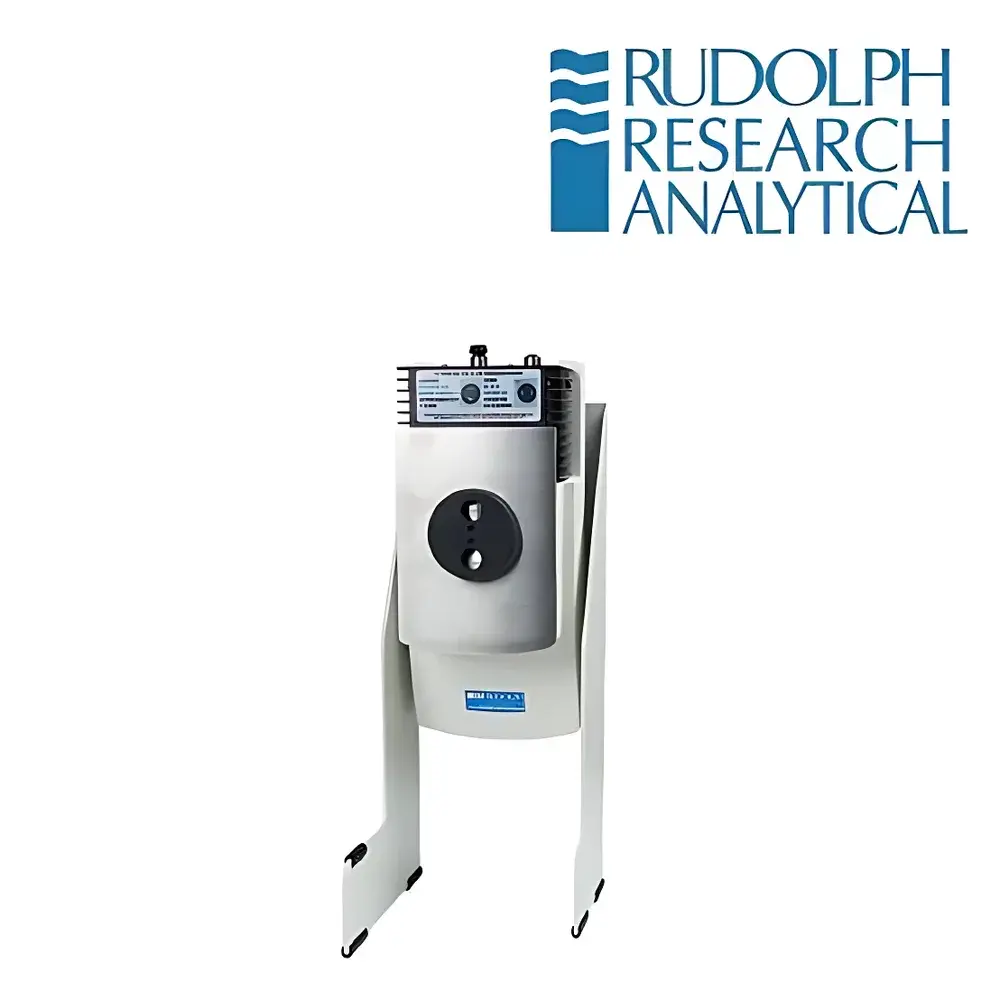
Rudolph J-Series Refractometer Module
| Brand | Rudolph |
|---|---|
| Origin | USA |
| Model | J-Series Refractometer Module |
| Product Type | Benchtop Refractometer |
| Temperature Control | Yes (Dual-zone semiconductor Peltier) |
| Digital Display | Yes (10.4" color TFT touchscreen) |
| Measurement Range | 1.26–1.72 RI, 0–100 Brix |
| Measurement Resolution | 0.00001 RI |
| Accuracy | ±0.00002 RI, ±0.015 Brix |
| Temperature Control Range | 10–110 °C (120 °C optional) |
| Temperature Stability | ±0.01 °C |
| Prism Material | Sapphire |
| Interface | RS-232, USB, Cat5 Ethernet |
| Compliance | NIST-traceable calibration standards available |
| Design | Modular split architecture (separate measurement head and control unit) |
Overview
The Rudolph J-Series Refractometer Module is a high-precision benchtop refractometer engineered for rigorous laboratory and industrial quality control applications requiring traceable, temperature-stabilized refractive index (RI) and Brix measurements. It operates on the principle of total internal reflection at the sample-prism interface, where the critical angle of incidence is optically detected via high-resolution CCD imaging and converted into RI using Snell’s law. The instrument’s optical path incorporates a sapphire prism—rated Mohs 9 hardness—ensuring long-term dimensional stability, chemical inertness, and resistance to abrasion or solvent degradation. Unlike conventional single-zone thermostatted refractometers, the J-Series employs dual independent Peltier elements to actively regulate both the sample chamber floor and the upper sample cover, eliminating thermal gradients across the measurement interface and enabling reproducible results under dynamic ambient conditions.
Key Features
- Dual-zone semiconductor temperature control with ±0.01 °C stability over 10–110 °C (120 °C optional), ensuring minimal thermal drift during extended measurement sequences.
- Sapphire prism assembly with integrated cleaning status monitoring—optical surface contamination is automatically assessed prior to measurement initiation.
- Smart Measure™ algorithm that evaluates sample homogeneity, meniscus formation, and prism contact integrity in real time; alerts users via on-screen icon and audible tone if suboptimal loading is detected.
- Modular split architecture: the compact, IP54-rated measurement head can be installed remotely (up to 30 m via Cat5 cable), while the 10.4-inch capacitive touchscreen control unit remains in a controlled lab environment—no external PC required.
- Full-range RI measurement capability from 1.26 to 1.72 and Brix from 0 to 100%, supporting diverse matrices including viscous polymers, high-sugar syrups, organic solvents, and high-refractive-index specialty fluids.
- Onboard data storage with timestamped audit trails, user access levels, and export-ready CSV/Excel-compatible output via USB or network interface.
Sample Compatibility & Compliance
The J-Series accommodates liquid, semi-liquid, and low-viscosity paste samples (up to ~5,000 cP) without dilution or filtration. Its wide RI range enables direct analysis of silicone oils, epoxy resins, fluorinated solvents, and pharmaceutical excipients—materials often outside the scope of standard Abbe refractometers. Temperature-controlled sample handling complies with ASTM D1218, ISO 287, and USP , and supports GLP/GMP workflows through configurable electronic signatures, 21 CFR Part 11–compliant audit logs (when paired with validated software), and NIST-traceable calibration verification using certified reference standards supplied by Rudolph Research Analytical.
Software & Data Management
The embedded operating system provides intuitive touchscreen navigation, multi-language support (English, German, Japanese, Chinese), and built-in method templates for routine QC testing. All measurements are automatically tagged with operator ID, method name, temperature setpoint, and environmental timestamp. Data export supports RS-232 serial transmission to LIMS, USB mass storage, or TCP/IP network transfer to centralized databases. Optional PC-based software (Rudolph WinRef) adds advanced statistical process control (SPC), trend analysis, report generation per ISO/IEC 17025 requirements, and integration with enterprise MES systems via OPC UA.
Applications
- Pharmaceutical manufacturing: concentration verification of active pharmaceutical ingredients (APIs) in syrups, ointments, and injectables; excipient identity testing.
- Food & beverage QA/QC: Brix quantification in fruit juices, concentrates, dairy products, and confectionery syrups—validated against AOAC 932.12 and ICUMSA methods.
- Chemical R&D: real-time monitoring of polymerization reactions, solvent blending ratios, and formulation stability studies.
- Petroleum & lubricants: hydrocarbon mixture characterization, additive concentration tracking, and base oil classification per ASTM D1152 and D1218.
- Academic research: optical property correlation studies, thermodynamic modeling of binary/ternary solutions, and interfacial behavior investigations.
FAQ
Does the J-Series require external calibration hardware?
No—NIST-traceable calibration verification is performed using factory-supplied certified standard fluids (e.g., water, sucrose solutions, and proprietary high-RI standards); no third-party calibrators are necessary for routine operation.
Can the measurement head operate in hazardous environments?
The detection unit carries an IP54 rating and is rated for non-classified industrial spaces; it is not intrinsically safe or explosion-proof, and should not be deployed in Zone 1/21 or ATEX-regulated areas without additional enclosure certification.
Is temperature ramping supported?
Yes—the instrument supports programmable temperature ramps (e.g., 20 → 60 °C at 1 °C/min) with dwell stabilization at each setpoint, enabling temperature-dependent RI profiling per ISO 1042.
How is cleaning validation documented?
The Smart Measure™ system logs prism cleanliness status (pass/fail) alongside each measurement event; this metadata is included in exported reports and audit trails for regulatory review.
What is the typical warm-up time to achieve thermal equilibrium?
Less than 15 minutes from ambient to 25 °C; full thermal stabilization across the dual-zone system (±0.01 °C) is achieved within 25 minutes at extreme setpoints (e.g., 110 °C).




