
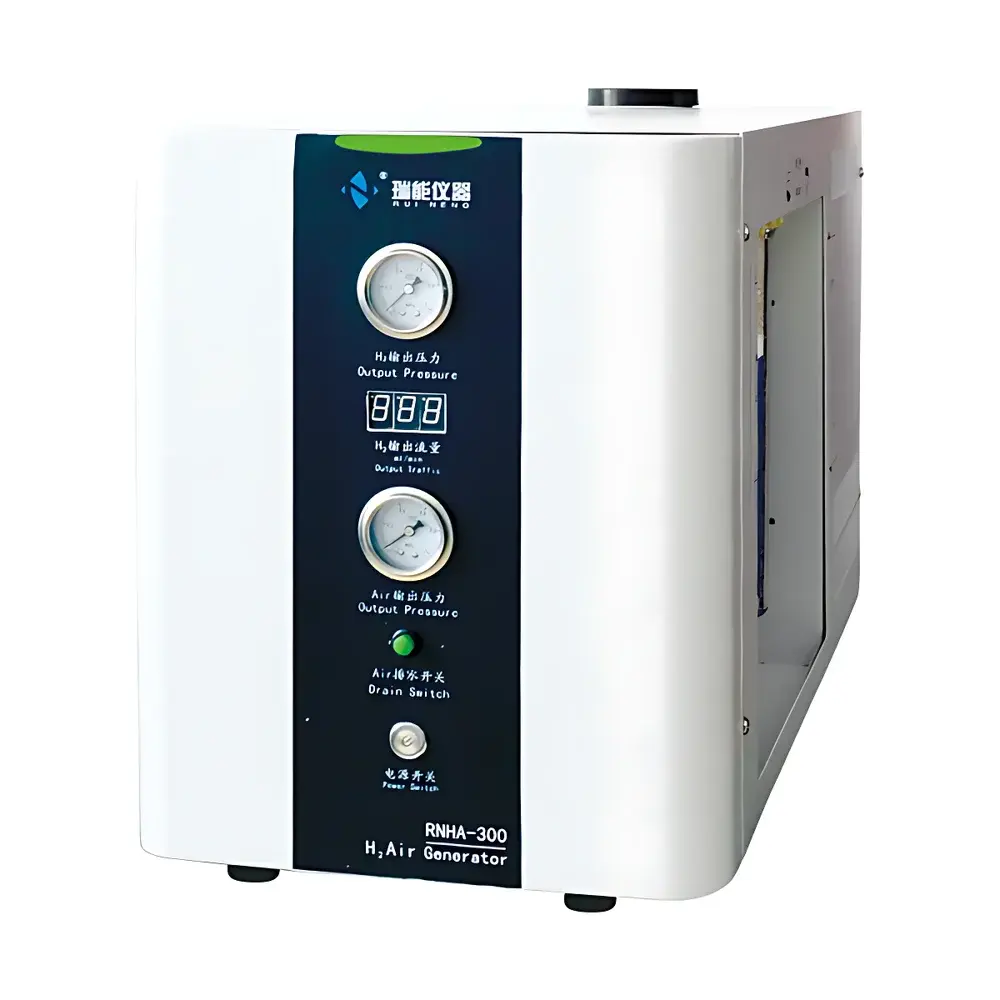
Ruinen Instrument RNHA-300 Hydrogen-Air Integrated Gas Generator
| Brand | Ruinen Instrument |
|---|---|
| Model | RNHA-300 |
| Output Flow | H₂ 0–300 mL/min, Air 0–3000 mL/min |
| Purity | H₂ >99.999% |
| Output Pressure | 0–0.4 MPa |
| Pressure Stability | <0.2% |
| H₂ Reservoir Volume | 3 L |
| Feed Water Resistivity | ≥1 MΩ·cm |
| Air Noise Level | <35 dB(A) |
| Power Supply | 220 V ±10%, 50–60 Hz |
| Operating Temperature | 0–40 °C |
| Operating Humidity | <85% RH |
Overview
The Ruinen Instrument RNHA-300 Hydrogen-Air Integrated Gas Generator is an engineered solution for laboratories requiring stable, on-demand supplies of high-purity hydrogen and instrument-grade air—primarily for gas chromatography (GC), GC–mass spectrometry (GC–MS), flame ionization detection (FID), thermal conductivity detection (TCD), and other analytical techniques demanding consistent carrier and combustion gases. Unlike cylinder-based systems, the RNHA-300 eliminates logistical constraints, safety hazards associated with high-pressure gas storage, and variability in gas quality across supply batches. It operates on the principle of proton exchange membrane (PEM) electrolysis for hydrogen generation and integrated low-pressure compression with multi-stage filtration for air production. The system delivers continuous, regulated flow without manual intervention, supporting unattended operation over extended periods—ideal for automated labs, 24/7 monitoring setups, and regulated environments where traceability and reproducibility are critical.
Key Features
- Integrated dual-gas architecture: Simultaneous, independent control of hydrogen and air output flows via precision mass flow controllers (MFCs), enabling synchronized optimization for detector-specific requirements.
- Electrolytic hydrogen generation using a PEM cell stack with platinum-coated titanium electrodes—ensuring rapid start-up, minimal maintenance, and intrinsic oxygen separation without external scrubbers.
- Stainless steel hydrogen reservoir (3 L capacity) with electropolished interior surface and ultrasonic passivation treatment to minimize metallic leaching and maintain long-term gas purity (>99.999% H₂).
- Low-noise, oil-free diaphragm air compressor (rated <35 dB[A] at 1 m distance) coupled with coalescing, activated carbon, and desiccant filtration stages to deliver particle-free, hydrocarbon- and moisture-controlled air (dew point ≤ −40 °C).
- Fail-safe pressure regulation: Dual-stage pressure-reducing valves and low-voltage solenoid valves ensure stable delivery across the full 0–0.4 MPa range, with real-time pressure feedback and automatic cut-off below 0.1 MPa or above 0.42 MPa.
- Intelligent power management: Adaptive load balancing between H₂ and air subsystems; auto-shutdown during prolonged idle states; built-in thermal protection and overcurrent safeguards compliant with IEC 61010-1.
Sample Compatibility & Compliance
The RNHA-300 is compatible with all major GC and GC–MS platforms requiring hydrogen as carrier or fuel gas and clean, dry air as oxidant for FID, NPD, or PFPD detectors. Its gas specifications meet or exceed ASTM D4057 (standard practice for manual sampling of petroleum and petroleum products), ISO 8573-1:2010 Class 2:2:2 for compressed air purity, and USP <642> requirements for pharmaceutical-grade process gases. The system supports GLP and GMP workflows through configurable event logging, user-accessible audit trails (with timestamped records of pressure, flow, temperature, and runtime), and optional integration with laboratory information management systems (LIMS) via RS-232 or Modbus RTU protocols. No external cooling or ventilation ducting is required—its compact footprint (W × D × H: 360 × 320 × 520 mm) and low heat dissipation (<120 W) allow benchtop deployment in standard analytical laboratories.
Software & Data Management
The RNHA-300 includes an embedded microcontroller-based interface with a backlit LCD display and tactile keypad for local parameter adjustment (e.g., target H₂ flow, air pressure setpoint, auto-purge interval). All operational data—including cumulative runtime, total H₂ generated (L), number of electrolyzer cycles, filter service alerts, and fault codes—are stored in non-volatile memory. Optional PC software (Windows/macOS compatible) enables remote monitoring, scheduled calibration prompts, export of CSV-formatted logs, and generation of compliance-ready reports aligned with FDA 21 CFR Part 11 requirements (electronic signatures, audit trail integrity, and role-based access control). Firmware updates are performed via USB flash drive with cryptographic signature verification to ensure system integrity.
Applications
- Carrier gas supply for capillary GC columns operating at low-to-moderate linear velocities (e.g., 20–50 cm/s), especially in environmental analysis (EPA Method 8260/8270) and residual solvent testing (ICH Q2(R2)).
- Fuel gas for FID and TCD in routine QC labs performing polymer characterization, petrochemical profiling, or food flavor analysis.
- Combustion air source for nitrogen-phosphorus detectors (NPD) and pulsed flame photometric detectors (PFPD), where hydrocarbon-free air prevents baseline drift and detector fouling.
- On-site hydrogen supply for portable GC systems deployed in field laboratories, mobile environmental monitoring units, or forensic evidence collection vans.
- Backup or primary gas source in regulated pharmaceutical manufacturing facilities where cylinder dependency introduces supply-chain risk and documentation overhead.
FAQ
What is the expected service life of the PEM electrolyzer stack?
Under normal operating conditions (≤300 mL/min H₂ output, ambient temperature <35 °C), the stack is rated for ≥15,000 hours of operation, equivalent to ~5 years of continuous 24/7 use.
Can the RNHA-300 be connected to multiple instruments simultaneously?
Yes—via appropriately sized stainless steel tubing and calibrated manifold distribution panels. Total combined demand must remain within the specified maximum flow rates (H₂ ≤300 mL/min, Air ≤3000 mL/min) and pressure limits (≤0.4 MPa).
Is deionized water sufficient for feedwater, or is additional purification required?
Feedwater must meet resistivity ≥1 MΩ·cm (equivalent to Type II water per ISO 3696); standard lab-grade deionized water is acceptable, but reverse-osmosis pretreatment is recommended if feedwater conductivity exceeds 1 µS/cm.
Does the unit require periodic calibration?
No routine calibration is needed—the MFCs are factory-trimmed and thermally compensated. Annual verification using NIST-traceable flow meters is recommended for ISO/IEC 17025-accredited labs.
How does the system handle power interruptions?
Upon power loss, the unit shuts down gracefully; internal capacitors maintain valve closure and purge residual pressure. Restart requires manual reset via front-panel keypress to prevent unintended gas release.



