Ruipho RZJ-304 Positive Photoresist for Mask & Reticle Fabrication
| Brand | Ruipho |
|---|---|
| Origin | Jiangsu, China |
| Manufacturer Type | Authorized Distributor |
| Product Origin | Domestic (China) |
| Model | RZJ-304 |
| Viscosity Options | 25 mPa·s |
| Recommended Developer | RZX-3038 |
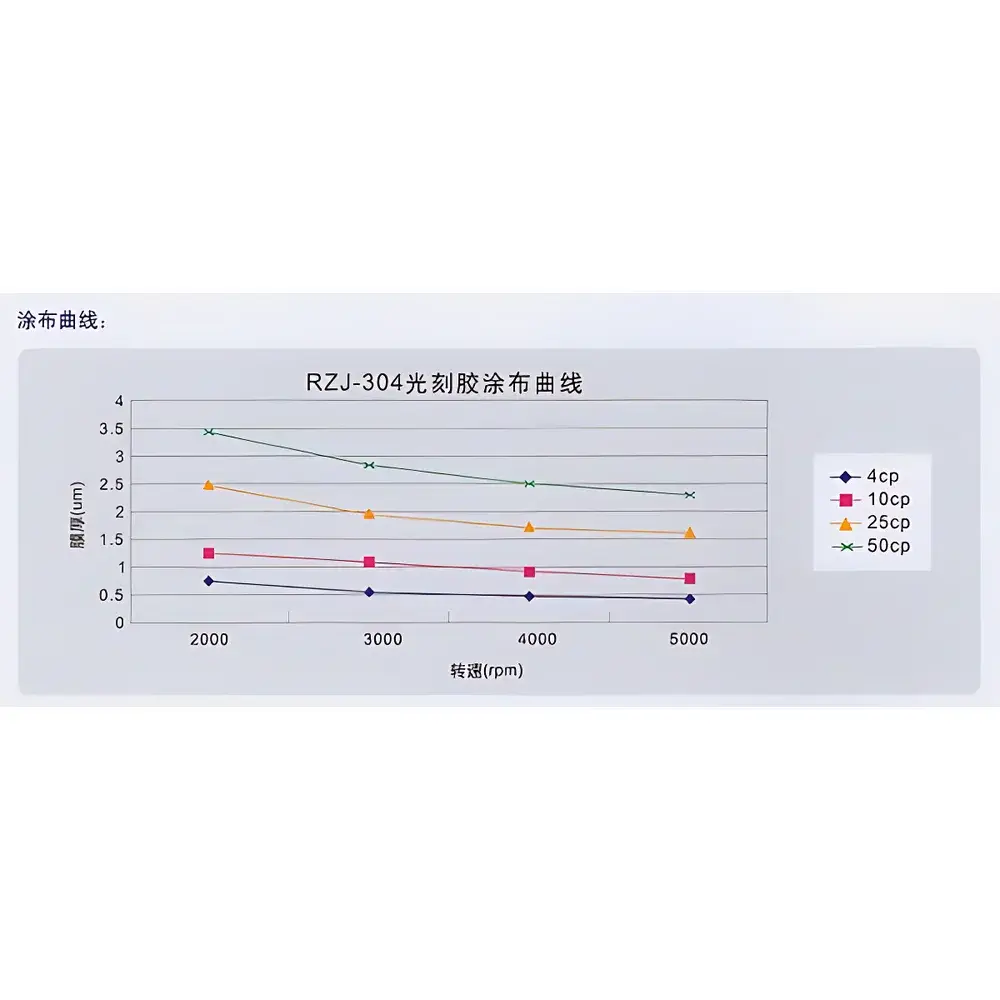
| Film Thickness Range (Spin-Coated) | 1.0–3.5 µm |
| Prebake | 100°C for 90 s |
| Exposure Dose | 50–75 mJ/cm² |
| Development | RZX-3038 at 23°C for 60 s |
| Post-Exposure Bake | 120°C for 120 s |
Overview
Ruipho RZJ-304 is a high-purity, solvent-based positive photoresist engineered specifically for mask and reticle manufacturing in semiconductor photomask fabrication facilities. Formulated using established diazonaphthoquinone (DNQ) chemistry, it operates on the standard DNQ-novolac mechanism: upon UV exposure (i-line, 365 nm), the DNQ inhibitor decomposes to generate carboxylic acid, increasing the solubility of the exposed regions in alkaline developer. This enables high-fidelity transfer of sub-micron chrome-on-quartz patterns from photomasks onto wafer-level substrates during lithography process validation and mask qualification. The resist exhibits inherent compatibility with quartz and low-thermal-expansion glass (LTEM) substrates—standard materials for high-precision photomasks—and maintains dimensional stability under vacuum and electron-beam inspection conditions common in mask shop metrology workflows.
Key Features
- High-resolution patterning capability: Designed for critical dimension (CD) control down to ≤0.5 µm on mask blanks, supporting advanced node photomask requirements (e.g., 28 nm logic and beyond).
- Controlled viscosity options: Available in two rheological grades (25 mPa·s and 50 mPa·s) to support both thin-film (<1.5 µm) and thick-film (≥2.5 µm) applications—enabling flexibility across binary mask, phase-shift mask (PSM), and OPC test mask fabrication.
- Robust adhesion to quartz and fused silica substrates: Demonstrated interfacial shear strength >12 MPa after post-exposure bake, minimizing pattern lift-off or edge peeling during aggressive wet etch steps (e.g., Cr etching with Ce(NH₄)₂(NO₃)₆/HNO₃ mixtures).
- Thermal and chemical stability: Exhibits <0.3% film shrinkage after PEB at 120°C and shows no detectable outgassing (<10⁻⁹ Torr·L/s·cm²) under vacuum—critical for electron-beam metrology and defect review tool compatibility.
- Process window robustness: Maintains CD uniformity (3σ ≤ ±1.8 nm) across exposure dose variations of ±15% and development time deviations of ±10 s—reducing sensitivity to tool drift in high-mix mask production environments.
Sample Compatibility & Compliance
RZJ-304 is validated for use on standard photomask substrates including synthetic quartz (SiO₂, OH-content <1 ppm), low-thermal-expansion glass (e.g., ULE®, Clearceram®), and chromium-coated blanks with anti-reflective layers (e.g., CrOₓ). It complies with SEMI Standard F22-0202 for photoresist purity (metal ion contamination <10¹⁰ atoms/cm² for Na, K, Fe, Ni, Cu) and meets ISO 14644-1 Class 5 cleanroom handling requirements when dispensed via nitrogen-purged syringe systems. While not certified to FDA 21 CFR Part 11, its formulation documentation supports full traceability per ISO 9001:2015 quality management systems and aligns with internal mask shop GLP audit protocols for process requalification.
Software & Data Management
As a material—not an instrument—RZJ-304 does not include embedded firmware or software interfaces. However, its process parameters are fully integrable into industry-standard lithography recipe management platforms, including ASML LithoTwin™, IMS Nanofabrication’s eBeam Suite, and PDF Solutions’ Exensio® Mask Analytics. Process logs (spin speed, bake temperature, exposure dose, development time) can be exported in CSV or SECS/GEM format for SPC analysis and cross-tool correlation studies. Batch-specific lot data—including viscosity certification, GC-MS residual solvent reports, and metal impurity certificates—is provided in PDF and XML formats compliant with SEMI E142 (Lot Traceability).
Applications
- Photomask fabrication for i-line (365 nm) and g-line (436 nm) lithography tools used in legacy and analog IC production.
- Reticle qualification and repair verification in mask shops performing e-beam inspection (EBI) and focused ion beam (FIB) repair.
- Optical proximity correction (OPC) test mask development requiring stable sidewall profiles and minimal line-edge roughness (LER <4.2 nm RMS).
- Phase-shift mask (PSM) blank patterning where high contrast ratio (>8.5) and low standing-wave effect are essential.
- Mask metrology reference standards for CD-SEM calibration and aerial image measurement system (AIMS®) validation.
FAQ
Is RZJ-304 compatible with deep-UV (248 nm) exposure tools?
No. RZJ-304 is formulated for near-UV (i-line/g-line) transparency and lacks the chromophore structure required for 248 nm absorption; it is not recommended for KrF stepper applications.
What is the shelf life and storage requirement?
Unopened bottles retain specification compliance for 12 months when stored at 2–8°C under inert nitrogen atmosphere; avoid freeze-thaw cycles and direct light exposure.
Can RZJ-304 be used for wafer-level lithography?
It is optimized for mask substrates and not qualified for direct wafer processing due to insufficient plasma etch resistance and lack of wafer-specific adhesion promoters.
Does Ruipho provide lot-to-lot consistency data?
Yes. Each production lot includes a Certificate of Analysis (CoA) documenting viscosity, solids content, residue on silicon wafer (ROS), and metal impurity screening by ICP-MS.
Is RZX-3038 developer available in bulk quantities with traceable lot documentation?
Yes. Bulk RZX-3038 (20 L HDPE carboys) is supplied with full SDS, CoA, and batch-specific conductivity/pH logs aligned with SEMI C37 specifications.