
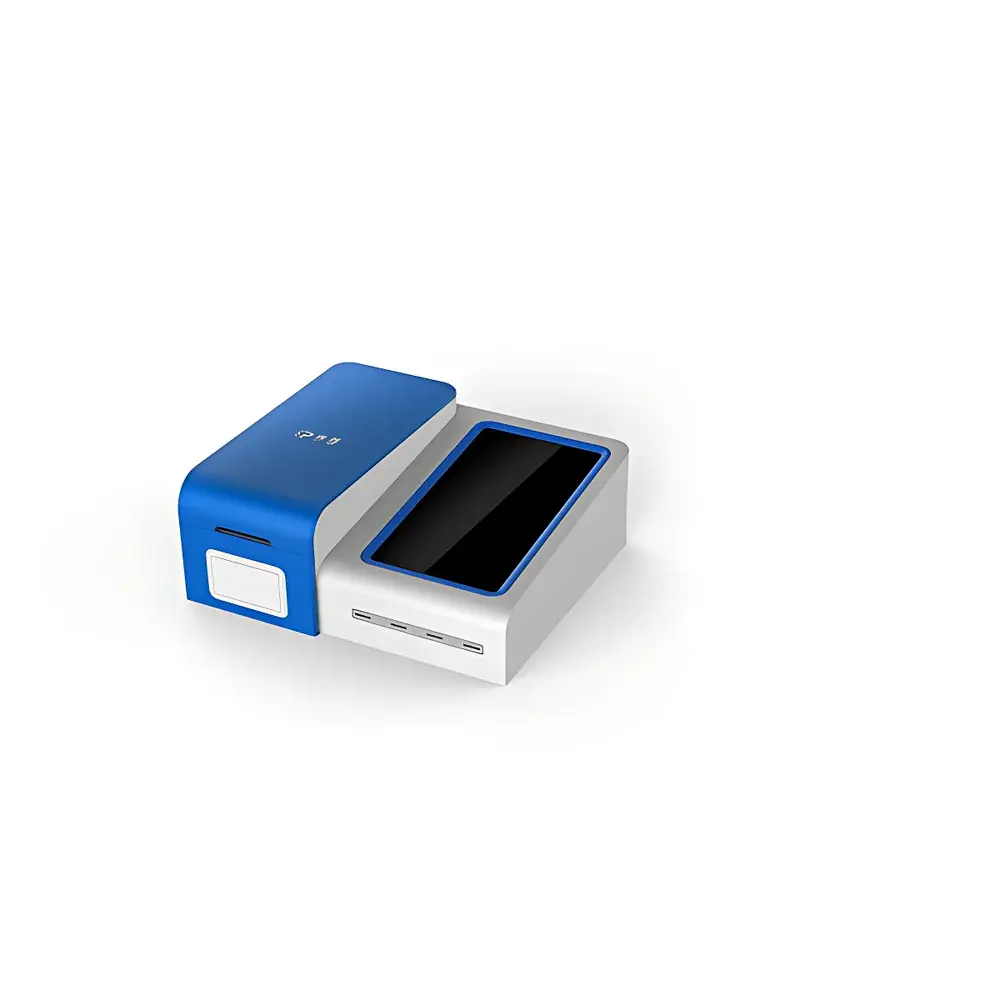
Ruixin CNY-1218LS Food Safety Rapid Detection System
| Brand | Ruixin |
|---|---|
| Origin | Shanghai, China |
| Manufacturer Type | Authorized Distributor |
| Country of Manufacture | China |
| Model | CNY-1218LS |
| Function Type | Multi-analyte (Pesticide Residues, Mycotoxins, Heavy Metals) |
| Sample Compatibility | Universal for Grains and Cereals |
| Wavelength Range | 380–680 nm |
| Detection Time | ≤3 min per assay |
| Photometric Repeatability | ≤0.2% T |
| Absorbance Repeatability | ≤0.3% |
| Optical Channels | 12 photometric + 3 colloidal gold (expandable to 10) |
| Display | 10.1″ TFT-LCD, 1024×600, IP65-rated front panel |
| Operating System | Android 7.0 (Quad-core, 1.8 GHz, 2 GB RAM, 16 GB storage) |
| Data Connectivity | Wi-Fi, RJ45 Ethernet, optional 3G/4G/5G module |
| Power Supply | AC 220 V ±10% |
Overview
The Ruixin CNY-1218LS Food Safety Rapid Detection System is an integrated analytical platform engineered for regulatory-compliant screening of chemical contaminants in cereal grains and processed grain commodities. It combines dual optical detection modalities—UV-Vis spectrophotometry (380–680 nm) and lateral-flow colloidal gold immunoassay quantification—within a single, field-deployable instrument. Designed for use in grain receiving laboratories, port quarantine facilities, and regional food safety monitoring centers, the system enables quantitative or semi-quantitative determination of three critical hazard classes: organophosphate and carbamate pesticides (e.g., chlorpyrifos, carbofuran), mycotoxins (aflatoxin B₁, deoxynivalenol, zearalenone, ochratoxin A, T-2 toxin), and heavy metals (Pb, Cd) via derivatized colorimetric assays. Its architecture adheres to the functional principles outlined in ISO 17025 for method validation readiness and supports traceability frameworks aligned with Codex Alimentarius guidelines for maximum residue limits (MRLs) and action levels.
Key Features
- Dual-mode detection engine: Simultaneous operation of 12-channel photometric absorbance measurement and 3-channel colloidal gold strip reader (expandable to 10), enabling parallel analysis of multiple analytes from a single sample extract.
- Industrial-grade human-machine interface: 10.1-inch capacitive touch display (1024×600 resolution, 400 cd/m² brightness) with IP65-rated front panel, supporting glove-compatible operation and handwritten digital signature capture for audit-ready reporting.
- Embedded Android 7.0 OS (Quad-core 1.8 GHz CPU, 2 GB RAM, 16 GB eMMC) ensures deterministic response latency and secure local data persistence; firmware supports over-the-air (OTA) updates compliant with IEC 62443-3-3 security baseline requirements.
- Integrated thermal label printer and high-speed thermal report printer support dual-output documentation: adhesive “Compliance Certificate” labels (per GB/T 31599–2015) and A4-format PDF export via USB or network.
- Built-in reference database containing >1,000 standardized grain and contaminant names (aligned with FAO/INFOODS nomenclature), enabling rapid sample metadata entry and cross-referencing against national MRL tables.
- Multi-protocol connectivity stack: IEEE 802.11 b/g/n Wi-Fi, 10/100 Mbps Ethernet (RJ45), Bluetooth 4.2, and optional LTE/5G modem integration for real-time synchronization with central LIMS or provincial food safety surveillance platforms.
Sample Compatibility & Compliance
The CNY-1218LS is validated for homogenized, solvent-extracted samples of paddy rice, wheat, maize, barley, sorghum, and soybean meal. Sample preparation follows AOAC Official Method 2007.01 (for organophosphates), AOAC 2012.01 (for aflatoxins), and GB 5009.12–2023 / GB 5009.15–2023 (for Pb/Cd). All optical measurements conform to the photometric accuracy specifications defined in ISO 7027 for turbidity and ISO 6059 for absorbance linearity. The system’s data management architecture supports ALCOA+ principles (Attributable, Legible, Contemporaneous, Original, Accurate, Complete, Consistent, Enduring, Available) and facilitates 21 CFR Part 11–compliant electronic records when deployed with time-stamped digital signatures and role-based access control.
Software & Data Management
The embedded software suite provides full lifecycle data handling: sample registration → assay protocol selection → automated calibration → result calculation → statistical validation → report generation → encrypted cloud upload (via TLS 1.2). Audit trails record all user actions, parameter changes, and instrument events with immutable timestamps. Data exports comply with ASTM E1467–21 (Standard Guide for Electronic Records in Laboratory Information Systems) and support CSV, PDF/A-2, and HL7 v2.5 message formats for interoperability with national food safety information systems (e.g., China’s NIFDC Food Risk Monitoring Platform). Local storage retains ≥50,000 test records with automatic rollover and SHA-256 hash verification.
Applications
- Pre-harvest and post-harvest grain quality assurance at cooperatives and elevators
- Import/export phytosanitary clearance at customs laboratories
- Routine surveillance testing under national food safety risk monitoring programs (e.g., China’s National Food Safety Risk Assessment Program)
- On-site verification during Good Agricultural Practice (GAP) and HACCP audits
- Reference laboratory triage prior to confirmatory LC-MS/MS or ICP-MS analysis
FAQ
Does the CNY-1218LS meet international regulatory acceptance criteria for screening?
Yes—the photometric module complies with ISO 7027 and ISO 6059; immunoassay performance aligns with AOAC Performance Tested Methods (PTM) validation benchmarks for qualitative/semi-quantitative screening. Quantitative results are intended for presumptive assessment per EU Commission Regulation (EU) No 519/2013 Annex II.
Can assay protocols be customized for non-standard analytes?
User-defined methods may be imported via USB using XML-based assay definition files compliant with CLSI EP25-A2; however, validation responsibility rests with the end-user laboratory per ISO/IEC 17025 Clause 7.2.2.
Is remote firmware update supported without physical access?
Yes—secure OTA updates are enabled via HTTPS-managed package deployment with cryptographic signature verification and rollback capability.
What is the calibration frequency requirement?
Factory-calibrated optical path; recommended verification with NIST-traceable neutral density filters every 90 days or after 500 measurements, per internal SOP-INST-017.
How is data integrity ensured during network transmission?
All cloud-synchronized data packets are encrypted end-to-end using AES-256-GCM; certificate pinning prevents man-in-the-middle interception.





