
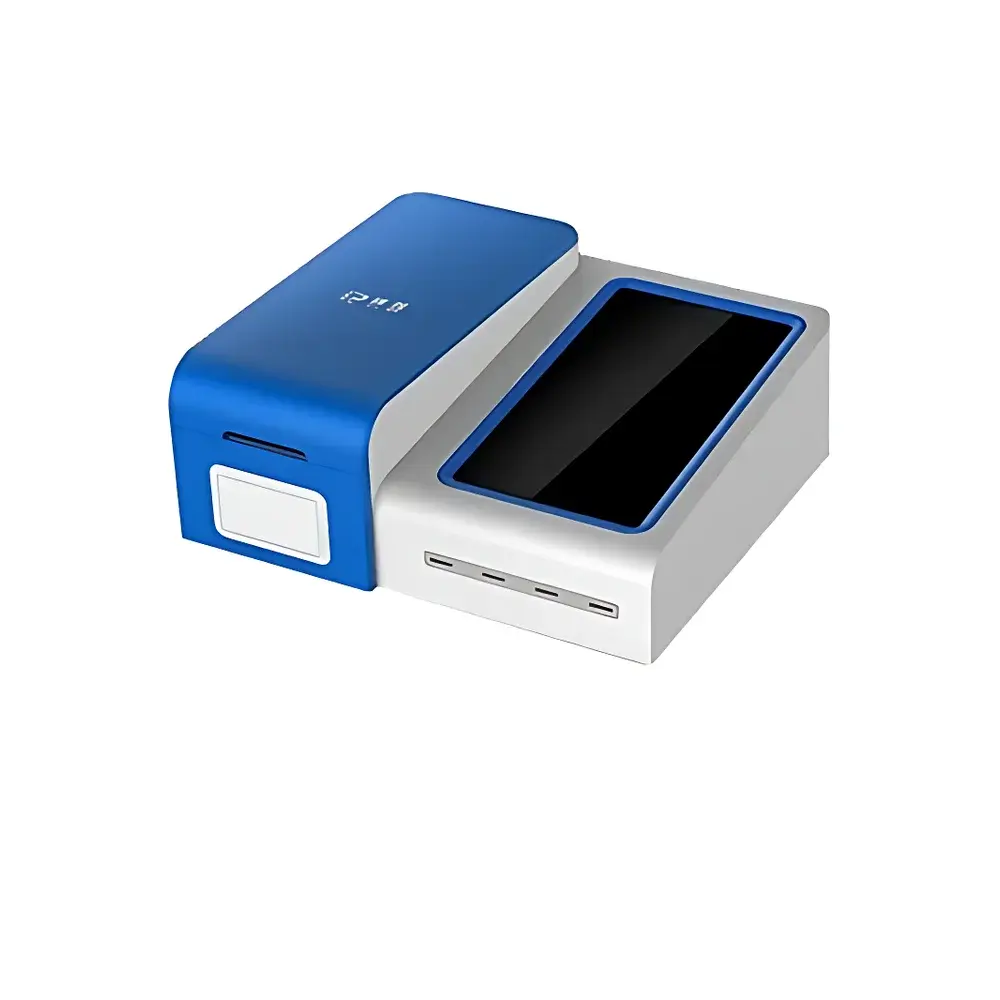
Ruixin CNY-1218ZY Multi-Parameter Traditional Chinese Medicine (TCM) Safety Analyzer
| Brand | Ruixin |
|---|---|
| Origin | Shanghai, China |
| Model | CNY-1218ZY |
| Wavelength Range | 380–680 nm |
| Detection Time | ≤3 min |
| Repeatability | ≤0.2% (T) |
| Optical Channels | 12 (spectrophotometric) + 3 (colloidal gold, expandable to 10) |
| Absorbance Range | 0.000–4.000 A |
| Transmittance Range | 0.00–100.00% T |
| Transmittance Resolution | 0.01% T |
| Absorbance Resolution | 0.001 A |
| Photometric Accuracy | ±2.0% T |
| Photocurrent Drift | ≤0.2% (3 min) |
| Measurement Accuracy | ±5% |
| Display | 10.1-inch Android touchscreen |
| Connectivity | Dual USB, Wi-Fi, RJ45, optional 3G/4G/5G |
| Power Supply | 220 V ±10% AC |
Overview
The Ruixin CNY-1218ZY Multi-Parameter Traditional Chinese Medicine (TCM) Safety Analyzer is an integrated, field-deployable analytical platform engineered for regulatory-grade screening of high-risk contaminants in herbal medicinal materials. It combines dual optical detection modalities—UV-Vis spectrophotometry and lateral-flow colloidal gold immunochromatography—within a single ruggedized Android-based instrument. The system operates on the principle of quantitative absorbance measurement (based on Beer–Lambert law) for enzyme inhibition assays (e.g., acetylcholinesterase inhibition for organophosphates and carbamates) and competitive immunoassay signal intensity quantification for mycotoxins, heavy metals, and sulfite residues. Designed for compliance with national and international food and herbal product safety frameworks—including China’s GB 2763–2021 (Maximum Residue Limits), GB 5009 series (food safety testing standards), and aligned with ISO/IEC 17025 method validation principles—the CNY-1218ZY delivers trace-level detection without laboratory infrastructure dependency.
Key Features
- Dual-mode detection architecture: 12-channel photometric module (380–680 nm) for multi-analyte colorimetric assays; 3 independent colloidal gold reader channels (expandable to 10) for rapid immunochromatographic strip quantification.
- Regulatory-ready performance: ≤0.2% transmittance repeatability and ±2.0% photometric accuracy ensure data integrity across batch testing and inter-laboratory comparison.
- Field-operational design: Integrated 10.1-inch capacitive touchscreen with Android OS, built-in thermal printer, rechargeable Li-ion battery, and dual-network connectivity (Wi-Fi + Ethernet; optional 4G/5G + GPS) support mobile inspection, market surveillance, and farm-to-market traceability workflows.
- On-device intelligence: Preloaded database of >100 standardized TCM botanical names with pinyin-based fuzzy search; embedded video-guided operation tutorials and audio feedback via onboard speaker.
- Data governance infrastructure: Real-time encrypted upload to cloud platforms with timestamped audit trails, supporting GLP-aligned record retention and FDA 21 CFR Part 11–compatible electronic signatures (when deployed with certified middleware).
Sample Compatibility & Compliance
The CNY-1218ZY accepts homogenized aqueous extracts from dried or fresh TCM herbs, decoction pieces, and processed herbal powders. Sample preparation follows standardized extraction protocols per GB/T 5009.199, GB/T 5009.12, and GB/T 5009.22. Validated analytes include: organophosphates (e.g., chlorpyrifos, omethoate), carbamates (carbofuran, methomyl), pyrethroids (deltamethrin, cypermethrin), mycotoxins (aflatoxin B₁, deoxynivalenol, zearalenone), heavy metals (Pb, Cd), sulfur dioxide, and plant growth regulators (forchlorfenuron, 6-benzylaminopurine). All assay kits used with this platform are manufactured under ISO 13485-certified conditions and comply with CNAS-CL01:2018 requirements for in vitro diagnostic device performance verification.
Software & Data Management
The embedded Android application provides role-based access control, customizable test templates, and automated calibration logging. Raw absorbance and strip-intensity values are stored with metadata (operator ID, GPS coordinates, sample ID, reagent lot, ambient temperature/humidity). Export formats include CSV, PDF reports (with QR-coded traceability links), and HL7-compliant JSON for integration into regional food safety information systems (e.g., China’s National Food Safety Risk Monitoring Platform). Audit logs capture all user actions—including result edits—with immutable timestamps, satisfying GMP/GLP documentation requirements for quality assurance departments and third-party auditors.
Applications
- Rapid pre-screening of TCM raw materials at procurement checkpoints and GMP-certified processing facilities.
- On-site enforcement testing by provincial drug administration and market regulation bureaus during routine inspections.
- Quality control in hospital pharmacy departments performing incoming herb verification prior to decoction.
- Research applications in ethnopharmacology labs assessing contamination prevalence across geographic sourcing regions.
- Integration into smart agriculture ecosystems for real-time risk mapping and supplier performance benchmarking.
FAQ
Does the CNY-1218ZY require external calibration standards for daily use?
No—built-in LED reference channels and auto-zeroing routines eliminate the need for daily solvent blanks; however, NIST-traceable calibration verification strips are recommended monthly.
Can test results be exported directly to LIMS or ERP systems?
Yes—via configurable API endpoints or scheduled SFTP transfers using standard XML/JSON schemas; custom middleware integration support is available upon request.
Is the colloidal gold module compatible with third-party rapid test kits?
It supports any lateral-flow strip with visible or nitrocellulose-based test/control lines; quantitative interpretation requires kit-specific calibration curves loaded via USB or cloud sync.
What is the operational lifetime of the optical system under continuous field use?
The solid-state LED光源 and CMOS sensor array are rated for ≥50,000 measurements with <±0.5% sensitivity drift over 24 months when operated within 10–35°C ambient range.
How does the system ensure data integrity during offline operation?
All measurements are locally timestamped and cryptographically hashed before local storage; synchronization resumes automatically upon network restoration, with conflict resolution logs maintained for audit review.





