
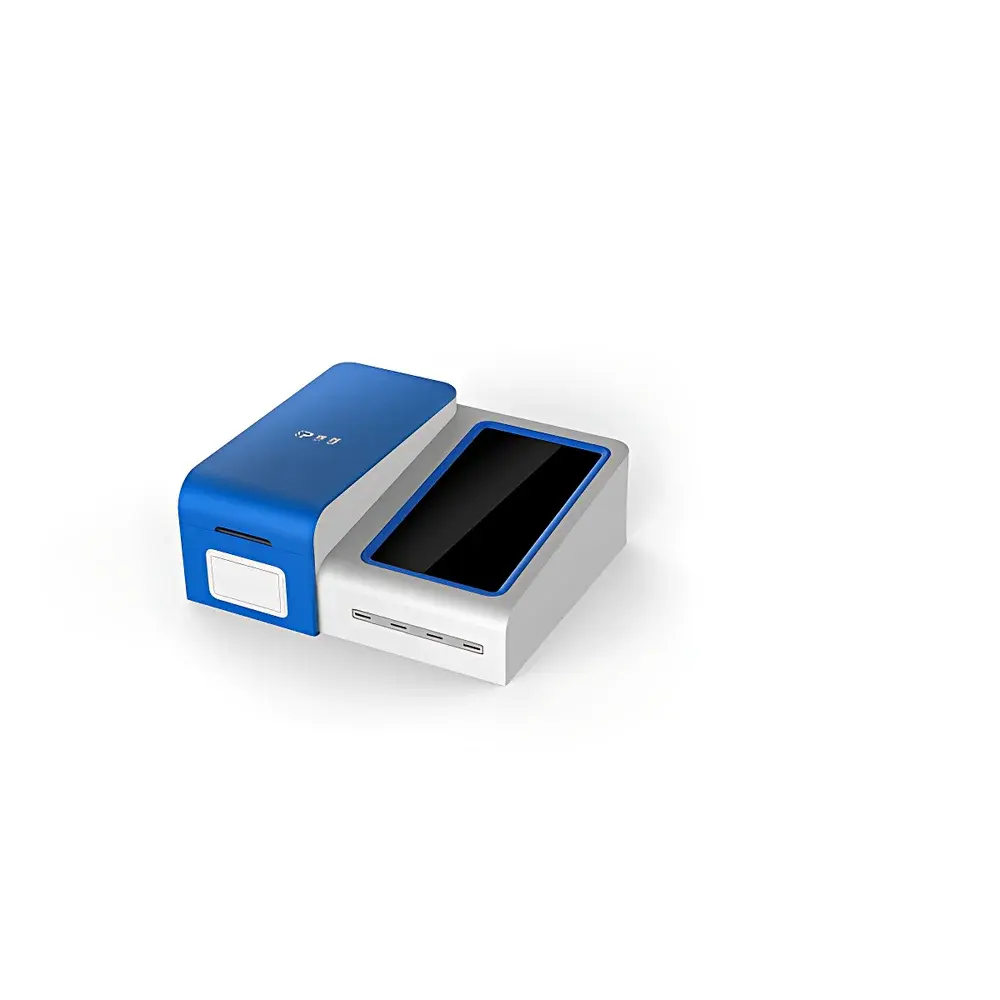
Ruixin CNY-1618NS Multi-Parameter Food Safety Rapid Detector
| Brand | Ruixin |
|---|---|
| Origin | Shanghai, China |
| Model | CNY-1618NS |
| Function Type | Multi-analyte (pesticide, veterinary drug, mycotoxin & heavy metal residues) |
| Sample Compatibility | Universal for agricultural commodities (fruits, vegetables, grains, tea, aquatic products, livestock tissues, eggs) |
| Wavelength Range | 400–680 nm |
| Detection Time | ≤10 min per sample |
| Repeatability (CV) | <5% |
| Optical Channels | 12 independent photometric channels |
| Absorbance Range | 0.000–4.000 A |
| Absorbance Resolution | 0.001 A |
| Transmittance Range | 0.00–100.00% T |
| Transmittance Resolution | 0.01% T |
| Photometric Accuracy (T) | ±2.0% |
| Photometric Repeatability (T) | ≤0.2% |
| Dark Current Drift | ≤0.2% (3 min) |
| Measurement Accuracy | ±5% |
| Integrated Lateral Flow Immunoassay (LFIA) Module | 3 strips |
| Display | 10.1-inch capacitive touchscreen (Android OS) |
| Data Connectivity | Wi-Fi, RJ45 Ethernet, optional 3G/4G/5G module |
| Storage | Internal high-capacity flash memory + dual USB ports |
| Database | Preloaded Chinese national standard sample library (>1,000 entries) with pinyin-based search |
Overview
The Ruixin CNY-1616NS Multi-Parameter Food Safety Rapid Detector is an integrated benchtop analytical platform engineered for regulatory compliance and field-deployable food safety screening in agricultural inspection agencies, market supervision bureaus, and centralized food distribution centers. It combines dual detection modalities—UV-Vis spectrophotometry (400–680 nm) and lateral flow immunoassay (LFIA) quantification—within a single compact instrument. The spectrophotometric module operates on the principle of Beer-Lambert law-based absorbance measurement, enabling quantitative analysis of enzymatic inhibition (e.g., acetylcholinesterase for organophosphates/carbamates) and colorimetric reactions (e.g., dithizone complexation for Pb/Cd). The LFIA module employs digital strip image acquisition and optical density calibration to quantify immunochromatographic signals for veterinary drugs and mycotoxins. This hybrid architecture eliminates the need for separate instruments for broad-spectrum residue screening, supporting harmonized workflows aligned with China’s GB standards and internationally referenced methodologies such as AOAC Official Methods and ISO 15726.
Key Features
- Integrated dual-mode detection: 12-channel photometric module + 3-channel digital LFIA reader for simultaneous multi-residue analysis
- 10.1-inch Android-powered capacitive touchscreen interface with intuitive icon-driven navigation and embedded video-guided operation tutorials
- Onboard thermal printer for immediate hard-copy reporting compliant with GLP documentation requirements
- Preloaded national reference database of >1,000 agricultural samples with pinyin-based rapid lookup and customizable ID tagging
- Dual USB ports and embedded connectivity suite (Wi-Fi, RJ45, optional cellular modem) enabling real-time cloud synchronization via secure HTTPS API endpoints
- Robust data integrity architecture: audit-trail enabled logging, timestamped result records, and cryptographic hash verification for data immutability
- Internal storage supports ≥50,000 test records; exportable via USB drive in CSV or PDF formats compatible with LIMS integration
Sample Compatibility & Compliance
The CNY-1618NS is validated for use across diverse food matrices including fresh produce (leafy greens, tomatoes, apples), cereal grains (rice, wheat, corn), processed teas, aquaculture samples (shrimp hepatopancreas, fish muscle), poultry tissues, and egg homogenates. Its assay protocols align with key regulatory frameworks: pesticide testing follows GB/T 5009.199 and GB 23200 series; heavy metal quantification complies with GB 5009.12 (Pb) and GB 5009.15 (Cd); veterinary drug detection adheres to GB/T 20763 (β-agonists), GB/T 21312 (nitrofurans), and GB/T 22973 (chloramphenicol). The system supports traceability through mandatory metadata capture—including operator ID, location GPS coordinates (when enabled), instrument serial number, and environmental temperature/humidity—and generates reports formatted for submission to provincial food safety monitoring platforms.
Software & Data Management
Built on Android 9.0 (custom firmware), the device runs Ruixin’s proprietary FoodTrace™ software, designed for operational continuity in low-connectivity environments. All measurements are automatically time-stamped and geotagged (if GNSS module active). Data encryption uses AES-256 at rest and TLS 1.2 in transit. Audit logs record every user action—including method selection, calibration events, and report generation—with immutable timestamps. Cloud synchronization supports both push-only and bidirectional sync modes, enabling centralized dashboard monitoring across multi-site deployments. Exported datasets include raw absorbance values, calculated inhibition rates, LFIA band intensity ratios, and pass/fail flags against configurable thresholds per analyte-matrix pair. Integration with third-party LIMS is supported via HL7 v2.x and RESTful JSON APIs.
Applications
- Routine surveillance testing in county-level agricultural product quality supervision stations
- On-site verification during farm-to-market inspections and wholesale market entry screening
- Pre-harvest residue clearance checks for export-certified growers
- Emergency response testing during foodborne outbreak investigations involving suspected contamination
- Contract laboratory support for GMP-compliant food processors requiring documented residue control plans
- Training and capacity building for rural extension technicians under national food safety literacy programs
FAQ
Does the CNY-1618NS comply with international food safety data integrity standards such as FDA 21 CFR Part 11?
The instrument meets core technical requirements for electronic records and signatures—including audit trail generation, user authentication, and data immutability—but is not formally certified under 21 CFR Part 11. Its architecture supports implementation of Part 11-aligned procedural controls when deployed within validated laboratory quality systems.
Can the device perform quantitative analysis without external calibration standards?
Yes—pre-programmed calibration curves for 86 priority analytes are embedded per GB and AOAC guidelines. Users may also load custom calibration files via USB for method validation or matrix-specific adjustments.
What is the maximum throughput for parallel sample processing?
The photometric module processes up to 12 samples simultaneously in a single run; the LFIA module accommodates three lateral flow strips concurrently. Total cycle time—including reagent addition, incubation, and reading—is ≤10 minutes per batch.
Is remote firmware update capability available?
Firmware updates are delivered via secure OTA (over-the-air) mechanism through Ruixin’s authorized cloud portal, requiring authenticated administrator credentials and SHA-256 signature verification prior to installation.
How is instrument performance verified between calibrations?
Built-in self-diagnostic routines execute at power-on and before each assay batch, verifying LED stability, detector linearity, and optical path cleanliness. Optional NIST-traceable neutral density filters enable periodic photometric verification per ISO/IEC 17025 requirements.
Related Products






