
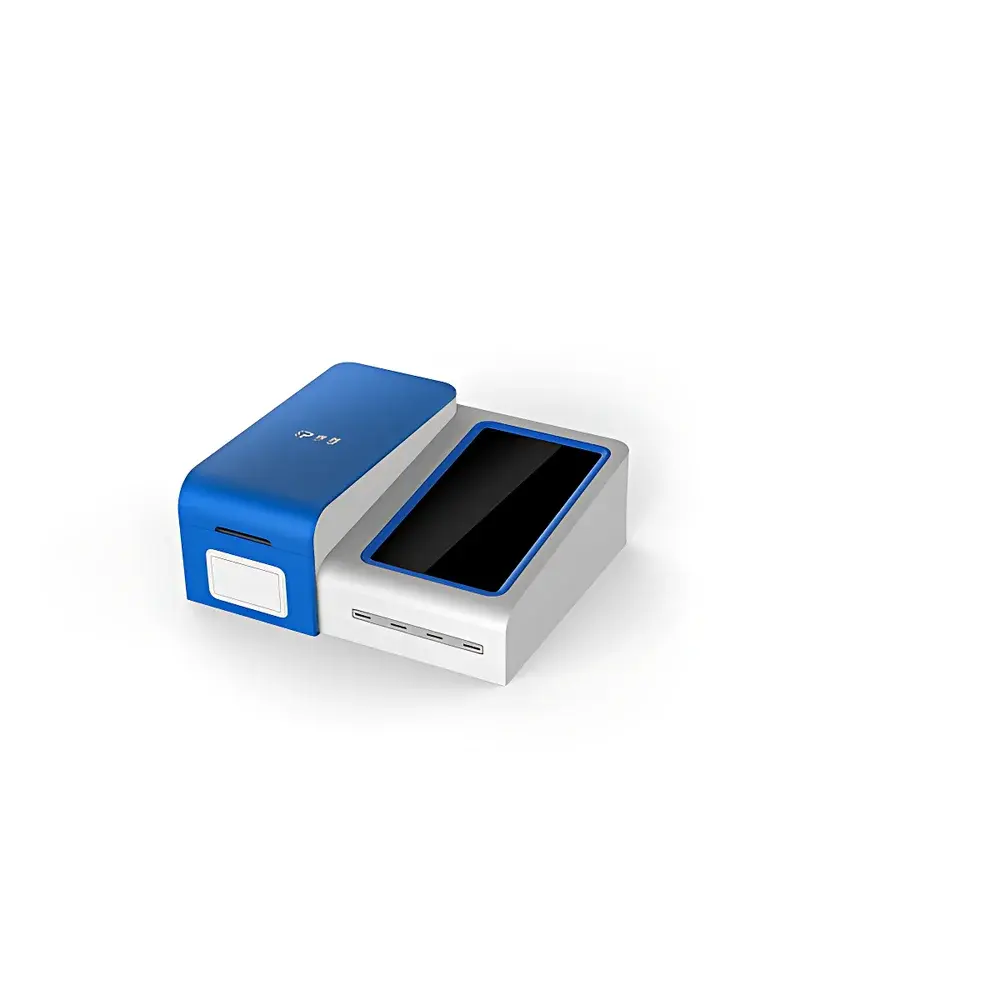
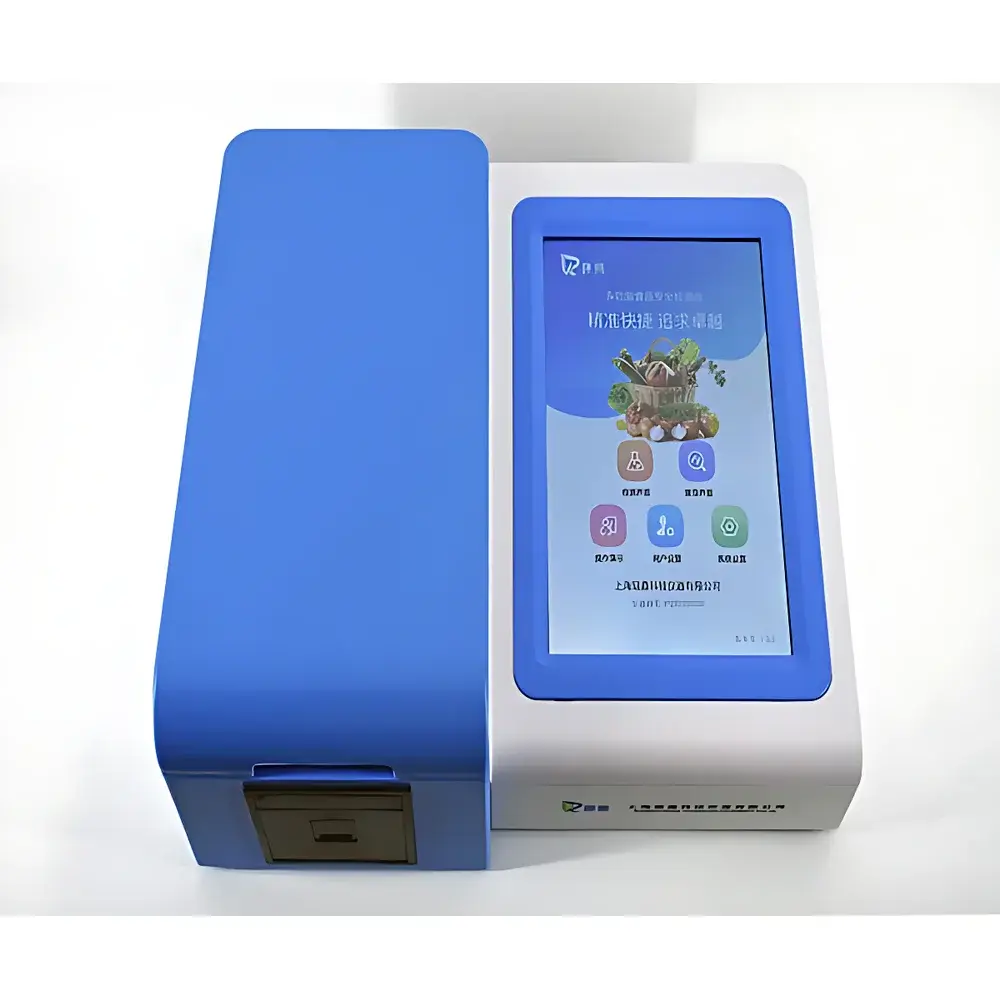
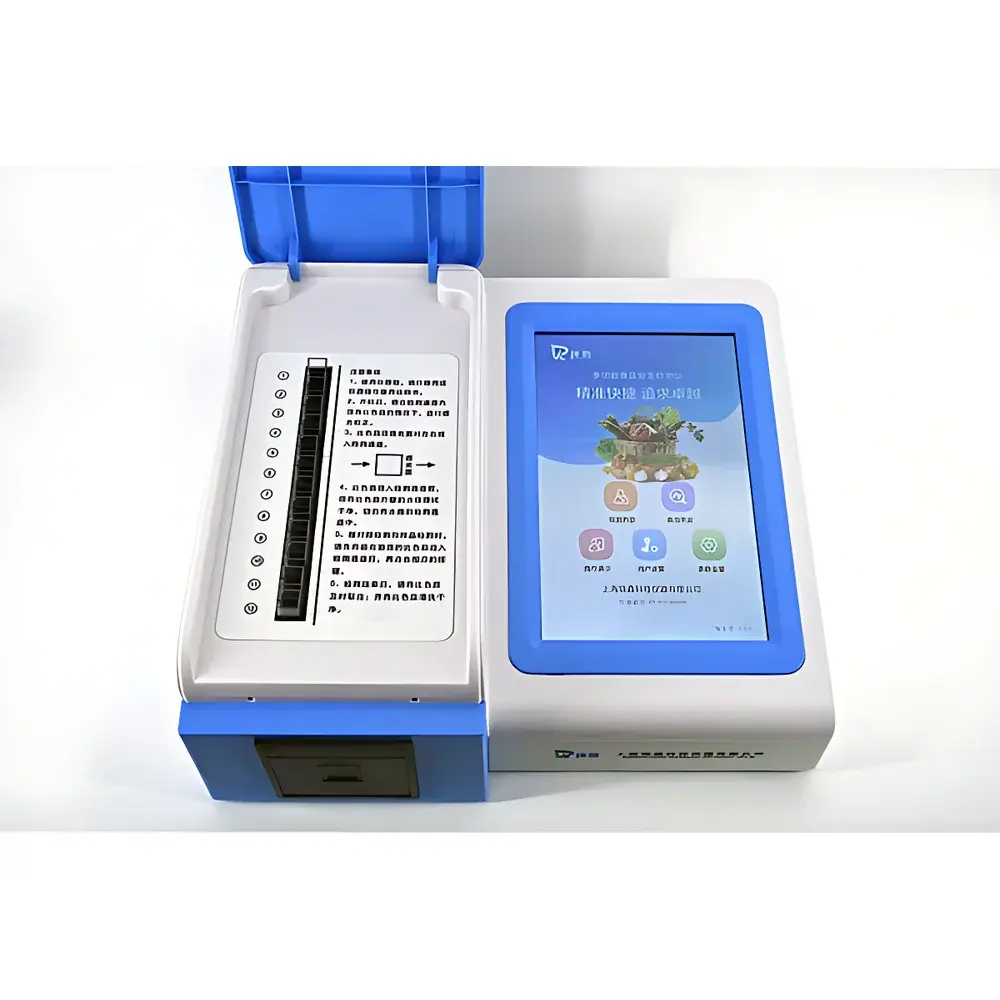
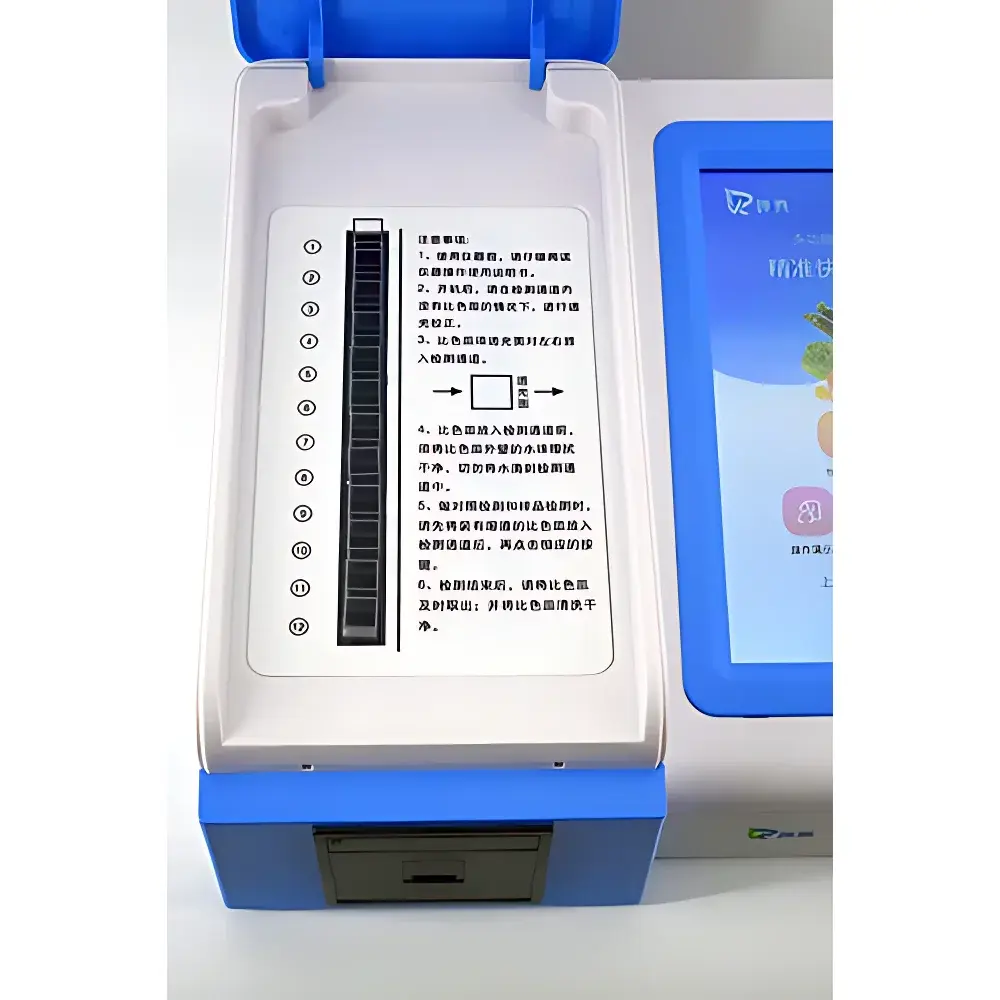
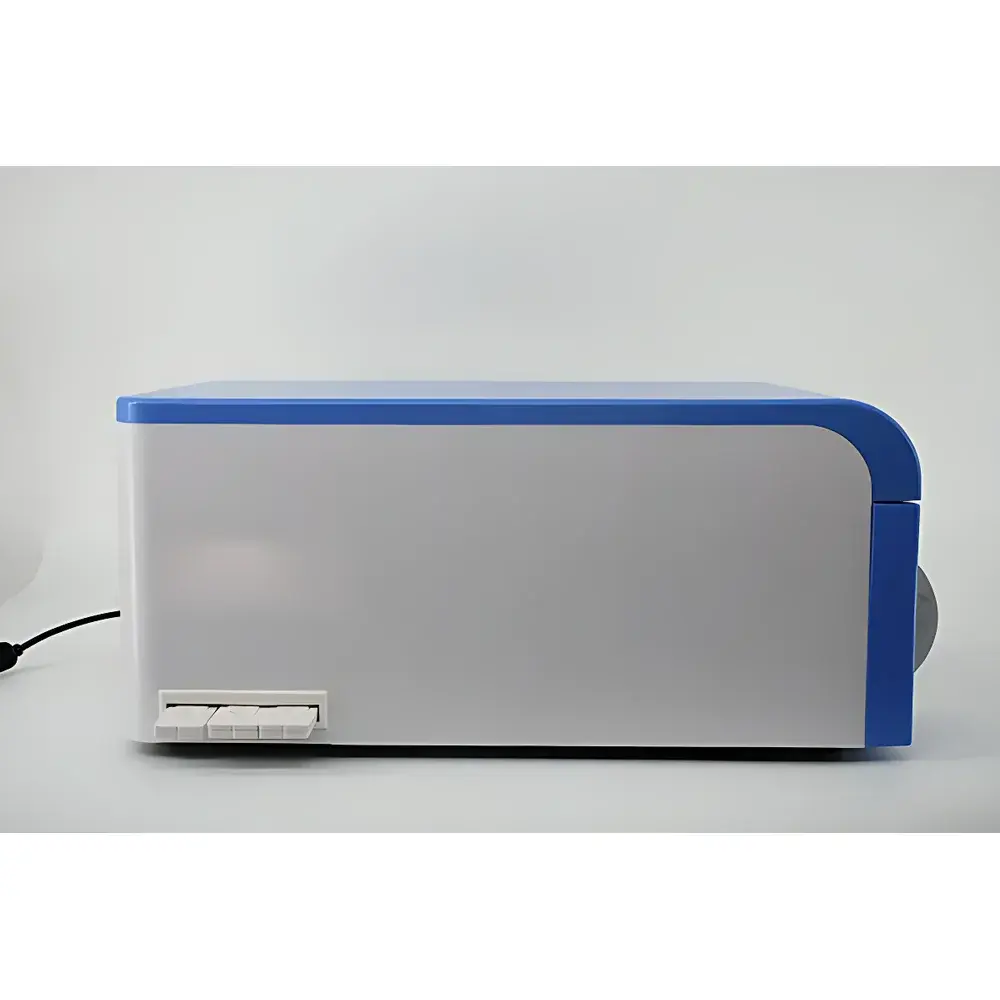
Ruixin CNY-2418NS Multi-Analyte Rapid Food Safety Analyzer
| Brand | Ruixin |
|---|---|
| Origin | Shanghai, China |
| Model | CNY-2418NS |
| Function Type | Multi-analyte (pesticide, veterinary drug & heavy metal residues) |
| Sample Compatibility | Universal for agricultural commodities |
| Wavelength Range | 380–680 nm |
| Detection Time | ≤3 min per sample |
| Repeatability | ≤0.2% (T) |
| Optical Channels | 24 photometric + 3 colloidal gold immunochromatographic channels |
| Display | 10.1″ capacitive touchscreen (1024×600), IP65-rated front panel |
| OS | Android 7.0 (quad-core 1.8 GHz, 2 GB RAM, 16 GB storage) |
| Connectivity | Wi-Fi, RJ45 Ethernet, optional 3G/4G/5G module, Bluetooth |
| Power Supply | 220 V ±10% AC |
| Absorbance Range | 0.000–4.000 A |
| Transmittance Range | 0.00–100.00% T |
| Transmittance Resolution | 0.01% T |
| Absorbance Resolution | 0.001 A |
| Photometric Accuracy | ±2.0% T |
| Photocurrent Drift | ≤0.2% (3 min) |
| Measurement Accuracy | ±5% (relative to reference standards) |
| Integrated Thermal Printer | Yes |
| Data Export | Cloud sync, USB, A4 report generation |
| Built-in Database | >1,000 standardized agricultural sample names per national standards (GB, NY) |
Overview
The Ruixin CNY-2418NS Multi-Analyte Rapid Food Safety Analyzer is an integrated optical detection platform engineered for field-deployable, high-throughput screening of chemical contaminants in food and agricultural commodities. It combines dual-mode detection architecture—UV-Vis spectrophotometry (380–680 nm) and lateral-flow colloidal gold immunochromatography—within a single ruggedized instrument. The photometric module operates on Beer-Lambert principle, quantifying enzymatic inhibition (e.g., acetylcholinesterase for organophosphates/carbamates) or colorimetric reactions (e.g., dithizone complexation for Cd/Pb), while the immunochromatographic module enables qualitative/semi-quantitative detection of low-molecular-weight veterinary drugs via antigen-antibody binding kinetics. Designed explicitly for regulatory compliance workflows, the system supports traceability-critical applications including agricultural law enforcement, market surveillance, origin tracing, and pre-harvest monitoring across vegetable, fruit, grain, tea, livestock, aquaculture, and egg matrices.
Key Features
- Integrated dual-detection architecture: 24-channel photometric reader + 3-channel colloidal gold strip reader, enabling parallel analysis of multiple analytes per sample batch.
- 10.1-inch industrial-grade capacitive touchscreen (1024×600 resolution, 400 cd/m² brightness) with IP65-rated front panel, glove-compatible operation, and handwritten signature capture for audit-ready reporting.
- Embedded Android 7.0 operating system (quad-core 1.8 GHz CPU, 2 GB RAM, 16 GB eMMC storage) supporting local data caching, offline operation, and firmware-upgradable functionality.
- Built-in thermal printer compliant with Chinese Agricultural Standard NY/T 761–2008 and GB/T 27404–2008 for immediate issuance of traceable test reports—including “Qualified Certificate for Agricultural Products” per national requirements.
- Pre-loaded database of over 1,000 standardized sample names aligned with GB, NY, and SN series standards, enabling rapid selection and context-aware method assignment.
- Multi-modal connectivity: Dual-band Wi-Fi (802.11 b/g/n), Gigabit Ethernet (RJ45), Bluetooth 4.2, and optional LTE/5G modules for real-time cloud synchronization and remote diagnostics.
- Calibration traceability: Onboard self-diagnostic routines, dark-current compensation, and user-accessible calibration verification using certified reference standards (NIST-traceable where applicable).
Sample Compatibility & Compliance
The CNY-2418NS is validated for homogenized extracts from fresh produce (leafy greens, fruits, root vegetables), cereals, tea leaves, muscle tissue (pork, beef, poultry), fish fillets, shrimp, eggs, and milk. Extraction protocols follow GB/T 5009.199–2003 (organophosphates/carbamates), GB/T 21312–2007 (β-agonists), GB/T 20762–2006 (sulfonamides), and GB 5009.12–2017 (Cd/Pb). Instrument performance meets the repeatability (≤0.2% T), photometric accuracy (±2.0% T), and measurement uncertainty (±5%) thresholds specified in CNAS-CL01:2018 and ISO/IEC 17025:2017 for rapid screening devices. Data integrity conforms to GLP-aligned audit trails, including timestamped operator ID, instrument serial number, calibration logs, and raw absorbance values stored locally and mirrored to secure cloud infrastructure.
Software & Data Management
The embedded Ruixin AgriLink™ software suite provides full lifecycle data governance: sample registration, method selection, automated result calculation (inhibition rate, cut-off ratio, semi-quantitative band intensity), statistical summary (batch mean, CV%), and export in CSV, PDF, or XML formats. All operations generate immutable digital records compliant with FDA 21 CFR Part 11 principles—including electronic signatures, role-based access control, and revision history. Cloud integration supports API-driven interoperability with provincial food safety supervision platforms (e.g., China’s National Food Safety Risk Monitoring System) and third-party LIMS environments. Remote firmware updates and diagnostic telemetry are enabled via encrypted TLS 1.2 communication.
Applications
- Agricultural administrative enforcement: On-site screening at wholesale markets, cooperatives, and border checkpoints per MOA Order No. 221 and Decree No. 172.
- Origin traceability systems: Integration with blockchain-enabled farm-to-market platforms for real-time residue status tagging.
- Quality assurance labs: Pre-screening prior to confirmatory LC-MS/MS or GC-MS analysis to optimize laboratory throughput.
- Cooperative self-monitoring: Farmer-led testing under guidance of county-level agricultural extension services.
- Emergency response: Rapid triage during contamination incidents involving chloramphenicol in aquaculture or clenbuterol in pork supply chains.
FAQ
Does the CNY-2418NS support quantitative analysis for all listed pesticides and veterinary drugs?
It delivers semi-quantitative results for immunoassay-targeted analytes (e.g., β-agonists, nitrofurans) and quantitative results for enzyme inhibition–based assays (e.g., organophosphates) within defined linear ranges per GB/T methods.
Can the instrument be calibrated using third-party reference materials?
Yes—calibration verification is supported using NIST-traceable absorbance filters and certified reference standards (e.g., CRM 8102 for Cd, CRM 8103 for Pb) following internal SOP-AGL-007.
Is cloud data storage compliant with China’s Personal Information Protection Law (PIPL)?
All cloud transmissions use AES-256 encryption; metadata anonymization and regional data residency (Shanghai-based servers) ensure PIPL and DSL compliance.
What is the expected service life of the optical components under daily field use?
The LED light source and silicon photodiode array are rated for ≥50,000 measurements; routine cleaning and annual factory recalibration extend operational lifespan beyond 7 years.
How does the system handle matrix interference in complex samples like fatty fish or fermented tea?
Built-in matrix correction algorithms apply standard addition and blank subtraction protocols defined in GB/T 27404–2008 Annex F, minimizing false positives in high-lipid or polyphenol-rich extracts.



