
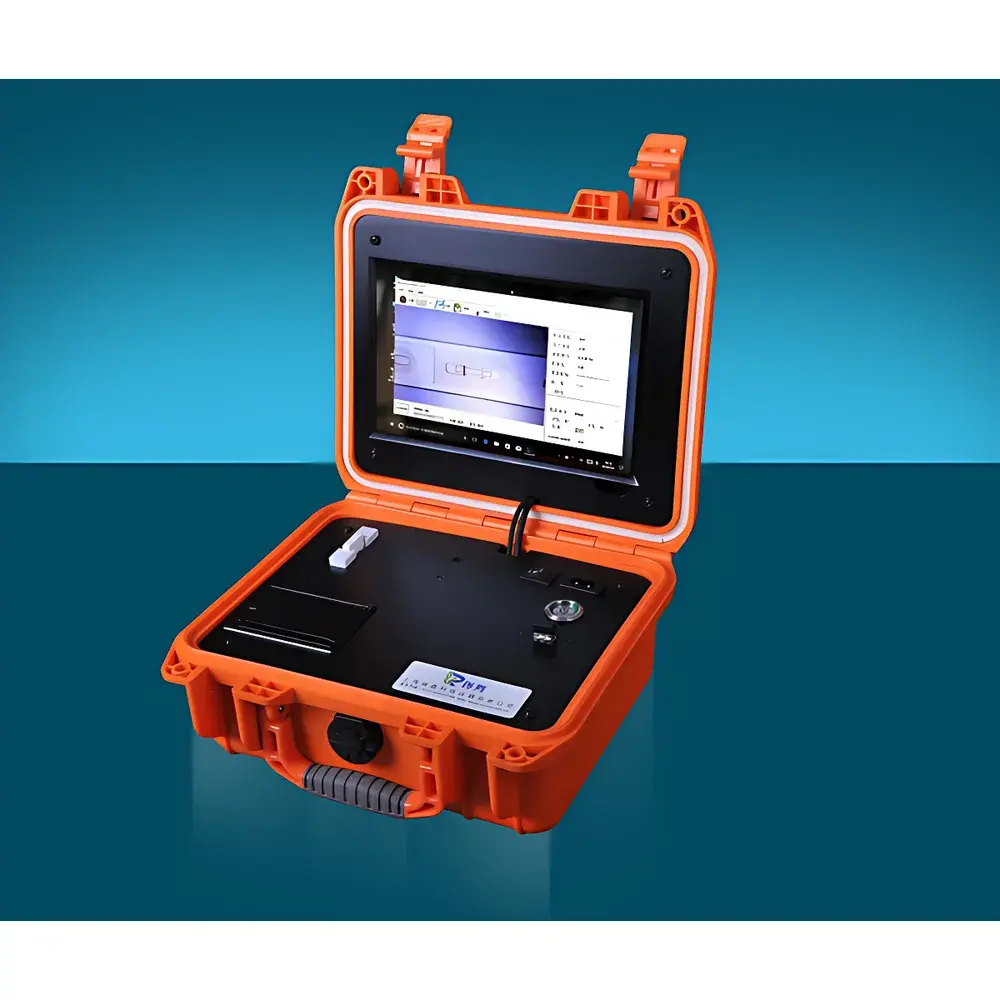
Ruixin JT-102Cd Rice Cadmium Rapid Detection Analyzer
| Brand | Ruixin |
|---|---|
| Origin | Shanghai, China |
| Manufacturer Type | Authorized Distributor |
| Country of Origin | China |
| Model | JT-102Cd |
| Price Range | USD 1,400 – 2,800 |
| Function Type | Multi-analyte (Cadmium-focused with expandable panel) |
| Sample Applicability | Generic for cereal grains and milled rice matrices |
| Wavelength Range | 380–680 nm |
| Detection Time | ≤3 min per test |
| Repeatability (CV) | ≤0.3% |
| Detection Channels | 6 independent lateral-flow strip readers |
Overview
The Ruixin JT-102Cd Rice Cadmium Rapid Detection Analyzer is a dedicated lateral-flow immunoassay (LFIA) quantification platform engineered for on-site and laboratory-based screening of cadmium (Cd) in polished rice and related cereal commodities. It operates on the principle of colloidal gold immunochromatography—where Cd-specific monoclonal antibodies conjugated to gold nanoparticles bind target analytes in extracted samples, forming visible test (T) and control (C) lines on nitrocellulose membranes. Unlike qualitative visual interpretation, the JT-102Cd integrates high-resolution CCD imaging (1280 × 800 px), spectral reflectance analysis across the 380–680 nm visible range, and AI-driven image segmentation algorithms to convert optical signal intensities into quantitative Cd concentration values (ppm). Designed for compliance with preliminary screening protocols under national food safety standards (e.g., GB 2762-2022), it delivers trace-level detection with a validated limit of detection (LOD) of 0.1 ppm Cd in rice flour extracts—meeting the regulatory threshold for safe consumption in major export markets.
Key Features
- Six-channel parallel detection architecture enables simultaneous analysis of up to six lateral-flow test strips—maximizing throughput for batch monitoring in grain elevators or inspection labs.
- High-fidelity CCD imaging system coupled with calibrated white-light illumination ensures consistent reflectance measurement across variable strip batches and ambient lighting conditions.
- On-device AI inference engine performs real-time T-line/C-line ratio calculation (CT ratio), colorimetric intensity normalization, and background subtraction—eliminating operator subjectivity in result interpretation.
- Integrated 8-inch capacitive touchscreen (1280 × 800 resolution), Intel-based processor, 2 GB RAM, and 32 GB internal storage support local data retention of >100,000 test records—including raw CCD images, metadata, timestamps, and geotags.
- Low-power design (<10 W operational draw; 72-hour standby) allows field deployment using standard AC mains (220 V) or optional external power banks for mobile inspection units.
- Multi-mode connectivity includes Wi-Fi 5 (802.11ac), Bluetooth 5.0, and optional 4G LTE modules—enabling encrypted cloud synchronization to LIMS or national food safety surveillance platforms via TLS 1.2.
- Open firmware architecture supports over-the-air (OTA) updates for new assay calibrations, algorithm refinements, and regulatory method adaptations—ensuring long-term method traceability and audit readiness.
Sample Compatibility & Compliance
The JT-102Cd is validated for use with homogenized, acid-extracted rice samples prepared according to standardized extraction protocols (e.g., GB/T 5009.15–2014 or AOAC Official Method 2019.02 for Cd in cereals). It accommodates common lateral-flow test kits from certified manufacturers compatible with the 0.1–5.0 ppm Cd linear dynamic range. While not a reference method instrument, its performance meets the repeatability (CV ≤0.3%), inter-assay precision (batch-to-batch CV <3%), and specificity requirements outlined in ISO/IEC 17025:2017 for screening-level testing. Data integrity safeguards—including timestamped audit logs, user authentication, and immutable result archiving—support alignment with GLP principles and facilitate traceability during regulatory audits.
Software & Data Management
The embedded Windows-based OS hosts a purpose-built analytical suite featuring dual-language UI (English/Chinese), touch-optimized workflows, and integrated document editing tools for generating compliant test reports. All results are stored with full metadata: sample ID, operator ID, extraction lot, calibration date, and image hash. Cloud sync employs end-to-end encryption and role-based access control (RBAC); historical datasets can be exported in CSV, PDF, or XML formats compliant with FAO/WHO Codex Alimentarius reporting templates. Optional API integration supports automated ingestion into enterprise LIMS or national food safety dashboards (e.g., China’s NIFDC Food Safety Monitoring System).
Applications
- Pre-harvest and post-milling quality assurance in rice processing facilities and cooperatives.
- Routine surveillance at central grain reserves and state-owned granaries to enforce GB 2762–2022 cadmium limits (0.2 mg/kg).
- Field-deployable verification during market supervision campaigns by provincial food and drug administrations.
- Method validation support for laboratories developing or verifying rapid LFIA kits for heavy metals in staple grains.
- Training and capacity building for agricultural extension officers and food safety inspectors in resource-constrained settings.
FAQ
What sample preparation is required prior to analysis?
Rice samples must be ground to ≤0.15 mm particle size, followed by microwave-assisted acid digestion (HNO₃/H₂O₂) or aqueous extraction per GB/T 5009.15–2014. Extracts are diluted to fall within the instrument’s linear range (0.1–5.0 ppm Cd).
Does the instrument require daily calibration?
No routine calibration is needed. Each test strip includes an internal control line; the system auto-validates strip functionality before quantification. Annual verification using NIST-traceable Cd reference standards is recommended.
Can the JT-102Cd quantify other heavy metals besides cadmium?
It is optimized for Cd detection using certified anti-Cd monoclonal antibody strips. Cross-reactivity with Pb, As, or Hg is negligible (<0.1%). Multi-metal expansion requires separate, validated strip formats and firmware configuration.
Is the device compliant with FDA 21 CFR Part 11 requirements?
While not formally Part 11-certified, the system implements electronic signature capture, audit trails, and data immutability features aligned with core Part 11 principles—suitable for hybrid (paper + digital) workflows in regulated environments.
What is the expected service life and maintenance interval?
With proper cleaning of the optical path after each batch and annual firmware updates, the unit maintains metrological stability for ≥5 years. No consumables beyond test strips are required; CCD sensor lifetime exceeds 100,000 cycles.




