
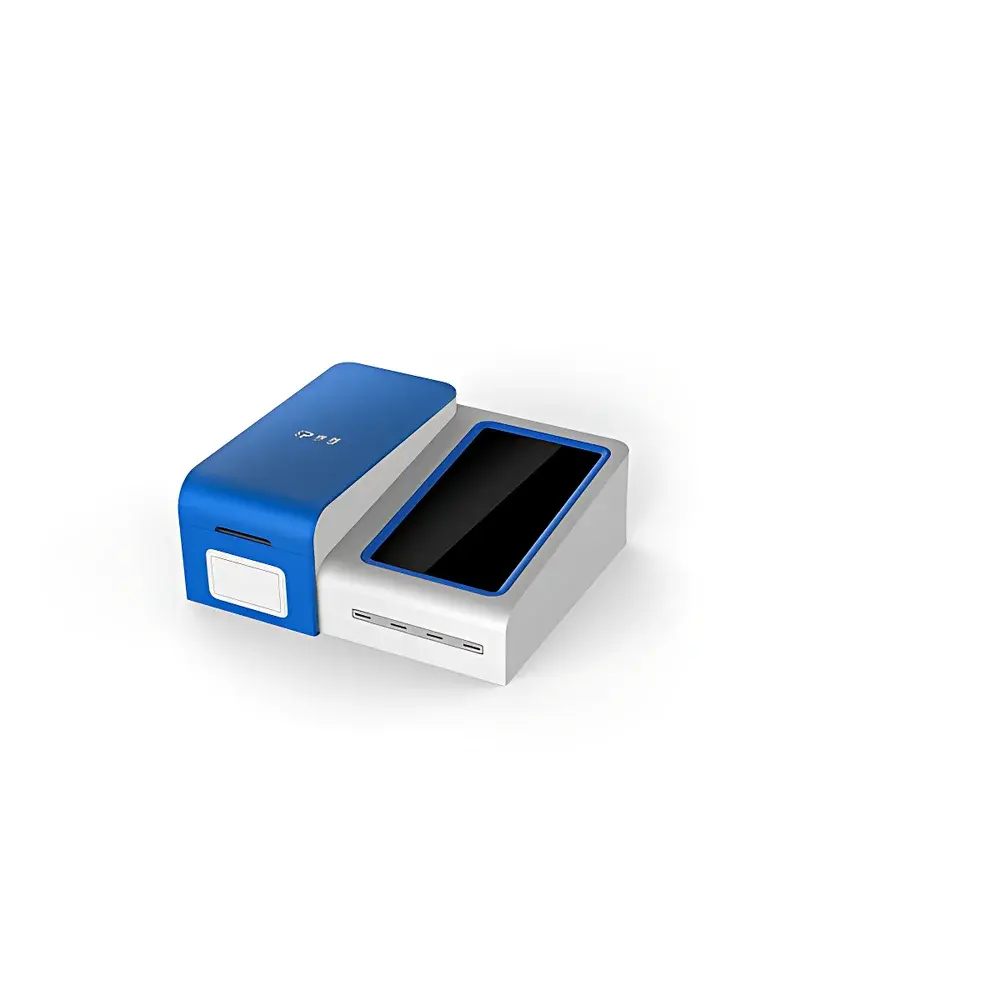
Ruixin JT-103JS Food Safety Rapid Heavy Metal Analyzer
| Brand | Ruixin |
|---|---|
| Origin | Shanghai, China |
| Manufacturer Type | Authorized Distributor |
| Country of Origin | China |
| Model | JT-103JS |
| Price | USD 5,300 (FOB Shanghai) |
| Function Type | Multi-analyte (Cd, Pb, and expandable panel) |
| Sample Compatibility | Cereals, rice, flour, feed, edible oils, and processed food matrices |
| Wavelength Range | 380–680 nm |
| Detection Time | ≤180 seconds per sample |
| Repeatability (RSD) | ≤0.3% |
| Detection Channels | 3 independent optical lanes |
| Detection Limits | Cd ≤0.2 ppm, Pb ≤0.1 ppm |
| Measurement Speed | <1 second per test strip image capture |
| Output Metrics | Colorimetric intensity, C/T ratio, T-line intensity, C-line intensity, qualitative/quantitative classification |
| Interface | USB 2.0 |
| Connectivity | Wi-Fi (802.11 b/g/n), RJ45 Ethernet, optional 4G LTE module |
| Operating System | Android 7.0 |
| Hardware | Quad-core ARM processor, 2 GB RAM, 16 GB internal storage + microSD expansion |
| Display | 10.1-inch capacitive touchscreen |
| Power Supply | AC 220 V ±10%, 50/60 Hz |
| Built-in Thermal Printer | Yes |
| Cloud Integration | HTTPS-based secure API for Ruixin Cloud Platform (ISO/IEC 27001-compliant infrastructure) |
| Data Compliance | Supports audit trail, user login authentication, and GLP-aligned electronic record retention |
Overview
The Ruixin JT-103JS Food Safety Rapid Heavy Metal Analyzer is a field-deployable, quantitative lateral flow immunoassay (LFIA) reader engineered for on-site screening of cadmium (Cd) and lead (Pb) in cereal-based commodities—including paddy rice, milled rice, wheat flour, animal feed, and edible oils. It operates on the principle of colloidal gold immunochromatography, where antigen–antibody binding on nitrocellulose membranes generates visible test (T) and control (C) lines. Unlike conventional visual interpretation, the JT-103JS employs high-resolution CCD imaging (12-bit dynamic range, 2592 × 1944 pixels) coupled with embedded AI-driven image segmentation and pixel-intensity calibration to convert qualitative strip responses into traceable, quantitative concentration values (ppm). This eliminates inter-operator variability and aligns with ISO 13843:2017 requirements for analytical method validation in rapid screening devices. The instrument is designed for use in grain inspection stations, food processing QA labs, regulatory field units, and third-party certification bodies requiring compliance-ready documentation.
Key Features
- Triple-channel optical detection architecture enabling simultaneous analysis of up to three test strips—reducing batch turnaround time without cross-channel interference.
- Automated strip recognition algorithm that discriminates valid LFIA cassettes from expired, damaged, or non-compatible formats using barcode-assisted validation and spatial pattern matching.
- Integrated thermal printer supporting direct output of GLP-compliant reports including sample ID, operator ID, timestamp, instrument serial number, raw C/T ratio, calculated concentration, and pass/fail status per AOAC Official Method 2021.01 criteria.
- Android-based platform with role-based access control (admin/operator/user), encrypted local database (SQLite with AES-256), and automatic firmware update via signed OTA packages over TLS 1.2.
- Real-time cloud synchronization via Ruixin Cloud Platform—generating QR-coded digital certificates compliant with China’s Agricultural Product Quality and Safety Law (2023 Revision) and enabling interoperability with provincial traceability systems (e.g., Guangdong Agri-Trace, Zhejiang Smart Farm).
- Environmental resilience: operating temperature range 10–40°C, relative humidity ≤85% non-condensing; IP52-rated enclosure for dust resistance and incidental splash protection.
Sample Compatibility & Compliance
The JT-103JS supports extraction protocols aligned with GB 5009.15–2014 (Cd) and GB 5009.12–2023 (Pb) for cereal matrices. Pre-extracted supernatants are applied directly to certified Ruixin-branded colloidal gold test strips (RU-Cd01, RU-Pb02), each validated per ISO 15197:2013 accuracy requirements (≥95% concordance with ICP-MS reference data at ≥LOD × 3). Instrument performance meets CNAS-CL01:2018 criteria for rapid screening devices used in accredited food testing laboratories. All software logs—including image captures, calibration events, and user actions—are time-stamped, digitally signed, and retained for ≥12 months to satisfy FDA 21 CFR Part 11 electronic record integrity requirements.
Software & Data Management
Data acquisition, quantification, and reporting are managed through Ruixin Analytical Suite v3.2—a CE-marked medical device software class I (MDD 93/42/EEC) adapted for food safety applications. Each measurement generates a structured JSON dataset containing metadata (GPS coordinates, ambient light level, battery status), raw pixel arrays, normalized C/T ratios, and uncertainty estimates derived from internal reference standards. Local storage retains ≥50,000 test records; cloud backup enables multi-site dashboard aggregation, statistical process control (SPC) charting, and automated outlier flagging per ISO 7870-2:2013. Audit trails are immutable and exportable in CSV/PDF formats for regulatory review.
Applications
- Routine surveillance of rice shipments at port-of-entry quarantine labs.
- In-process verification of heavy metal removal efficiency in grain polishing and parboiling facilities.
- Field-level monitoring by county-level agricultural extension services under China’s National Grain Quality Monitoring Program.
- Verification testing for HACCP prerequisite programs in feed mills supplying aquaculture and poultry operations.
- Contract laboratory support for organic certification bodies requiring documented screening prior to GC-MS confirmation.
FAQ
Does the JT-103JS require external calibration standards for daily operation?
No—each test strip includes integrated calibration zones; the instrument performs auto-zeroing and gain adjustment before every scan using built-in optical references.
Can third-party lateral flow strips be used with this analyzer?
Only Ruixin-certified strips (RU-Cd01, RU-Pb02, RU-As03) are supported due to proprietary barcode encoding, spectral response profiling, and lot-specific calibration coefficients.
Is remote diagnostic support available?
Yes—via secure SSH tunneling and screen-sharing capability enabled through the Ruixin Remote Assist module (requires prior admin authorization and TLS-encrypted session handshake).
How is data integrity ensured during network transmission to the cloud platform?
All payloads are signed with ECDSA-secp256r1 keys and encrypted using AES-GCM; certificate pinning prevents MITM attacks and ensures endpoint authenticity.
What regulatory documentation is supplied with the instrument?
Declaration of Conformity (CE), RoHS 2011/65/EU compliance statement, ISO 9001:2015 manufacturing certificate, and full traceability dossier for optical components (NIST-traceable photometric calibration report included).



