
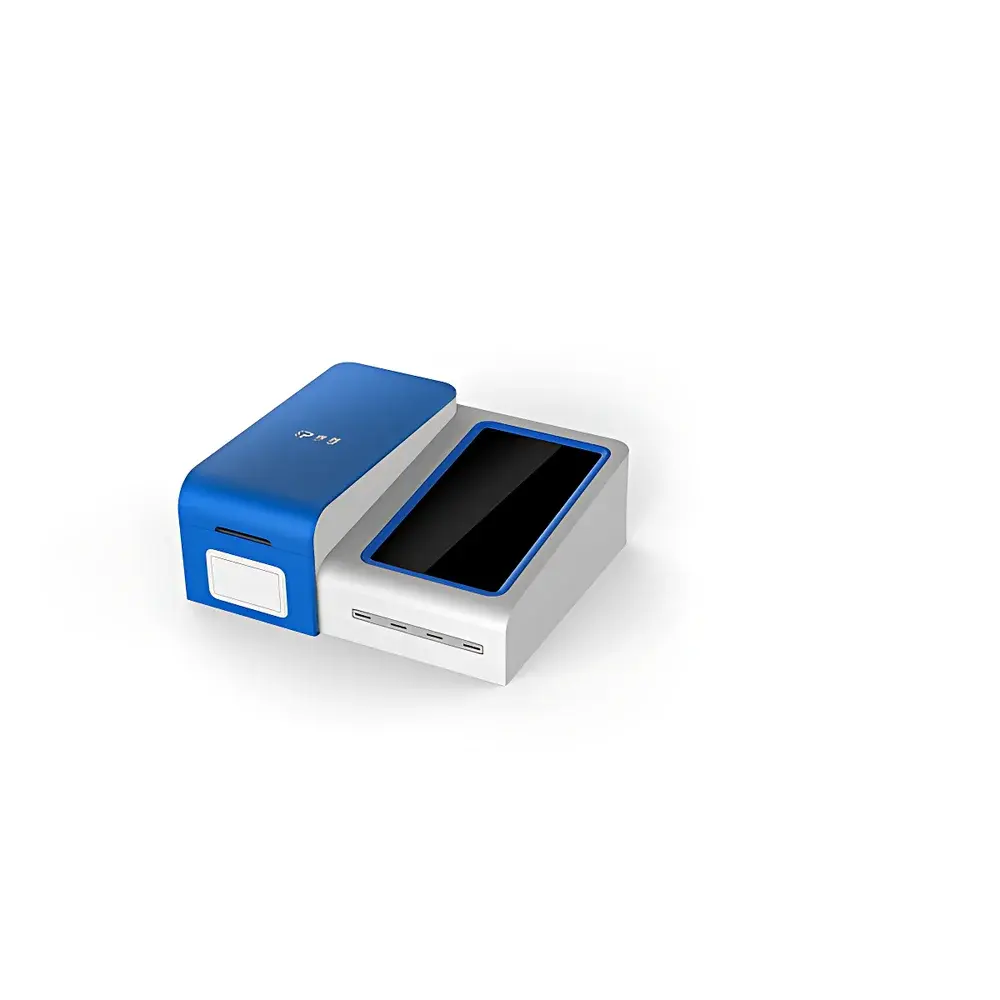
Ruixin JT-103SY Food Safety Rapid Detector for Veterinary Drug Residues
| Brand | Ruixin |
|---|---|
| Origin | Shanghai, China |
| Manufacturer Type | Authorized Distributor |
| Country of Origin | China |
| Model | JT-103SY |
| Price | USD 5,300 (approx.) |
| Function Type | Multi-analyte Detection Platform |
| Sample Applicability | Universal for Animal-Derived Foods |
| Wavelength Range | 380–680 nm |
| Detection Time | ≤ 3 minutes per test |
| Repeatability | ≤ 0.3% CV |
| Detection Channels | 3 independent optical channels |
Overview
The Ruixin JT-103SY is a CE-compliant, field-deployable rapid detection instrument engineered for quantitative immunochromatographic analysis of veterinary drug residues in food matrices. It operates on the principle of colloidal gold immunochromatography—where antigen–antibody binding on nitrocellulose membranes generates visible or optically quantifiable test (T) and control (C) lines. Unlike conventional visual interpretation, the JT-103SY integrates a high-resolution CCD imaging sensor (10.1-inch touchscreen interface) with embedded AI-based image recognition algorithms to convert qualitative lateral flow assay (LFA) results into objective, traceable quantitative outputs—including colorimetric intensity, C/T ratio, T-line optical density, and C-line validation status. This eliminates inter-operator variability and supports GLP-aligned documentation requirements in food safety laboratories, regulatory inspection units, and cooperative-level quality control centers.
Key Features
- Triple-channel independent optical detection system enabling simultaneous analysis of up to three sample strips without cross-contamination or mechanical repositioning.
- Auto-discrimination logic identifies invalid test strips (e.g., missing C-line, insufficient migration, or background noise) and flags them prior to result calculation—ensuring data integrity at point-of-use.
- Android-based embedded OS with intuitive touch interface; preloaded operational video guides accessible offline for immediate staff training and protocol verification.
- Onboard data storage capacity exceeding 1 million records; expandable via microSD card slot compliant with SDHC UHS-I standards.
- Multi-format printing support: thermal roll paper (58 mm), adhesive label printer (with GS1-compliant traceability QR code generation), and A4 direct PDF export via USB or network connection.
- Integrated dual-network architecture: IEEE 802.11ac Wi-Fi + 10/100 Mbps RJ45 Ethernet; optional 4G LTE module (via M.2 interface) for real-time cloud synchronization in remote or mobile deployment scenarios.
- GPS/AGPS geotagging capability ensures location-stamped audit trails required under ISO/IEC 17025 and China’s GB/T 27404–2019 guidelines for food testing laboratories.
Sample Compatibility & Compliance
The JT-103SY is validated for use with homogenized extracts from raw and processed animal-derived commodities—including muscle tissue (pork, beef, poultry), fish fillets, milk (raw, pasteurized, powdered), eggs (yolk/white), honey, and soup base concentrates. Its optical architecture conforms to ASTM E308–22 (Standard Practice for Computing the Colors of Objects by Using the CIE System) for spectral reflectance measurement within the visible range (380–680 nm). Instrument performance meets the repeatability threshold (≤0.3% CV) specified in GB/T 27404–2019 Annex B for rapid screening devices. All firmware and software modules comply with FDA 21 CFR Part 11 requirements for electronic records and signatures when configured with audit-trail logging enabled.
Software & Data Management
The device runs Ruixin’s proprietary CloudLink™ firmware v3.2+, supporting over-the-air (OTA) updates and remote diagnostics via secure TLS 1.2 encrypted channels. Raw CCD images, processed C/T ratios, pass/fail determinations, operator ID, timestamp, GPS coordinates, and sample ID are stored in ISO/IEC 27001-aligned encrypted SQLite databases. Data export formats include CSV (for LIMS integration), PDF (for certified reports), and JSON (for API-driven ingestion into national food safety surveillance platforms such as China’s NIFDC Food Risk Monitoring System). Optional RESTful API access enables bidirectional synchronization with third-party ERP or farm management systems.
Applications
- Routine screening of β-agonists (clenbuterol, ractopamine, salbutamol) in livestock tissues prior to slaughterhouse dispatch.
- Monitoring antibiotic residue compliance in aquaculture supply chains—especially for nitrofurans (furazolidone, furaltadone), chloramphenicol, and malachite green metabolites.
- Verification of honey authenticity and antibiotic/hormone adulteration (e.g., quinolones, sulfonamides, ampicillin) per Codex Alimentarius Standard CXS 12-1981.
- On-farm milk testing for β-lactams, tetracyclines, and aflatoxin M1 in accordance with EU Commission Regulation (EU) No 37/2010 and US FDA Grade A Pasteurized Milk Ordinance (PMO).
- Regulatory field inspections targeting illicit additives (e.g., poppy shell alkaloids in hotpot bases) under China’s SAMR Notice No. 2022–17 on Food Additive Control.
FAQ
Does the JT-103SY require calibration with reference standards before each use?
No. The system performs automatic self-calibration using built-in white-reference and dark-reference frames prior to each CCD acquisition cycle. External calibration is only required annually or after sensor replacement, per ISO/IEC 17025 Clause 6.5.2.
Can the instrument validate test strip lot-to-lot performance?
Yes. The firmware includes batch-specific correction coefficients that can be uploaded via QR-coded calibration cards supplied with each new lot of certified colloidal gold test strips.
Is raw image data export supported for independent algorithmic reanalysis?
Yes. Full-resolution TIFF-formatted CCD captures (12-bit depth, 2048 × 1536 px) are exportable via USB or network share for secondary analysis using open-source tools such as ImageJ or custom Python-based quantification pipelines.
What cybersecurity protocols govern cloud data transmission?
All data transmissions use AES-256 encryption in transit and at rest. Cloud endpoints comply with ISO/IEC 27001:2022 Annex A controls and undergo annual penetration testing per NIST SP 800-115 guidelines.
How does the system handle non-compliant samples flagged during routine monitoring?
Non-compliant results trigger automated SMS/email alerts to designated QA supervisors and generate a locked PDF report with digital signature, preventing post-hoc modification—a requirement under China’s GB 14881–2013 General Hygienic Standard for Food Production.





