
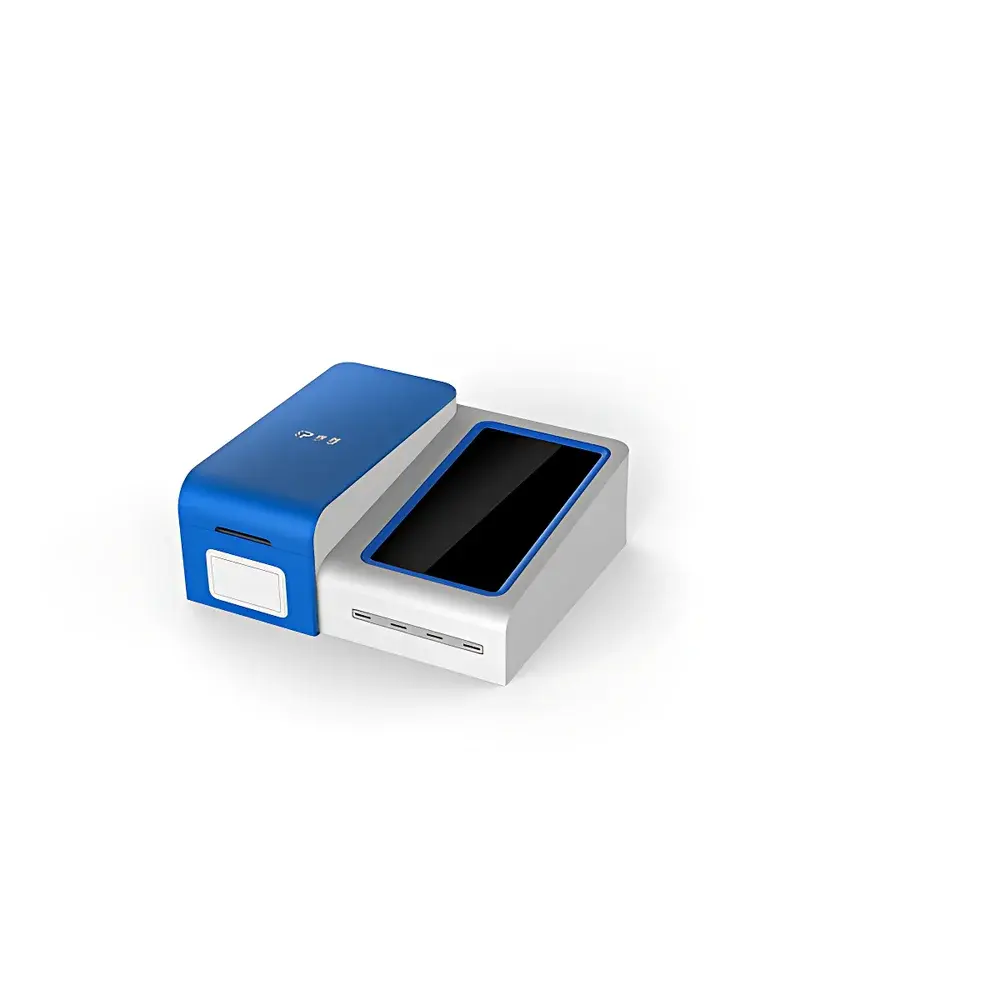
Ruixin JT-108B Colloidal Gold Immunoassay Analyzer
| Brand | Ruixin |
|---|---|
| Origin | Shanghai, China |
| Manufacturer Type | Authorized Distributor |
| Regional Classification | Domestic (PRC) |
| Model | JT-108B |
| Price | USD 5,300 (approx.) |
| Functionality | Multiplex Rapid Screening Platform |
| Sample Versatility | Universal for Solid & Liquid Food Matrices |
| Optical Detection Range | 380–680 nm |
| Assay Time per Test | ≤ 180 s |
| Photometric Repeatability (CV) | ≤ 0.3% |
| Detection Channels | 10 parallel optical lanes |
| Image Acquisition | High-Resolution CCD Sensor |
| Data Output | C/T Ratio, Colorimetric Intensity, Control Line (C), Test Line (T), Qualitative/Quantitative Interpretation |
| Connectivity | Wi-Fi 802.11 b/g/n, RJ45 Ethernet, USB 2.0, Optional 4G LTE Module |
| Operating System | Android 9.0 (Custom Embedded UI) |
| Display | 10.1-inch Capacitive Touchscreen |
| Onboard Storage | Internal eMMC + SD Card Slot (Supports ≥128 GB, >1,000,000 records) |
| Power Supply | AC 220 V ±10%, 50 Hz |
| Compliance | Designed to support ISO/IEC 17025-aligned laboratory workflows |
Overview
The Ruixin JT-108B Colloidal Gold Immunoassay Analyzer is a CE-marked (for non-IVD export configurations), benchtop rapid screening instrument engineered for quantitative interpretation of lateral flow immunoassays (LFIA) based on colloidal gold nanoparticle labeling. It operates on the principle of reflectance photometry—measuring optical density changes at discrete wavelengths (380–680 nm) across test (T) and control (C) lines of commercial or in-house developed immunochromatographic strips. Unlike subjective visual assessment, the JT-108B employs a calibrated high-resolution CCD imaging module coupled with embedded AI-assisted image segmentation algorithms to extract pixel-intensity profiles, compute C/T ratios, and generate reproducible semi-quantitative results. Its 10-channel parallel architecture enables batch processing of up to ten independent assays simultaneously—critical for high-throughput food safety laboratories performing routine surveillance of antibiotics, mycotoxins, pesticide residues, veterinary drug metabolites, and adulterants across diverse matrices including meat, dairy, honey, aquatic products, grains, and processed foods.
Key Features
- 10-channel simultaneous detection with <1-second per-strip image acquisition and automated line identification—no manual alignment or strip orientation required.
- Embedded Android 9.0 OS with intuitive touchscreen interface; operation guided by on-device video tutorials accessible without internet connectivity.
- Integrated data management: All raw images, C/T ratio values, calibration metadata, operator ID, timestamp, GPS geotag (optional), and sample ID are stored locally in encrypted format compliant with basic GLP record-keeping requirements.
- Multi-format reporting: Supports thermal, adhesive-label, and A4 printing with QR-code generation conforming to China’s National Edible Agricultural Products Certificate Regulation (No. 1 [2020], Ministry of Agriculture and Rural Affairs).
- Cloud-ready architecture: Native MQTT and HTTPS APIs enable secure transmission of structured JSON payloads—including test results, instrument logs, and certificate files—to third-party LIMS or national food safety monitoring platforms (e.g., NIFDC, provincial CDC portals).
- Modular communications: Dual-network redundancy (Wi-Fi + Gigabit Ethernet); optional LTE/4G add-on kit supports remote firmware updates and real-time telemetry in off-grid field deployments.
Sample Compatibility & Compliance
The JT-108B accommodates standardized colloidal gold test strips from multiple certified manufacturers (e.g., Biotest, Randox, BioVision, and domestic suppliers meeting GB/T 28799–2012 specifications). It has been validated for use with pre-extracted samples prepared according to GB 5009.x series standards—for instance, acetonitrile extraction for mycotoxins (GB 5009.22–2016), QuEChERS for pesticides (GB 23200.113–2018), and ELISA-compatible cleanup protocols for β-agonists and sulfonamides. While not an IVD device under EU IVDR or FDA 510(k), its output metrics align with AOAC Official Method validation criteria for rapid screening tools (e.g., specificity ≥95%, sensitivity within ±20% of reference LC-MS/MS). Instrument software logs include full audit trails (user actions, timestamps, result modifications) satisfying baseline requirements for ISO/IEC 17025 Clause 7.11 and China’s CNAS-CL01:2018 documentation policies.
Software & Data Management
Firmware v3.2.1 implements role-based access control (admin/operator modes), configurable pass/fail thresholds per analyte, and dynamic calibration curve loading via USB or cloud sync. All measurement data adhere to FAIR principles (Findable, Accessible, Interoperable, Reusable): CSV exports contain ISO 8601 timestamps, SI-unit-conformant concentration estimates (ng/mL or µg/kg), confidence intervals derived from internal CV modeling, and hash-verified image thumbnails. The system supports scheduled automated backups to network-attached storage (NAS) or SFTP servers. For regulated environments, optional 21 CFR Part 11 compliance packages (electronic signatures, biometric login, immutable log archives) are available upon request—subject to site-specific validation protocols.
Applications
- Routine screening of antibiotic residues (e.g., chloramphenicol, enrofloxacin, tetracyclines) in raw milk, egg homogenates, and aquaculture tissue extracts.
- Quantitative assessment of mycotoxins—including aflatoxin B1/M1, zearalenone, and deoxynivalenol—in corn, wheat, peanut butter, and animal feed.
- Detection of banned substances such as clenbuterol, ractopamine, and nitrofuran metabolites in pork, beef, and poultry liver samples.
- Pesticide residue verification (e.g., carbaryl, omethoate, cypermethrin) in fruits, vegetables, and tea leaves following standard extraction protocols.
- Authentication testing for adulterants like melamine in dairy powders or Sudan dyes in chili products.
- Field-deployable verification for cooperative farms and slaughterhouse QA units requiring real-time certificate generation and blockchain-linked traceability.
FAQ
Is the JT-108B suitable for regulatory submission of test results?
It serves as a validated rapid screening tool—not a confirmatory method. Positive findings must be verified by accredited reference methods (e.g., LC-MS/MS per GB/T 21312–2007) prior to official reporting.
Can custom assay strips be calibrated on this platform?
Yes. The instrument supports user-defined calibration curves via slope-intercept input or multi-point fitting using supplied reference standards.
What is the expected service life of the CCD sensor under continuous operation?
Rated for >50,000 scan cycles with factory recalibration recommended every 12 months or after 10,000 tests.
Does the system meet cybersecurity standards for network-connected lab devices?
It includes TLS 1.2 encryption for cloud uploads, disabled Telnet/FTP by default, and firmware signed with SHA-256 RSA keys—aligned with IEC 62443-3-3 SL1 requirements.
How is traceability ensured when printing certificates?
Each printed certificate embeds a unique QR code linking to a time-stamped, immutable record in the local database or designated cloud repository—including instrument serial number, analyst ID, and raw image hash.






