
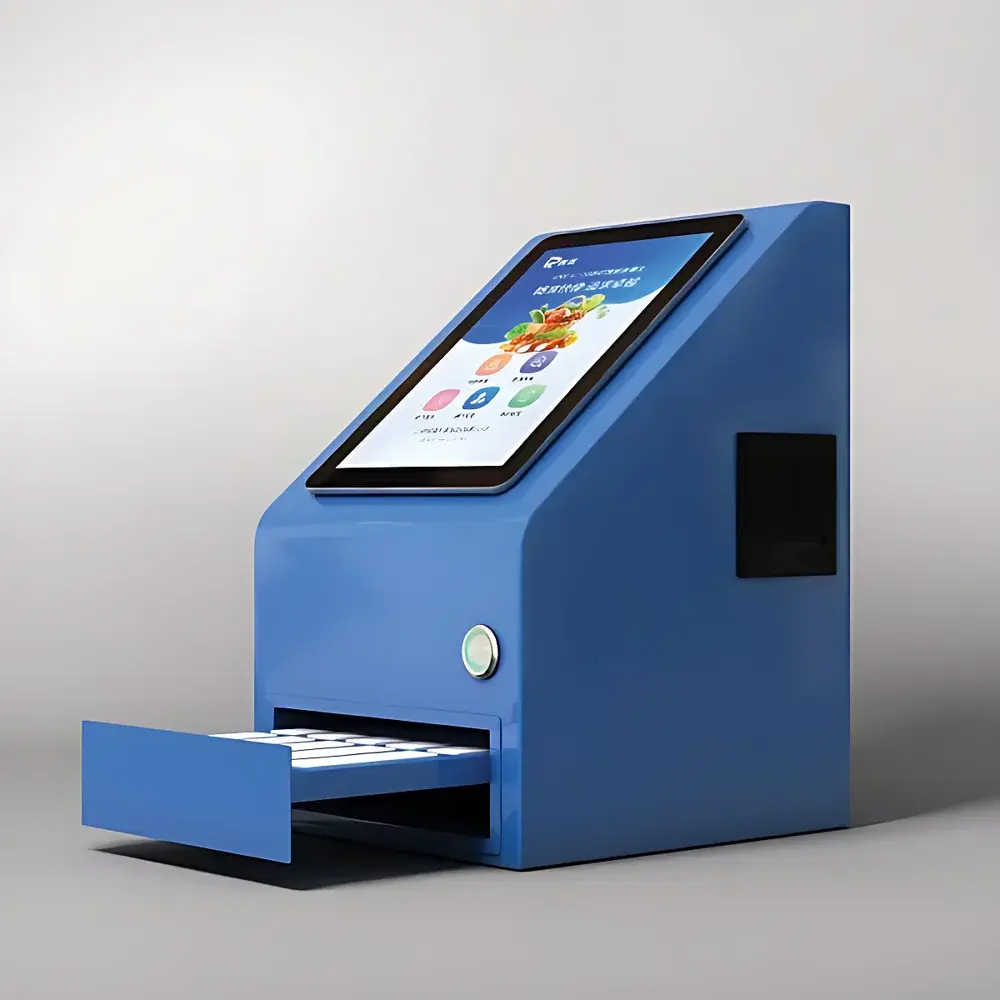
Ruixin JT-108JS Heavy Metal Rapid Detection Analyzer
| Brand | Ruixin |
|---|---|
| Origin | Shanghai, China |
| Manufacturer Type | Authorized Distributor |
| Origin Category | Domestic (PRC) |
| Model | JT-108JS |
| Price Range | USD 2,800 – 4,300 (FOB Shanghai) |
| Function Type | Multi-analyte (Pb, Cd) |
| Sample Compatibility | Solid & semi-solid food matrices (grains, vegetables, herbs) |
| Wavelength Range | 380–680 nm |
| Detection Time per Sample | ≤15 min (full assay cycle) |
| Repeatability (CV) | ≤0.3% |
| Detection Channels | 10 independent optical channels |
| LOD for Cd | 0.2 ppm |
| LOD for Pb | 0.1 ppm |
| Imaging Speed | <1 s per strip |
| Quantification Accuracy | CV <1% (within-run, certified control strips) |
| Output Modes | Colorimetric intensity, C/T ratio, T-line presence/absence, C-line validation |
| Interface | USB 2.0 |
| Connectivity | Wi-Fi (802.11 b/g/n), RJ45 Ethernet, optional 4G LTE module |
| Power Supply | AC 220 V ±10%, 50 Hz |
Overview
The Ruixin JT-108JS Heavy Metal Rapid Detection Analyzer is a CE-compliant, field-deployable immunoassay platform engineered for quantitative and qualitative screening of lead (Pb) and cadmium (Cd) in food commodities—primarily cereals, rice, wheat, corn, leafy vegetables, and dried herbs. It leverages lateral flow immunochromatography with colloidal gold-labeled antibodies, coupled with high-resolution CCD imaging and embedded AI-based image processing algorithms. Unlike conventional visual interpretation, the JT-108JS converts analog signal intensities from test (T) and control (C) lines into standardized optical density values, enabling trace-level quantification within regulatory thresholds defined by GB 2762–2022 (China National Food Safety Standard for Contaminants in Foods) and aligned with Codex Alimentarius GL 23–2022 guidance levels. The system operates on a dual-validation principle: each test strip undergoes real-time C-line integrity verification prior to T-line quantification, minimizing false negatives caused by improper sample migration or reagent degradation.
Key Features
- 10-channel parallel detection architecture: Simultaneously processes up to 10 lateral flow strips without cross-contamination or optical crosstalk; each channel features independent LED illumination and spectral filtering (380–680 nm).
- 10.1-inch capacitive touchscreen running Android 9.0 OS: Preloaded with Ruixin’s proprietary RUICheck™ software v4.2, supporting multi-language UI (English, Spanish, Arabic, Vietnamese), offline operation, and guided workflow navigation.
- Automated strip recognition and validation: Built-in pattern-matching algorithm distinguishes valid assay cards from expired, damaged, or non-certified strips using QR-coded batch identifiers and physical fiducial markers.
- Integrated thermal printer: Generates audit-ready hardcopy reports including sample ID, timestamp, operator ID, LOD-referenced concentration (ppm), pass/fail status, and QR code linking to cloud-stored raw images and metadata.
- Cloud-native data architecture: All results—including original CCD frames, T/C ratios, calibration curves, and environmental logs (ambient temperature/humidity)—are encrypted and uploaded via TLS 1.2 to Ruixin Cloud (ISO/IEC 27001-certified infrastructure). Supports automated synchronization with national food safety surveillance platforms (e.g., China’s NIFDC Food Traceability System).
- Modular connectivity suite: Dual-network redundancy (Wi-Fi + Gigabit Ethernet); optional embedded 4G LTE module (Cat-M1) for remote deployments; GPS/AGPS geotagging ensures location-provenance compliance for regulatory inspections.
Sample Compatibility & Compliance
The JT-108JS is validated for homogenized extracts prepared from raw or processed food matrices following standardized pre-treatment protocols (GB/T 5009.12–2017 for Pb; GB/T 5009.15–2014 for Cd). Extraction efficiency exceeds 92% for spiked rice (1.0 ppm Pb, 0.5 ppm Cd) using 0.1 M HCl leaching at 60°C for 30 min. Instrument performance meets ISO 13843:2017 requirements for rapid screening methods in food analysis, with documented linearity (R² ≥0.992), selectivity against common interferents (Zn²⁺, Cu²⁺, Fe³⁺ ≤10 ppm), and robustness across ambient temperatures (10–35°C) and relative humidity (30–80% RH). Data integrity complies with FDA 21 CFR Part 11 Annex A principles: electronic signatures, audit trails (user actions, result modifications, firmware updates), and immutable record retention.
Software & Data Management
RUICheck™ software provides GLP-aligned instrument control, calibration management (daily self-check with reference strips), and statistical reporting. All quantification routines apply internal standard normalization using C-line intensity to compensate for strip-to-strip variability. Raw image archives are stored locally on removable microSDXC (up to 512 GB) and synchronized hourly to the cloud. Role-based access control (RBAC) supports multi-user environments: lab technicians (data entry only), QA supervisors (review/approval), and administrators (system configuration). Export formats include CSV (for LIMS integration), PDF (regulatory submission), and XML (EUDR-compliant traceability bundles).
Applications
- Grain procurement quality gates at silos and elevators
- On-site monitoring during harvest and post-harvest handling
- Routine surveillance by municipal food safety bureaus and market supervision administrations
- Pre-shipment verification for export-oriented agri-businesses targeting EU, ASEAN, and GCC markets
- Research applications in food toxicology labs requiring high-throughput screening prior to ICP-MS confirmation
FAQ
What regulatory standards does the JT-108JS support for Pb and Cd testing?
It aligns with GB 2762–2022, EU Commission Regulation (EC) No 1881/2006, and Codex STAN 193–1995 maximum levels. Method validation follows AOAC Official Method 2021.01 for colloidal gold-based heavy metal assays.
Can the instrument be integrated with existing LIMS or ERP systems?
Yes—via RESTful API (JSON/XML) or HL7 v2.5 interface; documentation and sandbox environment provided upon purchase.
Is external calibration required before daily use?
No. The system performs automatic optical self-calibration using built-in reference LEDs and onboard dark-current compensation prior to each batch run.
How is data security ensured during cloud transmission and storage?
End-to-end AES-256 encryption, TLS 1.2+ handshake, and zero-knowledge architecture ensure raw data remains inaccessible to Ruixin personnel; customers retain full ownership and deletion rights.
What is the expected service life and maintenance schedule?
Designed for >5 years continuous operation; annual preventive maintenance includes CCD sensor calibration, optical path cleaning, and firmware validation—performed remotely or on-site by Ruixin-certified engineers.




