
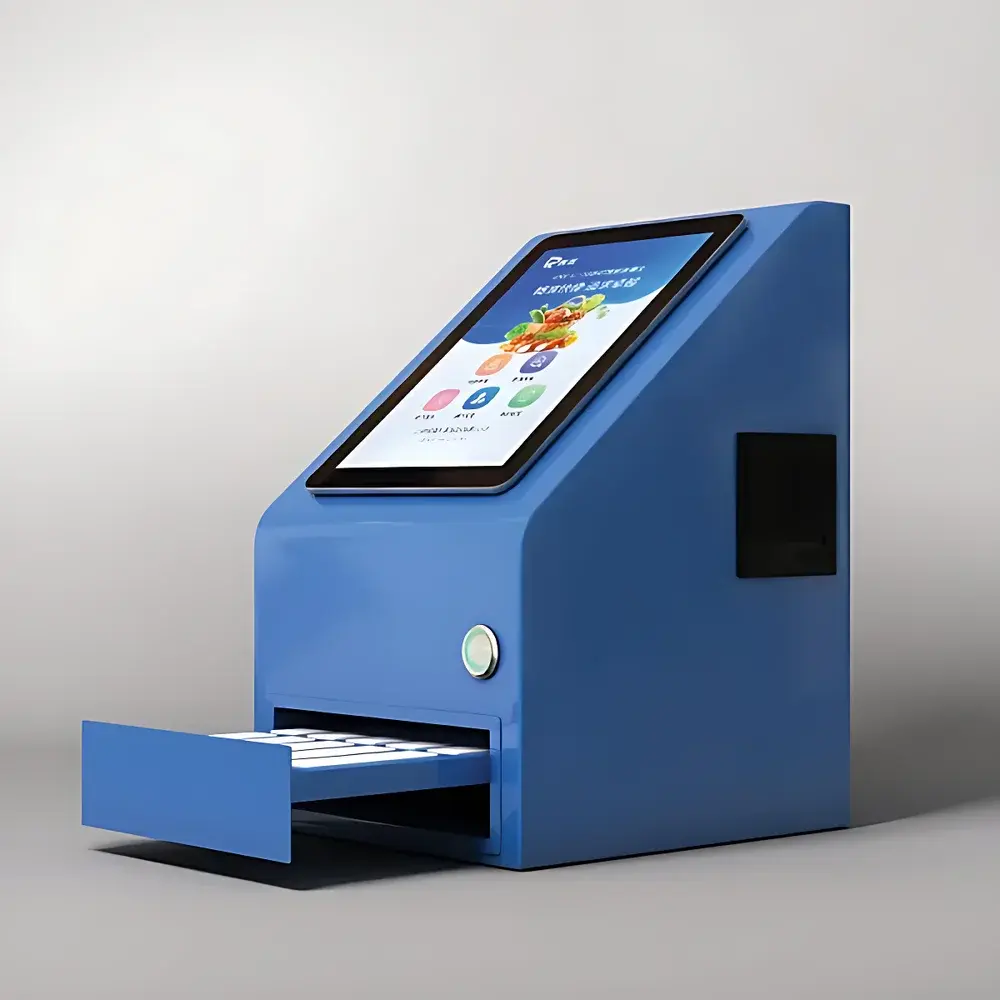
Ruixin JT-108Y Food Safety Rapid Immunoassay Analyzer
| Brand | Ruixin |
|---|---|
| Origin | Shanghai, China |
| Manufacturer Type | Authorized Distributor |
| Model | JT-108Y |
| Price | USD 9,200 (approx.) |
| Function Type | Multi-analyte Immunoassay Platform |
| Sample Compatibility | Universal for Solid & Liquid Food Matrices |
| Wavelength Range | 380–680 nm |
| Detection Time | ≤ 180 seconds per test strip |
| Repeatability | ≤ 0.3% CV |
| Detection Channels | 10 independent optical channels |
| Measurement Speed | < 1 second per channel |
| Output Metrics | Colorimetric intensity, C/T ratio, Test line (T) signal, Control line (C) signal |
| Interface | USB 2.0 |
| Network | Wi-Fi (802.11 b/g/n), RJ45 Ethernet, Optional 4G LTE module |
| Positioning | Integrated GPS/AGPS |
| Power Supply | AC 220 V ±10%, 50 Hz |
| Data Storage | Internal eMMC + microSD slot (up to 512 GB), ≥ 1,000,000 records |
| Display | 10.1-inch capacitive touchscreen, Android OS 11 |
| Printing Options | Thermal label printer (adhesive), thermal roll paper, A4 inkjet-compatible export |
Overview
The Ruixin JT-108Y Food Safety Rapid Immunoassay Analyzer is a CE-compliant, laboratory-grade lateral flow immunoassay (LFIA) quantification system engineered for high-throughput, field-deployable screening of veterinary drug residues, mycotoxins, pesticide metabolites, and adulterants in food supply chains. It operates on the principle of colloidal gold immunochromatography—where antigen–antibody binding on nitrocellulose membranes generates visible or optically detectable test (T) and control (C) lines—and integrates high-resolution CCD imaging with embedded AI-driven image segmentation algorithms to convert qualitative strip readouts into quantitative concentration values (ng/mL or µg/kg). Unlike subjective visual interpretation, the JT-108Y delivers objective, traceable, and auditable results compliant with ISO/IEC 17025 pre-screening guidelines and aligned with China’s *National Food Safety Standard – Determination of Residues in Foods by Colloidal Gold Immunochromatographic Assay* (GB/T 27404–2023). Its dual-purpose design supports both regulatory surveillance at provincial CDCs and rapid QC testing at cooperative farms, slaughterhouses, dairy processors, and wholesale markets.
Key Features
- 10-channel parallel optical detection architecture enables simultaneous analysis of up to 10 lateral flow strips without mechanical sample handling—eliminating cross-contamination risk and reducing operator dependency.
- High-fidelity 10.1-inch industrial-grade touchscreen interface running Android 11 ensures intuitive operation, guided workflow navigation, and real-time result visualization—including false-negative flagging via C-line intensity validation.
- Embedded AI engine performs automatic strip classification (valid/invalid), background correction, and pixel-based T/C ratio calculation with sub-pixel interpolation—achieving ≤0.3% intra-assay repeatability across batched strips.
- Modular connectivity suite includes Wi-Fi, Gigabit Ethernet, and optional 4G LTE with GPS/AGPS geotagging—enabling time-stamped, location-verified data upload to cloud-based LIMS platforms.
- Compliance-ready reporting engine generates QR-coded qualification certificates meeting the specifications of China’s *Pilot Implementation Plan for Edible Agricultural Products Qualification Certificates*, including producer ID, sampling date, analyte name, result status, and batch traceability fields.
- Firmware-upgradable open platform supports remote OTA updates, video-based SOP training modules, and third-party API integration for ERP or government food safety monitoring systems (e.g., NIFDC’s National Food Risk Monitoring System).
Sample Compatibility & Compliance
The JT-108Y accepts standardized colloidal gold test strips from certified manufacturers (e.g., Randox, Romer Labs, Bioo Scientific) as well as domestic OEM strips validated per GB/T 27404–2023 Annex B. Compatible matrices include homogenized muscle tissue (pork, beef, poultry), fish fillet extracts, raw milk, egg yolk supernatants, honey dilutions, grain flour supernatants, feed pellets, and vegetable wash solutions. All assays are calibrated against reference standards traceable to NIM (National Institute of Metrology, China) and cross-validated per AOAC Official Method 2017.01 for LFIA performance criteria. The instrument meets electromagnetic compatibility (EMC) Class B per GB/T 18268.1–2010 and carries CCC certification for domestic deployment. While not FDA 510(k)-cleared, its data output format complies with 21 CFR Part 11 audit trail requirements when deployed with validated cloud infrastructure.
Software & Data Management
Data acquisition, processing, and export are governed by Ruixin’s proprietary *FoodTrace™ v3.2* firmware—designed for GLP-aligned workflows. Each measurement logs raw CCD image (TIFF), processed T/C ratios, pass/fail thresholds, user ID, timestamp, GPS coordinates, and environmental temperature/humidity (via optional external sensor). Records are encrypted at rest (AES-256) and stored locally on eMMC with microSD redundancy. Cloud synchronization uses TLS 1.3-secured MQTT protocol to Ruixin’s ISO 27001-certified SaaS platform, enabling role-based access control, automated statistical dashboards (e.g., weekly residue incidence heatmaps), and export to CSV, PDF, or HL7-compliant XML for integration with provincial food safety information systems. Audit trails capture all user actions—including result edits—with immutable timestamps and digital signatures.
Applications
- Routine surveillance of β-agonists (clenbuterol, ractopamine), fluoroquinolones (enrofloxacin), and macrolides (tylosin) in livestock tissues per GB 29692–2013.
- Multi-mycotoxin screening in corn, wheat, and peanut meal—including aflatoxin B1/M1, zearalenone, deoxynivalenol, and fumonisins—aligned with GB 2761–2023 limits.
- Residue verification in honey for chloramphenicol, nitrofurans, and quinolones under EU Regulation (EC) No 1881/2006 MRL harmonization.
- Pesticide metabolite detection in leafy vegetables (e.g., carbaryl, omethoate, cypermethrin) following GB 2763–2021 multi-residue protocols.
- Adulterant screening in dairy—melamine, β-lactams, sulfonamides, and synthetic hormones—as required by GB 19301–2010 and GB 2761–2023.
- Field-level certification for farmer cooperatives seeking digital qualification certificate issuance per MOA Notice No. 1 [2020].
FAQ
Does the JT-108Y require calibration with reference standards before each use?
No—factory calibration is retained across power cycles; however, daily QC verification using included control strips is recommended per GB/T 27404–2023 Section 7.2.
Can the instrument validate third-party test strips not supplied by Ruixin?
Yes—provided the strip format (e.g., 4mm width, nitrocellulose membrane grade, conjugate pad composition) matches JT-108Y’s optical registration profile; method validation documentation must be submitted for firmware whitelist approval.
Is raw image data export supported for external reanalysis?
Yes—TIFF files with embedded EXIF metadata (exposure time, gain, lens focus) are exportable via USB or cloud sync for independent algorithmic review.
What cybersecurity certifications does the cloud platform hold?
Ruixin Cloud FoodTrace™ holds ISO/IEC 27001:2022 certification (Certificate No. ISMS-2023-XXXXX) and undergoes annual penetration testing by CNITSEC-accredited labs.
How is data integrity maintained during offline operation?
All measurements are timestamped and queued locally with SHA-256 hash chaining; uploads resume automatically upon network restoration without data loss or duplication.





