
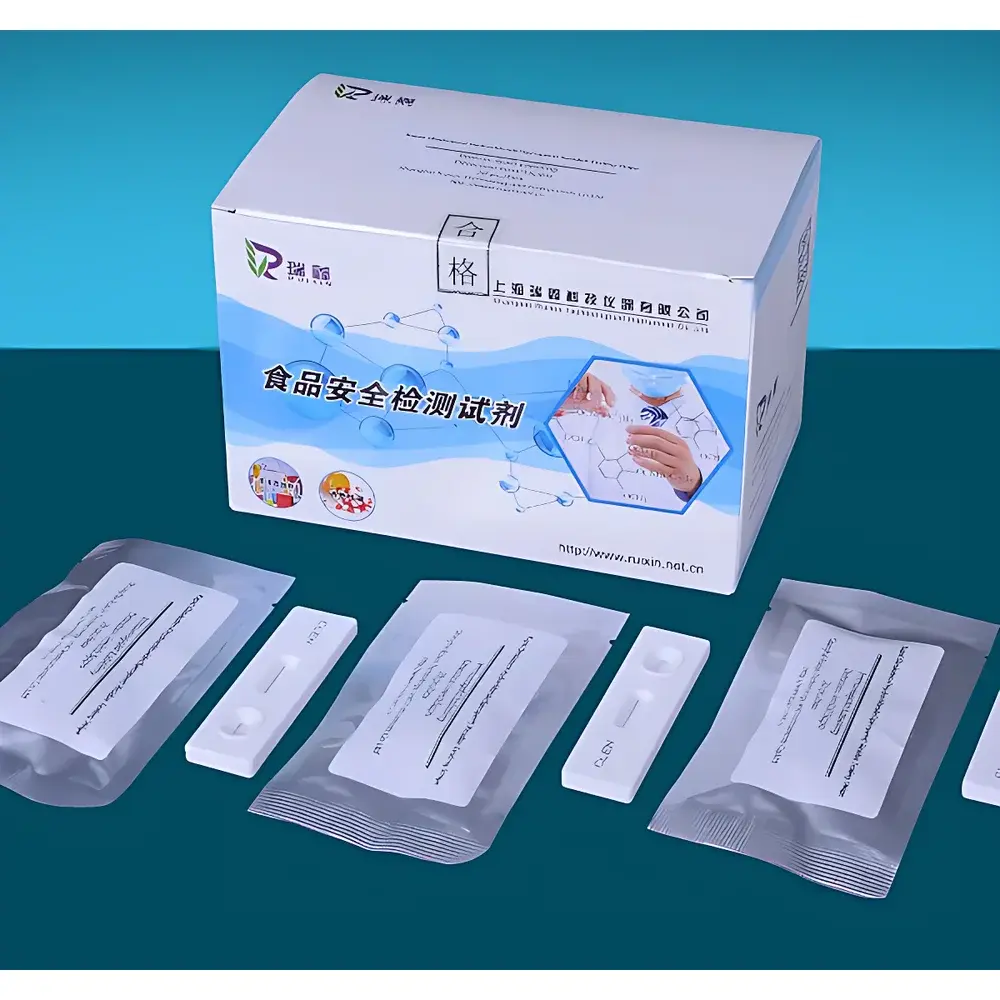
Ruixin JT-K10SY Veterinary Drug Residue Colloidal Gold Immunochromatographic Test Strip
| Brand | Ruixin |
|---|---|
| Model | JT-K10SY |
| Origin | Shanghai, China |
| Type | Lateral Flow Immunoassay (LFIA) Test Strip |
| Format | Single-use, qualitative/semi-quantitative rapid detection card |
| Pack Size | 20 tests per box |
| Detection Principle | Colloidal gold-labeled antibody-based competitive or sandwich immunoassay |
| Target Analytes | Chloramphenicol (0.1 ppb), Malachite Green (0.5 ppb), Diazepam (0.5 ppb), Fluoroquinolones (3 ppb), Olaquindox metabolite (2 ppb), Furazolidone metabolite (0.5 ppb), Furaltadone metabolite (0.5 ppb), Nitrofurantoin metabolite (0.5 ppb), Nifursol metabolite (0.5 ppb), Sulfonamides (5 ppb), Tetracyclines (10 ppb), Penicillins (20 ppb), Diethylstilbestrol (10 ppb), Enrofloxacin (10 ppb), Ofloxacin (1 ppb), Ciprofloxacin (10 ppb), Sarafloxacin (40 ppb), Danofloxacin (50 ppb), Amantadine (2 ppb), Dexamethasone (1 ppb), Chlorpromazine (10 ppb), Florfenicol (0.2 ppb), Metronidazole (3 ppb), Tilmicosin (10 ppb), Clopidol (200 ppb), Streptomycin (20 ppb), Gentamicin (10 ppb), Erythromycin (20 ppb), Oxytetracycline (20 ppb), Chlortetracycline (100 ppb), Sulfadimidine (25 ppb), Ceftiofur (100 ppb), Cefotaxime (200 ppb), Ceftriaxone (50 ppb), Ampicillin (50 ppb), Amoxicillin (20 ppb), Sodium Pentachlorophenate (1 ppb), Avermectins (20 ppb), Thiamphenicol (50 ppb), Apramycin (100 ppb), Methyltestosterone (100 ppb), Nicarbazin (20 ppb), Hydrocortisone (1 ppb), Albendazole (10 ppb), Tylosin (100 ppb), Microcystin-LR (1 ppb), Rosiglitazone (50 ppb), Trimethoprim (50 ppb) |
Overview
The Ruixin JT-K10SY Veterinary Drug Residue Colloidal Gold Immunochromatographic Test Strip is a field-deployable, single-use lateral flow immunoassay (LFIA) system engineered for the rapid, on-site screening of over 50 veterinary drug residues and prohibited substances in animal-derived food matrices—including muscle tissue, liver, kidney, eggs, milk, and honey. Based on well-established colloidal gold nanoparticle–antibody conjugation technology, each test strip operates via either competitive inhibition (for small-molecule haptens such as antibiotics and hormones) or sandwich format (for larger antigens), delivering visual colorimetric readouts within 5–15 minutes without instrumentation. Designed to meet preliminary screening requirements under national food safety surveillance programs, the JT-K10SY series supports compliance with regulatory thresholds defined by China’s GB 31650–2019, EU Commission Regulation (EU) No 37/2010, and Codex Alimentarius standards for maximum residue limits (MRLs). Its robust membrane architecture ensures consistent capillary flow and minimal matrix interference across diverse sample types when used with validated extraction protocols.
Key Features
- Multi-analyte portfolio: 58 distinct test configurations covering antibiotics (β-lactams, fluoroquinolones, sulfonamides, tetracyclines, macrolides, aminoglycosides), nitrofurans and their metabolites, chloramphenicol, anabolic agents (diethylstilbestrol, methyltestosterone), tranquilizers (diazepam, chlorpromazine), corticosteroids (dexamethasone, hydrocortisone), antiparasitics (ivermectin-class, albendazole), mycotoxins (microcystin-LR), and environmental contaminants (pentachlorophenol).
- Precision-engineered sensitivity: Detection limits range from 0.1 ppb (chloramphenicol in tissue) to 200 ppb (clopidol), calibrated against reference standards traceable to NIST or CRM-certified materials; all cutoff levels align with internationally recognized MRLs.
- Standardized 20-test format per foil-sealed pouch: Each box contains individually wrapped strips, desiccant packs, and batch-specific control lines—ensuring stability up to 18 months at 4–30 °C when unopened.
- No instrument dependency: Visual interpretation supported by built-in control (C) and test (T) lines; optional semi-quantitative analysis achievable using standardized chromatic charts or portable reflectance readers (e.g., Ruixin R-Reader Pro, sold separately).
- Regulatory-aligned workflow: Compatible with AOAC Official Method 2012.05 (for chloramphenicol), ISO 12439:2012 (for nitrofuran metabolites), and GB/T 22338–2008 (for sulfonamides) sample preparation procedures.
Sample Compatibility & Compliance
The JT-K10SY test strips are validated for use with homogenized animal tissues (bovine, porcine, poultry), egg homogenates, raw and pasteurized milk, and honey following specified dilution and centrifugation steps. Cross-reactivity profiles are documented for each assay—for example, the fluoroquinolone strip exhibits ≥85% cross-reactivity with enrofloxacin, ciprofloxacin, ofloxacin, and norfloxacin, while showing <5% reactivity with unrelated antimicrobial classes. All kits comply with ISO/IEC 17025 preconditions for method validation and support GLP-compliant recordkeeping when integrated into laboratory information management systems (LIMS). Documentation packages include Certificate of Analysis (CoA), lot-specific performance data, and conformity statements referencing GB/T 27404–2008 (Laboratory Quality Control Guidelines for Food Microbiology and Residue Testing).
Software & Data Management
While the JT-K10SY functions as a stand-alone rapid test, digital integration is supported via Ruixin’s optional R-Link Data Manager software (v3.2+), which enables barcode-assisted result logging, time-stamped audit trails, PDF report generation, and export to CSV or XML for ingestion into enterprise LIMS or food safety dashboards. The software enforces user authentication, electronic signatures, and configurable pass/fail criteria aligned with internal SOPs or third-party certification schemes (e.g., BRCGS, SQF, ISO 22000). All data handling conforms to GDPR and China’s PIPL requirements for personal and operational data protection.
Applications
- Pre-slaughter screening at abattoirs and collection centers
- In-process quality assurance in meat processing facilities
- Import/export border inspection laboratories performing rapid triage
- Contract testing labs conducting high-throughput surveillance under national residue monitoring plans (NRMPs)
- Research institutions validating novel extraction methods or assessing carryover effects in feed-to-food chains
- Field veterinarians supporting on-farm withdrawal period verification
FAQ
Are these test strips approved for official residue monitoring programs?
Yes—selected JT-K10SY assays (e.g., chloramphenicol, nitrofuran metabolites, sulfonamides) have undergone independent validation per ISO 13843 and are listed in China’s National Monitoring Plan Annex II for rapid screening tools.
Can results be used for regulatory enforcement decisions?
No—per CNAS-CL01:2018 and EU Decision 2002/657/EC, positive results must be confirmed by LC-MS/MS or GC-MS/MS prior to regulatory action.
What is the shelf life and storage requirement?
18 months from manufacture date when stored at 4–30 °C in original sealed packaging; avoid freezing and direct sunlight.
Is training required to interpret results reliably?
We recommend completion of Ruixin’s certified LFIA Interpretation Workshop (online or onsite), particularly for borderline T-line intensities; inter-operator concordance exceeds 98.7% after standardized training.
Do you provide method transfer support for accredited labs?
Yes—Ruixin offers full technical documentation packages, including validation reports, spike recovery studies, and collaborative inter-laboratory trials upon request.





