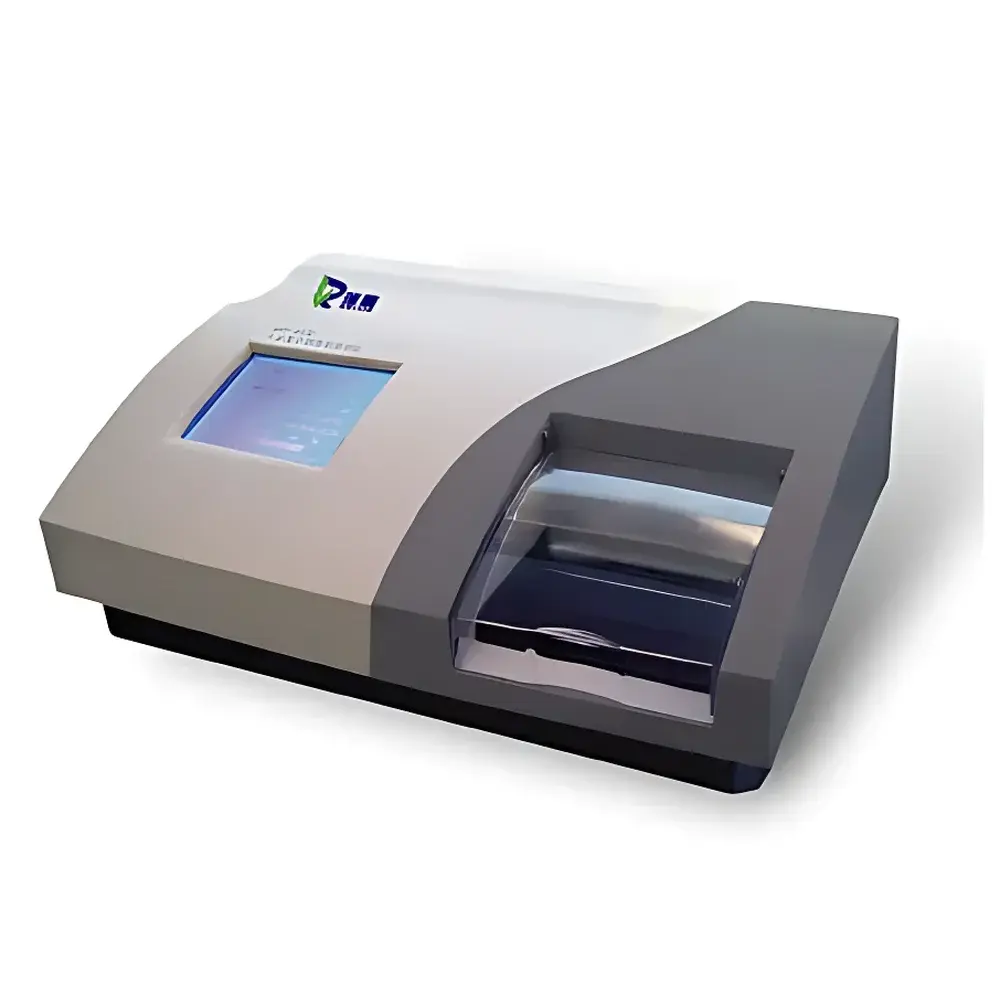
Ruixin NCD-96S Veterinary Drug Residue Analyzer
| Brand | Ruixin |
|---|---|
| Origin | Shanghai, China |
| Model | NCD-96S |
| Function Type | Multi-analyte Quantitative & Qualitative Detection |
| Sample Compatibility | Universal for Animal-Derived Food Matrices |
| Wavelength Range | 400–1100 nm |
| Detection Time | ≤3 min per 96-well plate |
| Photometric Repeatability | ±0.005 A (0–2 A) |
| Detection Channels | 96-well microplate format |
| Optical System | Auto-calibrating 8-channel photometric system with standard filters at 405/450/492/630 nm (expandable to 10 filters) |
| Light Source | Quartz halogen lamp with auto-dimming idle mode |
| Absorbance Range | 0.000–4.000 A |
| Resolution | 0.001 A |
| Accuracy | ±1% (0–2 A) |
| Linearity Error | ±0.1% (0–2 A) |
| Inter-channel Variation | ≤0.02 A |
| Stability | ≤0.005 A/h |
| Stray Light | ≥2.0 A at 510 nm using 50.0 g/L sodium nitrite solution |
| Plate Read Time | 5 s |
| Data Storage | ≥100,000 test records |
| Analysis Methods | 9 algorithmic models including linear regression, semi-log, log-log, ratio-based, exponential, and quadratic curve fitting |
| Compliance Support | Configurable audit trail, user access levels, and data export compliant with GLP documentation workflows |
Overview
The Ruixin NCD-96S Veterinary Drug Residue Analyzer is a dedicated microplate-based photometric immunoassay platform engineered for high-throughput, quantitative and qualitative screening of veterinary drug residues, mycotoxins, hormones, and pathogen antigens in food safety laboratories. It operates on the principle of enzyme-linked immunosorbent assay (ELISA), where analyte concentration in extracted samples is inversely or directly proportional to absorbance measured at specific wavelengths following enzymatic color development. Designed for routine use in QC/QA labs of slaughterhouses, aquaculture processors, dairy facilities, grain mills, and third-party testing centers, the NCD-96S delivers reproducible optical density (OD) measurements across all 96 wells simultaneously—enabling batch analysis of up to 90 samples plus controls in under three minutes. Its 400–1100 nm spectral range accommodates standard ELISA substrates (e.g., TMB, OPD) as well as emerging chromogenic and fluorogenic assays requiring extended wavelength flexibility.
Key Features
- True-color 7-inch capacitive touchscreen (800 × 480 resolution) with Windows-style GUI and native Chinese language interface for intuitive operation without external PC dependency
- Self-diagnostic startup sequence verifying optical path alignment, filter wheel positioning, lamp intensity, and mechanical carriage integrity—with real-time error codes displayed on-screen
- Automated 8-channel photometric system with motorized filter changer; standard set includes 405 nm, 450 nm, 492 nm, and 630 nm interference filters; optional expansion to 10 wavelengths
- Dual-mode detection: selectable single/dual wavelength and single/dual reference well configurations to optimize signal-to-noise ratio and compensate for background interference
- Flexible plate layout editor supporting horizontal or vertical arrangement of standards, controls, and unknowns—fully customizable per assay protocol
- Intelligent light source management: quartz halogen lamp automatically reduces to standby voltage during idle periods, extending operational lifetime beyond 2,000 hours
- Embedded thermal printer enabling immediate hardcopy output of raw OD values, calculated concentrations, cut-off ratios (P/CO), and qualitative pass/fail determinations
- Onboard data management supporting ≥100,000 test records, 200 programmable assay protocols, and 126 stored calibration curves with editable parameters and traceable version history
Sample Compatibility & Compliance
The NCD-96S is validated for use with homogenized, centrifuged, and filtered extracts from diverse food matrices—including muscle tissue, liver, kidney, fish fillet, shrimp, milk, cheese, eggs, honey, feed, corn, wheat, soybean meal, and edible oils. It supports regulatory screening methods aligned with national standards (e.g., GB/T 22338–2008 for chloramphenicol, GB/T 21312–2007 for β-agonists) and internationally referenced immunoassay kits certified by AOAC PTM or CNAS-accredited manufacturers. While not FDA 21 CFR Part 11–validated out-of-the-box, its software architecture permits configuration of electronic signatures, audit trails, and role-based access control—facilitating alignment with GLP and GMP documentation requirements when deployed within validated laboratory information management systems (LIMS).
Software & Data Management
The instrument integrates Ruixin’s proprietary R-ELISA Suite firmware, which enables full local control including protocol loading, kinetic reading, curve fitting, and result classification. Data export is supported via RS-232 serial port or USB 2.0 interface in native .CSV and Excel-compatible .XLSX formats. Optional PC-hosted desktop software provides centralized instrument control, multi-instrument fleet monitoring, statistical process control (SPC) charting, trend analysis across time-series batches, and automated report generation meeting ISO/IEC 17025 clause 7.8.2 requirements for result reporting. All exported datasets retain metadata including operator ID, timestamp, plate ID, calibration curve ID, and raw OD matrix—ensuring full traceability.
Applications
- Quantitative detection of antibiotics: chloramphenicol, streptomycin, sulfonamides, nitrofurans, tetracyclines, malachite green, diethylstilbestrol
- Hormone screening in meat: clenbuterol hydrochloride, ractopamine, salbutamol, dexamethasone
- Mycotoxin analysis in grains and oilseeds: aflatoxin B1/M1, zearalenone, deoxynivalenol (DON)
- Dairy safety verification: β-lactam antibiotics, melamine, staphylococcal enterotoxin B (SEB)
- Pathogen antigen detection: Salmonella spp., Listeria monocytogenes, E. coli O157:H7 via rapid lateral-flow strip reader mode (optional accessory support)
FAQ
What types of immunoassay formats does the NCD-96S support?
It supports direct, indirect, competitive, and sandwich ELISA formats—as well as rapid lateral flow strip scanning when used with optional adapter hardware.
Can calibration curves be imported from external sources?
Yes—users may import pre-defined standard curves in CSV format, assign them to specific assay IDs, and apply them to subsequent runs with full version logging.
Is remote software update capability available?
Firmware updates are performed locally via USB flash drive; no cloud-based OTA functionality is implemented to maintain air-gapped lab security compliance.
Does the instrument meet electromagnetic compatibility (EMC) standards for laboratory environments?
It complies with GB/T 18268.1–2010 (equivalent to IEC 61326-1:2012) for industrial and laboratory use, including electrostatic discharge (ESD) and radiated immunity testing.
How is user accountability maintained during operation?
Each measurement event logs operator name (via login), date/time stamp, plate barcode (if scanned), and active protocol ID—supporting manual or electronic signature workflows per internal SOPs.
Related Products