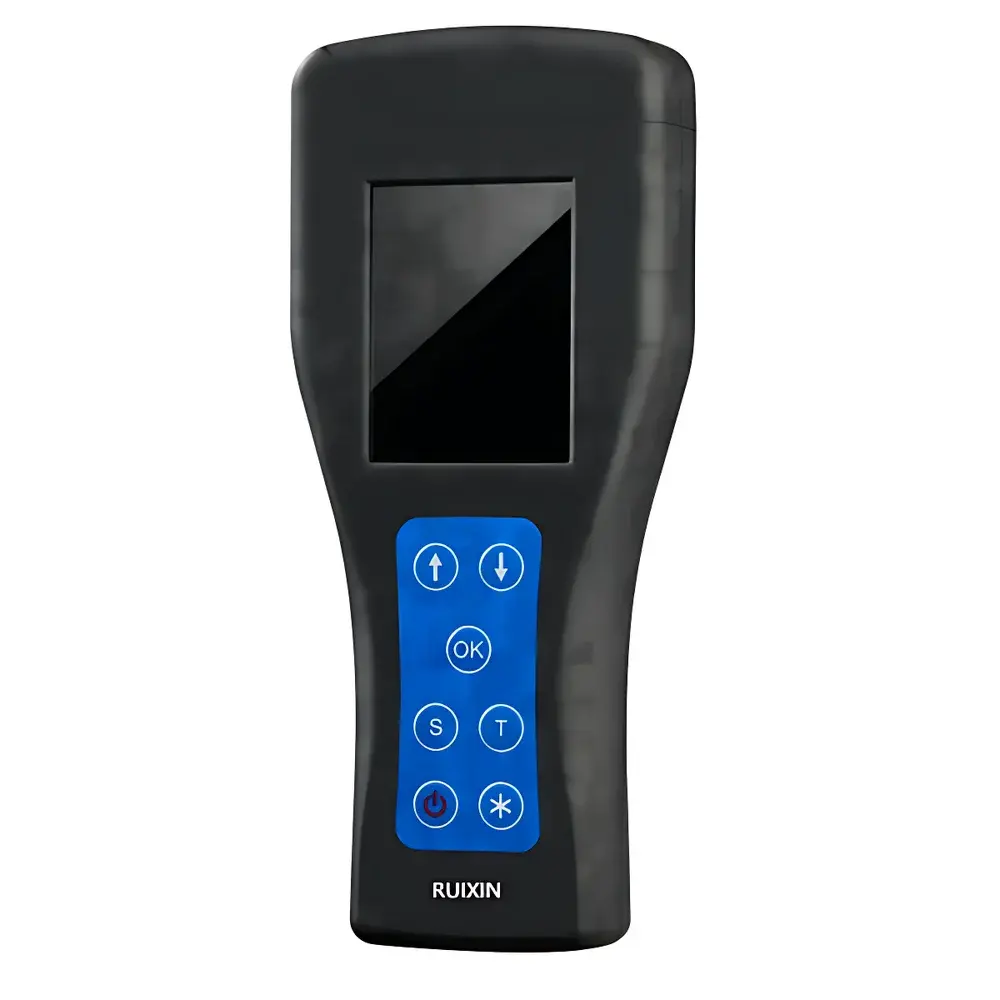
Ruixin RFE-3 ATP Bioluminescence Analyzer
| Brand | Ruixin |
|---|---|
| Origin | Shanghai, China |
| Manufacturer Type | Authorized Distributor |
| Country of Origin | China |
| Model | RFE-3 |
| Price Range | USD 4,200 – 7,000 |
| Detection Range | 0–9999 RLU |
| LOD | 1×10⁻¹⁶ mol ATP |
| Detection Time | 10 s |
| Repeatability | CV ≤ 8% |
| Detection Channels | 1 |
| Display | LCD |
| Detection Principle | Bioluminescent reaction between ATP and luciferin-luciferase complex |
| Communication Interface | RS232 (Wi-Fi optional per firmware upgrade) |
| Power Supply | Rechargeable Li-ion battery |
| Form Factor | Handheld |
| Net Weight | 400 g |
| Light Source | LED |
| Sample Volume | 1 mL per swab |
| Swab Tube Dimensions | Ø12 × 155 mm |
| Data Storage | 2000 records |
| Limit Sets | 100 user-defined thresholds |
| Operating Temperature | 0–60 °C |
| Relative Humidity | 15–95% RH |
| Battery Life | ≥200 h (AA alkaline, 2 pcs) or equivalent Li-ion cycle |
| Output Units | RLU and configurable CFU (via user-defined conversion factor) |
| Compliance | ISO 15161:2001 (Food & Beverage sector application of ISO 9001), aligned with ISO 22000 hygiene validation requirements |
Overview
The Ruixin RFE-3 ATP Bioluminescence Analyzer is a handheld, field-deployable instrument engineered for rapid, quantitative assessment of surface hygiene and microbial load in food production, processing, and distribution environments. It operates on the well-established principle of firefly luciferase-mediated bioluminescence: when ATP—present in viable cells and organic residues—is introduced to a stabilized reagent containing luciferin and luciferase, an oxidative reaction occurs, emitting photons proportional to ATP concentration. The RFE-3 captures this emitted light using a high-sensitivity photodiode coupled with a temperature-compensated LED excitation system and converts signal intensity into Relative Light Units (RLU). Unlike qualitative swab tests, the RFE-3 delivers traceable, numerical output calibrated against certified ATP standards, enabling objective pass/fail decisions based on preconfigured hygiene thresholds. Its design prioritizes robustness in non-laboratory settings—no external power source, climate-controlled room, or optical darkroom required.
Key Features
- True handheld architecture: Compact dimensions (86 × 189 × 33 mm) and net weight of 400 g enable one-handed operation during line audits, cold storage inspections, or mobile sanitation verification.
- Sub-second photometric response: Integrated 2000-Hz sampling rate ensures stable RLU integration over the standard 10-second measurement window, minimizing operator-induced variability.
- Dual-unit reporting: Direct RLU readout supplemented by user-configurable CFU estimation via built-in conversion algorithms—supporting facility-specific correlation models validated per ISO 22000 Annex H or internal SOPs.
- Low-power, long-duration operation: Optimized circuitry supports >200 hours of continuous use on two AA alkaline cells or equivalent rechargeable Li-ion packs—critical for shift-based QA teams and remote facility audits.
- Environmental resilience: Rated for operation across 0–60 °C and 15–95% RH, including refrigerated zones, wet processing floors, and ambient warehouse conditions without condensation-related drift.
- Intuitive human interface: Backlit LCD with navigable menu tree, tactile keypad, and on-device data entry—eliminating dependency on external tablets or PCs during real-time monitoring.
Sample Compatibility & Compliance
The RFE-3 is validated for use with standardized liquid-stabilized ATP swabs (Ø12 × 155 mm tube format, 1 mL elution volume), compatible with major commercial ATP test kits meeting AOAC PTM-01-001 performance criteria. It supports full auditability under GLP/GMP-aligned workflows: timestamped records include RLU value, threshold ID, operator code, location tag, and swab lot number (manually entered). Data export via RS232 enables integration into LIMS or electronic batch record systems. While not FDA 21 CFR Part 11-certified out-of-the-box, its firmware architecture permits secure user authentication, electronic signature logging, and immutable audit trails when deployed with compliant middleware—fulfilling ISO 15161:2001 clause 8.2.4 (monitoring and measurement process control) and supporting HACCP prerequisite program verification.
Software & Data Management
On-device memory retains 2000 measurement records with full metadata. Optional PC software (Windows/macOS compatible) enables batch export to CSV/Excel, statistical trend analysis (X-bar/R charts), and automated report generation per shift, line, or zone. Threshold management allows up to 100 site-specific limits—e.g., “Conveyor Belt Post-CIP: ≤100 RLU”, “Fill Nozzle Pre-Use: ≤30 RLU”—with visual pass/fail indicators on-screen. Wi-Fi capability (firmware-upgradable) permits encrypted transmission to cloud dashboards or local servers, satisfying traceability requirements in multi-site quality management systems. All data fields are editable only by authorized users with role-based access credentials.
Applications
- Routine sanitation verification across food contact surfaces (conveyors, mixers, fillers, valves) post-clean-in-place (CIP) or manual wipe-down.
- Validation of cleaning efficacy during SSOP development and periodic requalification per ISO 22000 Clause 8.2.3.
- Raw material screening (e.g., incoming dairy tanks, grain silos, produce wash water) where rapid ATP screening supplements microbiological culture methods.
- Environmental monitoring in low-moisture facilities (baking, snack production) where traditional agar-based methods underestimate biofilm-associated contamination.
- Training and competency assessment: Real-time feedback reinforces proper swabbing technique and cleaning protocol adherence among frontline staff.
FAQ
What does RLU mean, and how is it related to microbial count?
RLU (Relative Light Unit) is an instrument-specific photometric output reflecting total ATP-derived photon flux. It is not a direct CFU measure but correlates empirically with viable microorganisms and residual organics. Conversion to CFU requires facility-specific calibration using parallel plate counts under controlled conditions.
Can the RFE-3 be used for liquid samples like milk or juice?
Yes—when paired with appropriate dilution protocols and validated swab/elution methods per ISO 21528-2, it quantifies ATP in raw milk, whey, or beverage lines to detect early-stage spoilage or post-pasteurization recontamination.
Is routine calibration required?
The RFE-3 performs automatic zero-point correction before each measurement. Annual verification against NIST-traceable ATP standards (e.g., Sigma-Aldrich A7699) is recommended for ISO 17025-accredited labs.
How does it handle background luminescence from cleaning agents?
The instrument’s spectral filtering and short integration window minimize interference from common quaternary ammonium compounds and peracetic acid residues; however, thorough rinsing prior to swabbing remains essential per AOAC guidelines.
Does it support regulatory submissions?
Raw RLU data, timestamps, and operator logs meet documentation requirements for FDA Food Safety Modernization Act (FSMA) preventive controls verification and EU Regulation (EC) No 852/2004 Annex II hygiene monitoring records.