
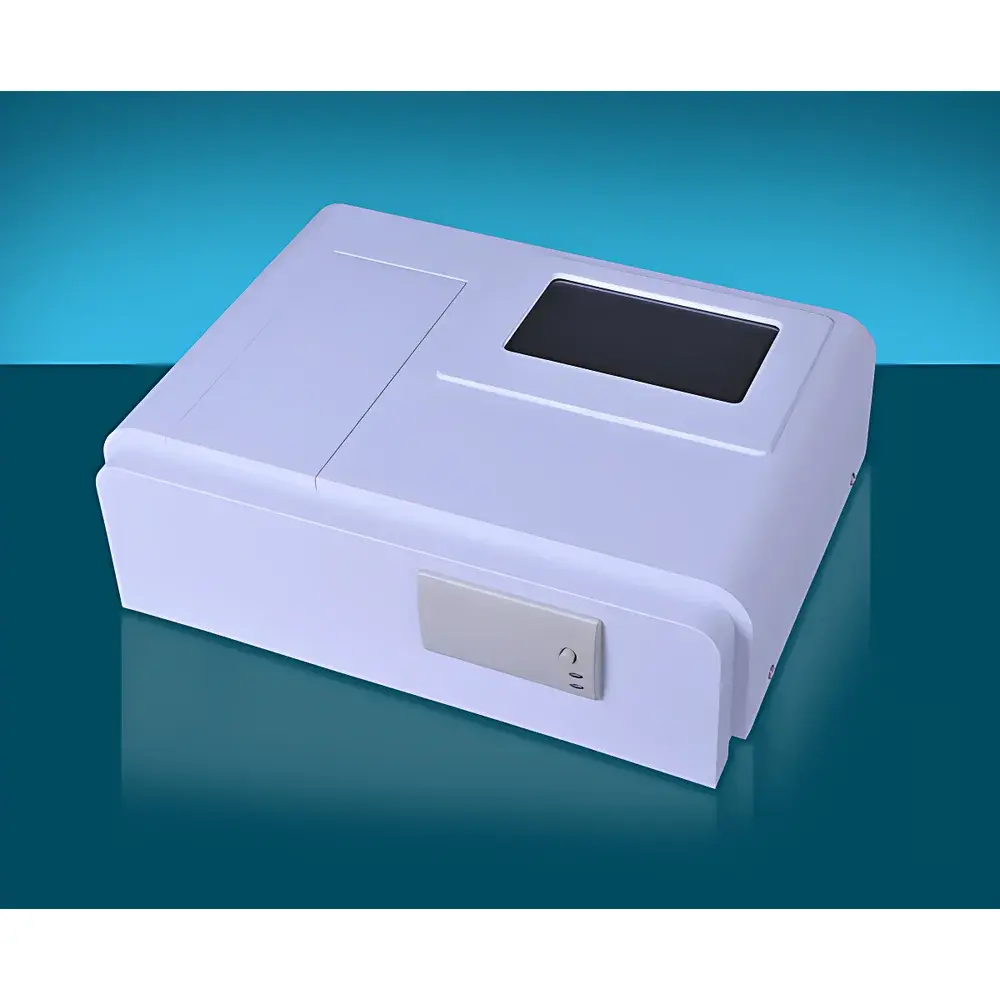
Ruixin SP-1001T Tea Safety Analyzer
| Brand | Ruixin |
|---|---|
| Model | SP-1001T |
| Origin | Shanghai, China |
| Wavelength Range | 400–680 nm |
| Detection Time | <2 min |
| Repeatability | <5% |
| Detection Channels | 8 |
| Photometric Accuracy | ±2.0% T |
| Photometric Repeatability | 1.0% T |
| Dark Current Drift | 0.5% (3 min) |
| Dimensions | 470 × 280 × 150 mm |
| Function Type | Single-analyte Quantitative Detection |
| Sample Compatibility | Multi-sample Universal Format |
| Interface | USB |
| Data Output | Built-in Thermal Printer + PC Software Integration |
Overview
The Ruixin SP-1001T Tea Safety Analyzer is a dedicated photometric quantification system engineered for rapid, on-site screening of regulated contaminants and quality markers in tea and related botanical matrices. Operating on the principle of visible-light absorbance spectroscopy (400–680 nm), the instrument employs fixed-wavelength or multi-point spectral interrogation to quantify target analytes—such as pesticide residues (e.g., carbendazim, pyrethrins), heavy metals (via chelation-based colorimetric assays), mycotoxins (e.g., ochratoxin A), and polyphenol oxidation markers—based on calibrated calibration curves. Designed for compliance with preliminary screening protocols under national food safety standards (e.g., GB 2763–2021, GB 5009 series), it delivers quantitative results in under two minutes per sample without requiring laboratory-grade infrastructure. Its architecture integrates optical path stabilization, temperature-compensated photodiode detection, and embedded firmware optimized for low-interference matrix handling—critical for heterogeneous, pigmented, and tannin-rich tea infusions and powdered extracts.
Key Features
- Eight independent optical detection channels enable parallel analysis of up to eight samples or replicates per run, significantly improving throughput in batch screening workflows.
- 7-inch backlit LCD touchscreen with native Chinese UI supports intuitive navigation, real-time concentration display (mg/kg or µg/L), and context-sensitive operational prompts—minimizing operator training requirements.
- Dual-curve architecture: pre-loaded factory calibration curves (validated against certified reference materials) coexist with user-definable curve sets, supporting method adaptation across diverse tea cultivars (e.g., green, oolong, pu-erh) and extraction protocols.
- Open parameter configuration allows adjustment of incubation time, reaction volume, dilution factor, and wavelength selection—enabling method optimization for non-standardized assays or emerging contaminants.
- Integrated thermal printer provides immediate hard-copy documentation of results, including sample ID, timestamp, operator code, and pass/fail flags aligned with regulatory threshold limits.
- USB 2.0 interface enables bidirectional data exchange with Windows-based Food Analysis Data Management Software (v3.2+), supporting audit-ready export in CSV, PDF, and XML formats.
- Automatic result archiving retains ≥10,000 test records with searchable metadata (date/time, assay type, operator, instrument ID), compliant with GLP documentation traceability requirements.
Sample Compatibility & Compliance
The SP-1001T accepts liquid extracts (aqueous or ethanol-based), clarified filtrates, and homogenized suspensions prepared from dry tea leaves, compressed cakes, instant granules, and blended herbal infusions. Sample introduction uses standard 10-mm pathlength cuvettes or disposable microcuvettes (optional), minimizing carryover risk. The system adheres to fundamental performance criteria outlined in ISO 7027 (water quality — determination of turbidity) and adapted principles from AOAC Official Method 2012.01 (colorimetric pesticide screening). While not a confirmatory instrument, its repeatability (<5% RSD) and photometric accuracy (±2.0% T) meet the acceptance thresholds specified in China’s JJF 1523–2015 verification regulation for rapid food safety analyzers. It supports internal QC checks using NIST-traceable neutral density filters and blank correction routines to mitigate matrix-induced baseline drift.
Software & Data Management
The bundled Food Analysis Data Management Software operates under Windows 10/11 and provides role-based access control (administrator, technician, reviewer). Core functions include curve validation reporting (linearity R² ≥ 0.995), QC flagging (out-of-control points per Westgard rules), electronic signature capture, and automated report generation compliant with FDA 21 CFR Part 11 Annex 11 expectations for audit trails. Data synchronization supports secure upload to provincial food monitoring platforms via TLS 1.2–encrypted HTTP(S) endpoints. All raw absorbance values, calibration logs, and instrument diagnostics are stored locally with SHA-256 hashing to ensure data integrity and tamper evidence.
Applications
- Routine surveillance of tea processing facilities for residual chlorpyrifos and triazophos in raw leaf lots prior to blending.
- On-farm verification of post-harvest fungicide application compliance in Fujian and Yunnan growing regions.
- Quality control of instant tea powders for catechin degradation index (CDI) via FeCl₃-based colorimetry.
- Import inspection laboratories performing first-line triage of consignments flagged by customs risk algorithms.
- Research applications assessing antioxidant capacity (FRAP assay) and heavy metal bioaccessibility (in vitro digestion models).
FAQ
Is the SP-1001T suitable for quantitative analysis under ISO/IEC 17025-accredited testing?
No—it is designed for rapid screening and semi-quantitative decision support, not definitive quantification. Confirmatory analysis requires LC-MS/MS or ICP-MS per ISO/IEC 17025 requirements.
Can custom assay protocols be validated and locked into the instrument firmware?
Yes. Users may import validated SOPs (including reagent lot numbers, incubation parameters, and acceptance criteria) via encrypted USB key; firmware enforces protocol execution without modification during routine use.
Does the system support remote diagnostics or firmware updates?
Firmware updates require local USB installation; remote diagnostics are not implemented to maintain data sovereignty and network isolation per China’s Cybersecurity Law requirements.
What is the recommended maintenance interval for optical alignment verification?
Optical path verification using certified neutral density filters is advised every 90 days or after 500 measurement cycles, documented in the built-in maintenance log.
Are consumables proprietary or third-party compatible?
Cuvettes and reagent kits are standardized (10-mm pathlength, ANSI/SCTE-compliant); however, Ruixin-certified reagents are recommended to maintain stated accuracy and repeatability specifications.
Related Products






