
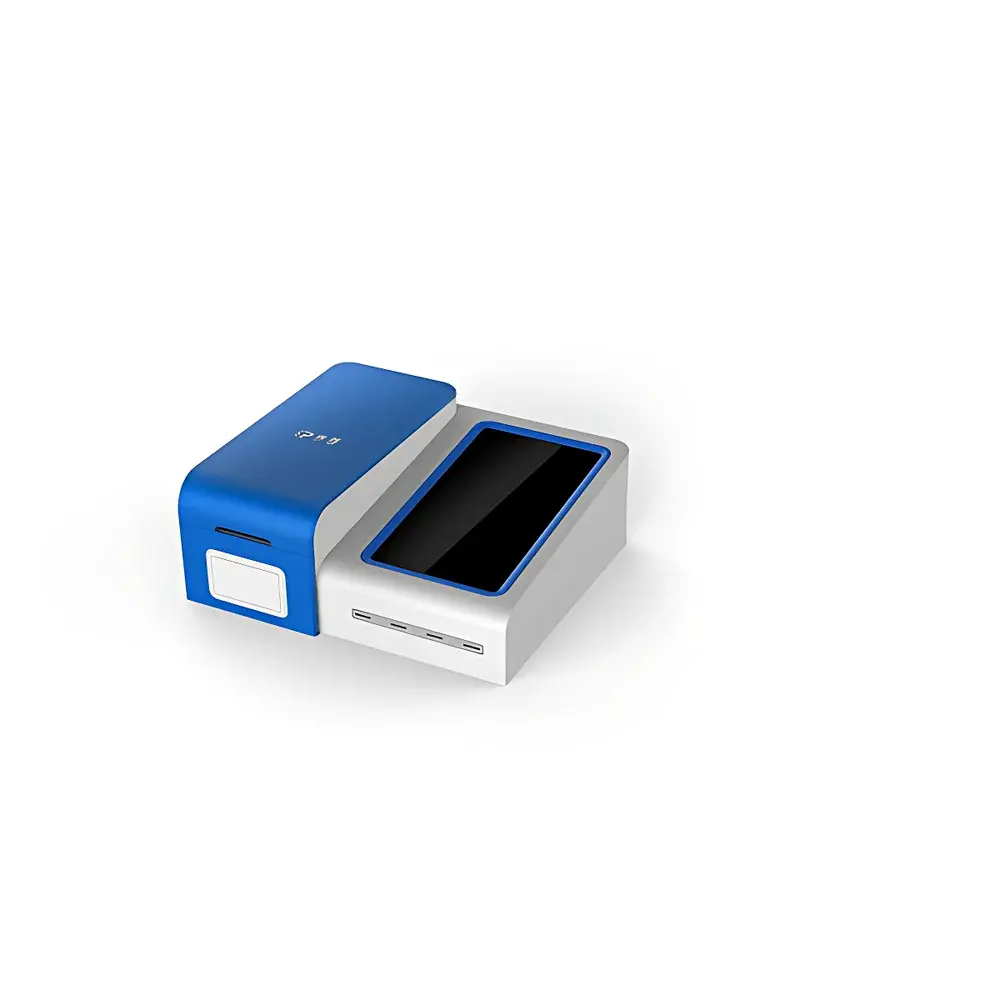
Ruixin SP-2418D Multi-Parameter Food Safety Analyzer
| Brand | Ruixin |
|---|---|
| Origin | Shanghai, China |
| Model | SP-2418D |
| Function Type | Multi-parameter rapid detection (expandable to 100+ assays) |
| Wavelength Range | 380–680 nm |
| Detection Time | ≤3 min per assay |
| Photometric Repeatability | ≤0.2% T |
| Optical Channels | 24 independent photometric channels |
| Colloidal Gold Reader Modules | 3 standard (expandable to 10) |
| Display | 10.1″ capacitive touchscreen (Android OS) |
| Data Connectivity | RJ45 Ethernet, Wi-Fi 802.11 b/g/n, Bluetooth 4.2, 4G LTE Cat.4 |
| Power Supply | AC 220 V ±10% |
| Absorbance Range | 0.000–4.000 A |
| Transmittance Range | 0.00–100.00% T |
| Transmittance Resolution | 0.01% T |
| Absorbance Resolution | 0.001 A |
| Photometric Accuracy | ±2.0% T |
| Photocurrent Drift | ≤0.2% (3 min) |
| Overall Measurement Accuracy | ±5% (relative to reference methods) |
Overview
The Ruixin SP-2418D Multi-Parameter Food Safety Analyzer is an integrated, field-deployable optical detection platform engineered for regulatory-grade screening of chemical contaminants, biological toxins, and adulterants in food, agricultural commodities, dairy, meat, aquatic products, dietary supplements, cosmetics, and environmental samples. It combines dual-mode optical detection—24-channel visible-spectrum photometry (380–680 nm) and modular colloidal gold immunochromatographic strip analysis—to deliver simultaneous quantitative and semi-quantitative results across diverse analyte classes. The instrument operates on a validated Android-based embedded system with real-time data acquisition, onboard calibration management, and full traceability support. Its architecture aligns with the operational requirements of national food safety surveillance programs, mobile inspection units, and decentralized laboratory networks where rapid triage, audit-ready documentation, and interoperability with centralized cloud platforms are essential.
Key Features
- 24 independent photometric channels with programmable wavelength selection within 380–680 nm, enabling parallel quantification of colorimetric assays (e.g., formaldehyde, sulfites, nitrites, peroxide value, acid value, amino nitrogen) without cross-channel interference.
- Modular colloidal gold reader with three standard detection lanes (expandable to ten), supporting automated interpretation of lateral flow strips via C/T line intensity ratio, chromaticity analysis, and threshold-based classification per FDA/ISO 15197:2013 principles.
- 10.1-inch high-brightness capacitive touchscreen interface running a hardened Android 9.0 OS, featuring intuitive bilingual (English/Chinese) UI, offline operation capability, and local storage for ≥100,000 test records with timestamp, operator ID, and GPS metadata (when enabled).
- Embedded thermal printer for immediate hard-copy reporting per channel, including sample ID, assay name, result, cutoff value, pass/fail status, and QC flag indicators.
- Multi-modal connectivity: triple USB 3.0 ports, RJ45 Gigabit Ethernet, IEEE 802.11 b/g/n Wi-Fi, Bluetooth 4.2, and embedded 4G LTE Cat.4 module for seamless synchronization with Ruixin Cloud or third-party LIMS via HTTPS/RESTful API.
- Fully open assay configuration framework—users may import validated method templates, define custom calibration curves, assign LOD/LOQ thresholds, and configure pass/fail logic without firmware modification.
Sample Compatibility & Compliance
The SP-2418D accommodates liquid extracts, homogenized suspensions, centrifuged supernatants, and strip-based lateral flow assays derived from raw or processed food matrices—including fruits, vegetables, grains, edible oils, dairy products, meat, seafood, honey, spices, and herbal supplements. Sample preparation follows AOAC Official Method guidelines, ISO 22000:2018-aligned protocols, and China’s GB standards (e.g., GB 5009 series). Instrument performance meets ISO/IEC 17025:2017 requirements for measurement uncertainty estimation in screening applications. Data integrity complies with ALCOA+ principles; audit trails record all user actions, calibration events, and result modifications. Optional 21 CFR Part 11 compliance mode supports electronic signatures, role-based access control, and immutable log export for GLP/GMP environments.
Software & Data Management
The embedded Ruixin AnalyzeOS provides end-to-end workflow control—from sample registration and reagent lot tracking to result validation and report generation. All data are encrypted at rest (AES-256) and in transit (TLS 1.2+). Cloud synchronization enables centralized dashboard monitoring, geospatial heat mapping of contamination trends, batch-level statistical process control (SPC), and automated alerting upon threshold breaches. Raw absorbance/reflectance values, image captures of test strips, and calibration logs are preserved for retrospective reanalysis. Export formats include CSV, PDF (with digital signature), and HL7-compatible XML for integration into national food safety information systems.
Applications
- Routine surveillance of pesticide residues (organophosphates, carbamates, pyrethroids, neonicotinoids) in produce and cereals using enzyme inhibition or immunoassay formats.
- Quantitative detection of food additives (benzoic acid, sorbic acid, sulfur dioxide) and illegal adulterants (melamine, Sudan dyes, Rhodamine B, formaldehyde) in processed foods.
- Screening for veterinary drug residues—including β-agonists (clenbuterol, ractopamine), fluoroquinolones, tetracyclines, sulfonamides, and nitrofurans—in meat, aquaculture, and honey.
- Analysis of mycotoxins (aflatoxin B1/M1, ochratoxin A, zearalenone, deoxynivalenol) in grains and dairy using competitive ELISA-like strip formats.
- Heavy metal screening (Pb, Cd) via colorimetric chelation assays compliant with GB 5009.12/5009.15.
- Authentication testing for GMO markers (Bt Cry1Ab/Ac) and adulteration in edible oils and soybean products.
FAQ
What regulatory standards does the SP-2418D support for method validation?
It supports verification per AOAC PTM, ISO 15197:2013 (for strip readers), and GB/T 27404–2008 (for laboratory quality control of rapid detection methods).
Can the instrument be used in unpowered field conditions?
No—it requires AC 220 V ±10% input; external DC-AC inverters (12 V/24 V to 220 V) are compatible but not included.
Is method development supported for novel analytes?
Yes—users may define new calibration models, import standard curves, and assign custom decision logic through the Admin Mode interface.
How is data security ensured during cloud transmission?
All communications use TLS 1.2+ encryption; device authentication employs certificate-based mutual TLS; no credentials are stored on the instrument.
What is the recommended maintenance interval for optical calibration?
Photometric channels require quarterly verification with NIST-traceable neutral density filters; colloidal gold module alignment is verified daily via built-in reference strip.




