
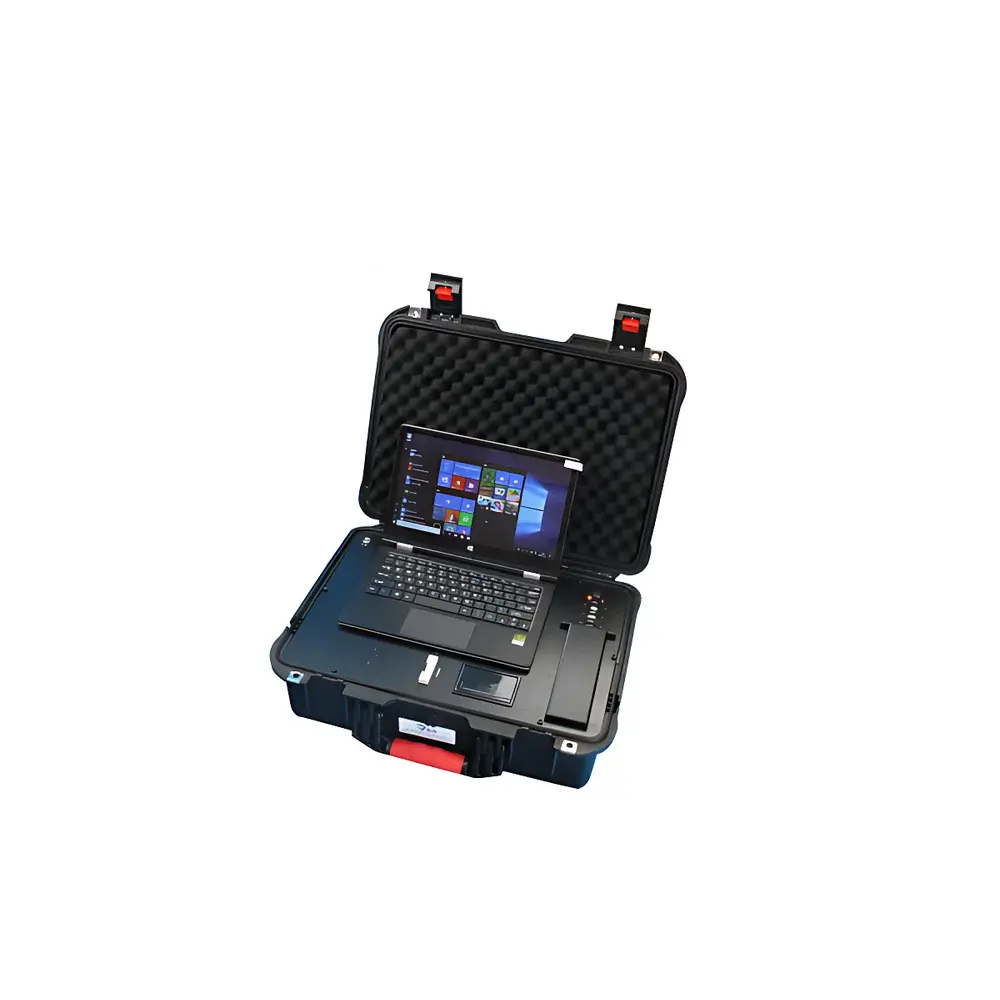
Ruixin SP-801D Multi-Functional Food Safety Analyzer
| Brand | Ruixin |
|---|---|
| Origin | Shanghai, China |
| Model | SP-801D |
| Wavelength Range | 380–680 nm |
| Detection Time | ≤3 min per assay |
| Photometric Repeatability | ≤0.3% (T) |
| Optical Channels | 8 independent photometric channels + 1 integrated colloidal gold lateral flow reader |
| Absorbance Range | 0.000–4.000 A |
| Transmittance Range | 0.00–100.00% T |
| Absorbance Resolution | 0.001 A |
| Transmittance Resolution | 0.01% T |
| Photometric Accuracy | ±2.0% (T) |
| Dark Current Drift | ≤0.3% over 3 min |
| Measurement Accuracy | ±5% (relative to reference standards) |
| Operating System | Android 9.0 or Windows 10 IoT Enterprise (pre-installed) |
| Storage | 32 GB eMMC (expandable to 64 GB) |
| RAM | 2 GB DDR4 |
| Connectivity | Dual-band Wi-Fi (802.11 a/b/g/n/ac), Bluetooth 5.0, optional 3G/4G LTE module |
| Power Supply | AC 220 V ±10% / Internal rechargeable Li-ion battery (5 h continuous operation) |
| Display | 10.6-inch capacitive multi-touch LCD (1920×1080) |
| Compliance | Designed for GLP-aligned workflows |
Overview
The Ruixin SP-801D Multi-Functional Food Safety Analyzer is an integrated benchtop instrument engineered for rapid, on-site, and laboratory-based screening of chemical contaminants, adulterants, and biological residues in food matrices. It combines dual detection modalities—UV-Vis spectrophotometry (380–680 nm) and digital colloidal gold immunochromatographic assay (CGIA) quantification—within a single, portable platform. The spectrophotometric module applies Beer-Lambert law-based quantification for colorimetric assays targeting food additives (e.g., sulfites, nitrites, formaldehyde), spoilage indicators (e.g., TVB-N, peroxide value), and adulterants (e.g., melamine, Sudan dyes). The CGIA module employs high-resolution CMOS imaging and intelligent card-edge recognition to perform semi-quantitative and quantitative analysis of lateral flow test strips, enabling trace-level detection of veterinary drug residues (e.g., chloramphenicol, enrofloxacin), mycotoxins (e.g., aflatoxin B1, zearalenone), and hormone metabolites (e.g., clenbuterol, ractopamine). Its architecture supports method validation under ISO/IEC 17025 guidelines and aligns with analytical workflows referenced in AOAC Official Methods®, USDA-FSIS directives, and China’s GB 5009 series standards.
Key Features
- 8-channel simultaneous photometric measurement with auto-zero and auto-100% transmittance calibration—eliminating manual baseline adjustment.
- Dual-mode optical engine: High-stability tungsten-halogen light source with precision interference filters for absorbance/transmittance measurement; plus a dedicated 12-megapixel CMOS scanner optimized for lateral flow strip geometry and signal uniformity.
- Intelligent CGIA interpretation: Real-time strip alignment correction, background subtraction, and T/C line intensity ratio calculation with adaptive thresholding across diverse commercial test kits.
- Full-featured embedded OS (Android 9.0 or Windows 10 IoT): Supports touchscreen, stylus, external keyboard/mouse, and multi-language IME—including English, Chinese, Spanish, and Arabic input.
- On-device data management: Automatic timestamped storage of raw spectra, processed results, CGIA images, and operator metadata; exportable via USB or encrypted cloud sync.
- Regulatory-ready reporting: Built-in thermal printer generates GLP-compliant reports showing channel ID, sample name (UTF-8), analyte concentration, LOD/LOQ flags, date/time, analyst ID, and instrument serial number.
- Modular expandability: Firmware-upgradable assay library supporting >100 validated methods; new protocols deployed remotely via secure OTA updates.
Sample Compatibility & Compliance
The SP-801D accepts liquid extracts, homogenized suspensions, and centrifuged supernatants from diverse food categories—including fruits, vegetables, meat, dairy, grains, edible oils, condiments, and aquatic products. Sample preparation follows standardized extraction procedures outlined in GB/T 5009.x, SN/T, and AOAC protocols. The system meets electromagnetic compatibility (EMC) requirements per IEC 61326-1 and safety standards per IEC 61010-1. While not certified as an IVD device, its performance characteristics support use in official food surveillance programs conducted under national food safety authority mandates (e.g., China’s SAMR, EU’s RASFF-participating labs, US FDA Import Alert screening). Data integrity features—including user authentication, electronic signatures, and immutable audit logs—facilitate compliance with 21 CFR Part 11 when deployed with Ruixin CloudLink™ (a validated SaaS platform).
Software & Data Management
Preloaded Ruixin AnalyzeSuite™ software provides intuitive workflow navigation, customizable test templates, and real-time QC charting (Levey-Jennings, moving range). All measurements are tagged with GPS coordinates (when enabled), environmental temperature/humidity (via optional sensor), and operator credentials. Raw data files (.ruix, .csv, .tiff) retain full metadata and are digitally signed using SHA-256 hashing. Cloud synchronization enables centralized dashboard monitoring across mobile inspection units, fixed laboratories, and regulatory command centers. Role-based access control (RBAC) governs method editing, report generation, and firmware update permissions. Audit trails record every action—including result modification, calibration event, and user login—with tamper-evident timestamps traceable to NIST-traceable time servers.
Applications
- Routine surveillance of pesticide residues (organophosphates, carbamates) in fresh produce using acetylcholinesterase inhibition assays.
- Quantification of preservatives (sodium benzoate, potassium sorbate) and illegal bleaching agents (formaldehyde, borax) in processed foods.
- Screening for antibiotic residues in aquaculture samples (e.g., furazolidone, malachite green) via competitive immunoassay strips.
- Detection of mycotoxins—including aflatoxin M1 in milk and ochratoxin A in cereals—using certified lateral flow devices.
- Assessment of dairy quality parameters: melamine adulteration, protein content (biuret method), and peroxide value in edible oils.
- Field-deployable verification of halal/kosher authenticity markers (e.g., porcine DNA surrogate detection via indirect ELISA readout).
FAQ
Is the SP-801D compliant with international food testing standards?
Yes—the instrument’s photometric accuracy, repeatability, and spectral bandwidth meet specifications required by ISO 6425 (spectrophotometers), AOAC 2012.01 (lateral flow readers), and GB/T 5009.34–2016 (food additive detection). Method validation packages are available upon request.
Can the colloidal gold module read test strips from third-party manufacturers?
Yes—its adaptive image processing engine recognizes variable strip dimensions, conjugate pad positions, and control/test line configurations without hardware modification. Pre-loaded profiles exist for over 40 commercial kit brands.
What is the data retention policy for cloud-synced results?
Data stored on Ruixin CloudLink™ is retained for 12 months by default; archival extensions and on-premise server deployment options are available under enterprise licensing agreements.
Does the device require annual recalibration by an authorized service center?
No—optical self-calibration occurs at power-on. However, periodic verification using NIST-traceable neutral density filters and certified reference materials is recommended every 6 months for ISO/IEC 17025 compliance.
Is remote firmware update supported over cellular networks?
Yes—when equipped with the optional 4G LTE module, the SP-801D downloads and validates signed firmware updates over HTTPS, with rollback capability and version-locking controls.



