
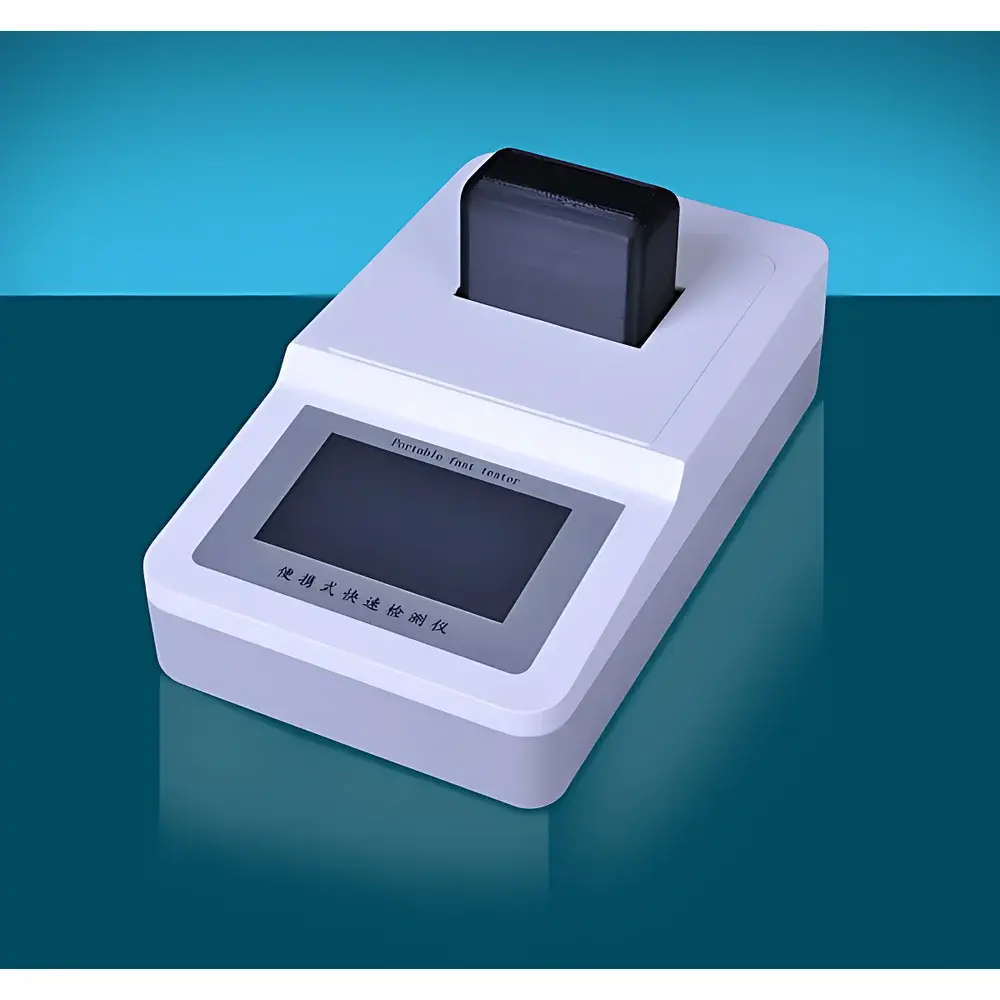
Ruixin SP-GYS2 Peroxide Value & Acid Value Analyzer for Edible Oils
| Brand | Ruixin |
|---|---|
| Origin | Shanghai, China |
| Model | SP-GYS2 |
| Wavelength Range | 400–680 nm |
| Detection Time | <2 min |
| Repeatability | <5% |
| Detection Channels | 1 |
| Absorbance Range | 0.000–4.000 |
| Transmittance Range | 0.00–100.00% |
| Transmittance Resolution | 0.01% |
| Absorbance Resolution | 0.001 |
| Photometric Accuracy (Transmittance) | ±2.0% |
| Photometric Repeatability (Transmittance) | ≤0.2% |
| Stability (3 min) | ≤0.3% |
| Peroxide Value Detection Limit | 0.05 g/100g |
| Peroxide Value Range | 0.05–5.00 g/100g |
| Acid Value Detection Limit | 0.1 mg KOH/g |
| Acid Value Range | 0.0–30.0 mg KOH/g |
| Interface | RS232, USB |
| Power Supply | AC 220 V |
Overview
The Ruixin SP-GYS2 Peroxide Value & Acid Value Analyzer is a dedicated benchtop-to-field spectrophotometric instrument engineered for rapid, quantitative assessment of lipid oxidation and hydrolytic rancidity in edible oils and fat-containing food matrices. It operates on the principle of visible-light absorbance spectroscopy (400–680 nm), applying standardized colorimetric reaction protocols—specifically the ferric thiocyanate method for peroxide value (PV) and the acid-base titration-based indicator method adapted for photometric endpoint detection for acid value (AV). Designed to meet the procedural requirements of GB 5009.227–2023 (National Food Safety Standard for Determination of Peroxide Value in Foods) and GB 5009.229–2023 (Determination of Acid Value in Foods), the SP-GYS2 delivers traceable, laboratory-grade results without requiring wet chemistry expertise or full analytical lab infrastructure. Its compact aluminum chassis and integrated power management enable deployment in regulatory inspection vehicles, on-site commodity screening stations, and quality control labs where throughput, reproducibility, and compliance-ready documentation are critical.
Key Features
- Portable aluminum housing with ergonomic form factor optimized for field mobility and benchtop stability.
- 4.3-inch high-resolution color TFT touchscreen with full Chinese GUI—designed for intuitive navigation by non-specialist operators in regulatory or production environments.
- Integrated intelligent Chinese input system supporting both on-screen soft keyboard and stylus-based text entry for sample labeling, operator ID, and institutional metadata.
- Embedded thermal printer providing immediate hard-copy reporting per test channel; output includes numeric PV/AV result, Chinese sample name, test date/time, analyst ID, and testing unit—formatted to support audit-ready record retention.
- Self-calibrating optical path architecture: automatic zero and reference (100% T) correction at power-on eliminates manual calibration drift and reduces operator dependency.
- Dual-mode photometric display: simultaneous real-time readout of absorbance (A) and transmittance (%T), enabling method development, instrument verification, and cross-application adaptability.
- Automated concentration calculation: firmware applies preloaded calibration curves (based on GB-standard reagent kits) to convert raw absorbance into final PV (g/100g) and AV (mg KOH/g) units.
- Local data persistence: up to 1,000 test records stored internally with timestamp, sample ID, and result metadata; searchable by date range or keyword.
- Standardized digital connectivity: RS232 serial and USB interfaces support bidirectional data exchange with LIMS, QA databases, or centralized monitoring platforms—compatible with basic SCADA-level integration.
Sample Compatibility & Compliance
The SP-GYS2 is validated for direct analysis of refined and unrefined vegetable oils (e.g., soybean, peanut, rapeseed, sunflower), fried snack matrices (nuts, seeds, pastries), cereal grains, and processed bakery products. Sample preparation follows GB 5009.227–2023 and GB 5009.229–2023 protocols—including solvent extraction (chloroform–methanol or isooctane–acetic acid), reaction incubation, and chromogenic development. While not certified to ISO/IEC 17025 under third-party accreditation, the instrument’s photometric performance (±2.0% transmittance accuracy, ≤0.2% repeatability, ≤0.3% 3-min baseline drift) meets minimum metrological thresholds for routine screening per CNAS-CL01:2018 guidance. Data output supports GLP-aligned documentation practices, including operator traceability and time-stamped result logs—facilitating internal audits and provincial-level market supervision reporting in China.
Software & Data Management
The embedded firmware implements a deterministic state-machine architecture with no external OS dependencies. All measurement logic, curve fitting, and unit conversion occur locally without cloud reliance. Internal memory maintains immutable records with write-once timestamps; deletion requires physical authentication via admin password. USB export generates CSV files with UTF-8 encoding and BOM header, preserving Chinese characters in sample fields. RS232 communication uses ASCII protocol at 9600 bps, N-8-1, compatible with legacy QA software and custom Python/Node.js ingestion scripts. No FDA 21 CFR Part 11 compliance features (e.g., electronic signatures, audit trails) are included—intended for environments where paper-based verification or secondary digital logging suffices.
Applications
- Routine shelf-life monitoring of bulk edible oil inventories at distribution centers and cold-storage facilities.
- On-the-spot verification of imported oil shipments at port-of-entry inspection points.
- High-frequency screening in snack food manufacturing lines to detect early-stage oxidative degradation pre-packaging.
- Field-based surveillance by county-level agricultural product safety bureaus during seasonal harvest inspections.
- Teaching laboratories introducing students to AOAC- and GB-aligned food quality assays without full spectrophotometer infrastructure.
FAQ
What reagents are required for operation?
The SP-GYS2 requires GB-compliant peroxide value and acid value test kits—typically including potassium iodide solution, chloroform–methanol extraction solvent, starch indicator, and standardized sodium thiosulfate or potassium hydroxide titrant. Reagents are not supplied with the instrument.
Can the instrument be used for other analytes beyond PV and AV?
No. It is a single-function analyzer with fixed-wavelength optics and application-specific firmware. The 400–680 nm band supports only the chromogenic reactions defined in GB 5009.227 and GB 5009.229.
Is external calibration necessary?
No. The built-in optical self-correction system performs automatic dark-current and reference compensation at startup. However, periodic verification using certified reference standards (e.g., PV 1.0 g/100g oil standard) is recommended every 30 days for regulatory continuity.
Does the device support multi-language firmware?
Firmware is localized exclusively in Simplified Chinese. No English, Spanish, or Arabic language packs are available.
What is the expected service life of the light source?
The LED-based illumination module is rated for ≥50,000 hours of operational use under typical intermittent duty cycles (≤10 tests/day), with no user-replaceable components.






