
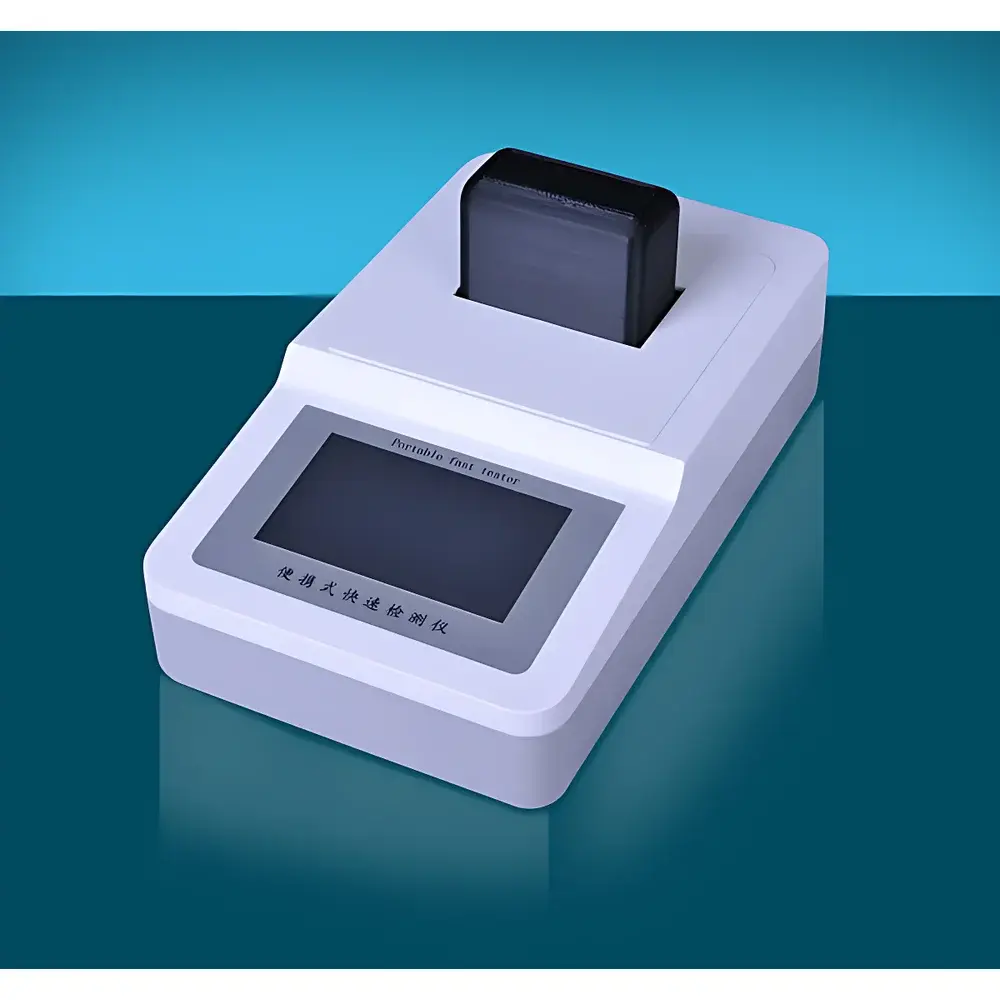
Ruixin SPb-201FM Honey Quality Analyzer
| Brand | Ruixin |
|---|---|
| Origin | Shanghai, China |
| Model | SPb-201FM |
| Wavelength Range | 400–680 nm (discrete fixed wavelengths at 410 nm, 510 nm, 630 nm) |
| Detection Time | <2 min per sample |
| Repeatability | ≤5% CV |
| Optical Resolution | Absorbance 0.001 AU |
| Absorbance Range | 0.000–4.000 AU |
| Transmittance Range | 0.00–100.00% |
| Photometric Accuracy | ±2.0% T |
| Photometric Stability | ≤0.2% T (3 min) |
| Detection Channels | 1 |
| Sample Type | Liquid honey (pre-diluted or direct injection per protocol) |
| Compliance | Designed for routine QC in food processing labs compliant with GB 14963–2011 (Chinese National Standard for Honey), supports internal GLP documentation workflows |
| Connectivity | USB interface for data export |
| Power Supply | 220 V ±10%, 50 Hz |
Overview
The Ruixin SPb-201FM Honey Quality Analyzer is a dedicated photometric instrument engineered for rapid, on-site quantification of key quality parameters in raw and processed honey—specifically fructose + glucose (reducing sugars) and sucrose content. It operates on the principle of visible-spectrum absorbance spectroscopy, utilizing discrete fixed-wavelength LED sources (410 nm, 510 nm, and 630 nm) optimized for colorimetric enzymatic or anthrone-based assay chemistries commonly specified in national honey standards (e.g., GB 14963–2011). Unlike general-purpose spectrophotometers, the SPb-201FM integrates assay-specific calibration curves into firmware, enabling direct concentration readout without manual calculation. Its optical architecture incorporates an auto-zeroing light-path self-calibration system at startup, eliminating the need for manual 0%T and 100%T adjustments and reducing operator-induced variability. The device is purpose-built for high-throughput screening in honey packaging facilities, beekeeping cooperatives, and regional food safety inspection stations where speed, repeatability, and minimal training are operational imperatives.
Key Features
- 7.0-inch high-resolution color TFT touchscreen with full Chinese GUI—designed for intuitive operation by non-specialist personnel in production or field environments.
- Integrated thermal printer supporting real-time report generation: includes channel ID, numeric concentration result, Chinese sample name, date/time stamp, analyst ID, and testing unit—enabling traceable paper records aligned with basic GLP practices.
- Dual-mode optical display: simultaneous real-time readout of both absorbance (0.000–4.000 AU, resolution 0.001 AU) and transmittance (0.00–100.00%, resolution 0.01%), facilitating method development and cross-validation with reference instruments.
- Onboard data management: automatic storage of ≥500 test records with searchable recall by date, sample ID, or operator—no external software required for basic audit trails.
- Fixed-wavelength photometry platform ensures robustness against lamp drift and eliminates wavelength scanning complexity, enhancing long-term reliability in ambient-temperature industrial settings.
- USB port enables secure export of CSV-formatted results to external PCs for integration into LIMS or QA databases—supports manual import into Excel or validated laboratory informatics systems.
Sample Compatibility & Compliance
The SPb-201FM is validated for use with clarified, filtered, or appropriately diluted liquid honey samples conforming to standard preparation protocols outlined in GB 14963–2011 and AOAC Official Method 981.12 (for sucrose determination). It does not support viscous, unfiltered, or crystallized honey without prior standardized dilution and centrifugation. While not certified to ISO/IEC 17025 or FDA 21 CFR Part 11 out-of-the-box, its firmware-enforced calibration lock, timestamped reports, and immutable result storage provide foundational elements for internal validation under GMP-aligned food safety programs. Users are responsible for establishing documented verification procedures—including daily blank checks, control sample analysis, and periodic inter-instrument comparison—as required by HACCP plans or third-party audit frameworks.
Software & Data Management
No proprietary desktop software is bundled; data exchange occurs exclusively via USB mass-storage mode. Exported files follow a structured CSV schema containing columns for TestID, DateTime, Wavelength(nm), Absorbance, Transmittance, CalculatedConc(%), SampleName(CN), OperatorID, and InstrumentSN. This design avoids dependency on closed platforms and permits direct ingestion into validated enterprise systems. Firmware supports user-defined sample naming (via on-screen Chinese input) and configurable report headers—critical for multi-facility traceability in cooperative supply chains. Audit-ready functionality includes sequential record numbering and non-editable timestamps embedded at time of measurement.
Applications
- Routine QC screening of incoming honey lots for compliance with maximum sucrose limits (≤5% for monofloral, ≤10% for polyfloral per GB 14963).
- Verification of adulteration indicators—elevated sucrose or depressed fructose+glucose ratios suggest cane sugar or corn syrup addition.
- In-process monitoring during thermal treatment or filtration to assess invertase activity impact on reducing sugar profiles.
- Field deployment by agricultural extension officers conducting cooperative-level honey grading and certification support.
- Educational use in food science laboratories for teaching fundamental principles of enzymatic colorimetry and honey authentication protocols.
FAQ
Does the SPb-201FM require external calibration standards for daily use?
Yes—while the optical path self-calibrates at startup, NIST-traceable or certified reference materials (e.g., sucrose solutions at 5%, 10%, 15% w/v) must be analyzed daily to verify assay linearity and recovery before sample testing.
Can the instrument measure hydroxymethylfurfural (HMF) content?
No—the SPb-201FM is configured exclusively for fructose+glucose and sucrose via established colorimetric endpoints; HMF quantification requires UV detection at 284 nm and is outside its optical and firmware scope.
Is firmware upgrade supported?
Firmware updates are available via Ruixin’s authorized service channels only and require physical USB drive delivery; no over-the-air or web-based update capability is provided.
What is the expected lifetime of the LED light sources?
LED emitters are rated for ≥50,000 hours of operational life under normal duty cycles—equivalent to >10 years of typical QC lab usage—with negligible spectral shift over time.
How is measurement repeatability verified during performance qualification?
Repeatability is assessed by measuring the same prepared honey control sample (n=10) within a single session; acceptance criterion is ≤5% coefficient of variation (CV) for reported concentration values.






