
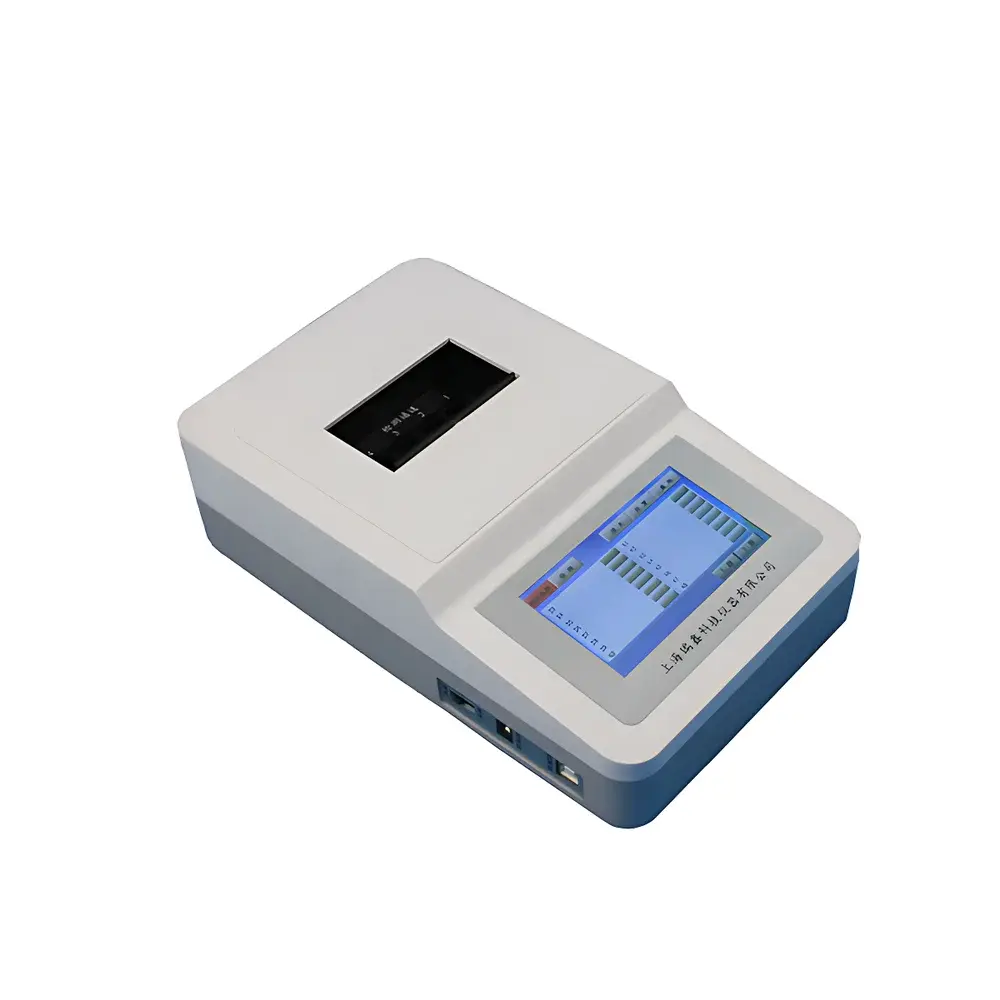
Ruixin SPb-AJ2 Amino Acid Nitrogen Analyzer
| Brand | Ruixin |
|---|---|
| Origin | Shanghai, China |
| Manufacturer Type | Authorized Distributor |
| Country of Origin | China |
| Model | SPb-AJ2 |
| Price Range | USD 4,200 – 7,000 (FOB) |
| Functionality | Single-Analyte Dedicated Instrument |
| Sample Throughput | Single-Sample Mode |
| Optical Wavelength | 410 nm |
| Assay Time | ≤ 180 seconds |
| Photometric Repeatability | ≤ 0.2% (Transmittance) |
| Detection Channels | 1 |
Overview
The Ruixin SPb-AJ2 Amino Acid Nitrogen Analyzer is a dedicated photometric instrument engineered for rapid, on-site quantification of amino acid nitrogen (AAN) in food and beverage matrices—primarily soy sauce, fermented pastes, fish sauces, and other nitrogen-rich condiments. It operates on the principle of spectrophotometric detection following the formaldehyde titration–colorimetric reaction (modified ninhydrin or o-phthaldialdehyde method), where amino groups react under controlled pH to generate a chromophore with strong absorbance at 410 nm. The device integrates a stable LED light source, precision optical path design, and embedded auto-calibration to eliminate manual zero/100% transmittance adjustment—ensuring measurement consistency across field, mobile lab, and fixed laboratory environments. Its compact form factor, internal rechargeable lithium battery, and ruggedized housing make it suitable for deployment in regulatory inspection vehicles, market surveillance units, and decentralized quality control points without dependency on mains power.
Key Features
- Integrated 4.3-inch high-resolution color TFT touchscreen with full Chinese GUI—enabling intuitive navigation, real-time data visualization, and direct annotation via on-screen keyboard or stylus.
- Self-calibrating optical system: automatic baseline correction at startup; no manual zeroing or reference adjustment required before analysis.
- Dual-mode photometric display: simultaneous readout of absorbance (0.000–4.000 AU, resolution 0.001) and transmittance (0.00–100.00%, resolution 0.01%), supporting method validation and cross-compatibility with legacy protocols.
- Embedded thermal printer: generates compliant hard-copy reports containing analyte concentration (g/100 mL), sample name (Chinese/English), test date/time, operator ID, and institutional stamp field.
- On-device data management: automatic storage of ≥1,000 test records with timestamped metadata; searchable by date, sample ID, or operator.
- Multi-source power architecture: supports operation via internal Li-ion battery (≥6 h continuous use), AC 220 V adapter, or external DC 5 V supply—ideal for mobile deployment.
- Optical performance certified per ISO 7027 and GB/T 5009.235–2016: transmittance accuracy ±2.0%, repeatability ≤0.2%, 3-minute baseline drift ≤0.3%.
Sample Compatibility & Compliance
The SPb-AJ2 is validated for aqueous extracts of liquid and semi-solid fermented foods per national standard GB/T 5009.235–2016 (Determination of amino acid nitrogen in soy sauce and similar products). Sample preparation follows standardized dilution and reagent addition protocols to ensure stoichiometric conversion of primary amines to measurable chromophores. While optimized for single-analyte AAN testing, its open calibration interface allows qualified users to configure custom curves for related nitrogen species (e.g., total volatile basic nitrogen) under documented method verification. The instrument meets GLP-aligned data integrity requirements: all measurements are time-stamped, non-erasable, and traceable to operator login. Data export complies with FDA 21 CFR Part 11–compatible audit trail principles when connected to Ruixin’s optional LIMS integration module (RS232/USB).
Software & Data Management
Data handling is performed through embedded firmware with no external PC dependency. Test results are stored locally with full metadata (date, time, operator ID, sample name, concentration, instrument serial number). USB and RS232 interfaces support bidirectional communication: raw data export in CSV format, firmware updates, and remote configuration via Ruixin’s desktop companion software (Windows-based, provided separately). When deployed within municipal or provincial food safety monitoring networks, the SPb-AJ2 supports TCP/IP-enabled data forwarding to centralized dashboards—enabling real-time heatmap generation, outlier flagging, and statistical trend analysis across jurisdictional boundaries. All transmitted records retain cryptographic checksums to prevent tampering during transit.
Applications
- Routine AAN verification in soy sauce production QC labs (batch release testing).
- Field-based screening by market supervision bureaus during unannounced inspections of retail and wholesale outlets.
- Mobile food safety laboratories aboard regulatory inspection vehicles (e.g., China NMPA “Food Safety Patrol Units”).
- Third-party certification bodies conducting on-site audits under GB 2717–2018 (Soy Sauce Hygiene Standard).
- Educational use in food science programs for teaching quantitative colorimetry and food authenticity assessment.
FAQ
What is the detection limit and linear range for amino acid nitrogen?
The instrument achieves a detection limit of 0.2 g/100 mL and a linear dynamic range of 0.0–1.5 g/100 mL under standard assay conditions per GB/T 5009.235–2016.
Does the SPb-AJ2 require daily recalibration?
No—its self-aligning optical path and temperature-compensated LED source enable stable performance over multi-hour sessions; only periodic verification with certified reference standards (e.g., glycine solution) is recommended per ISO/IEC 17025 guidelines.
Can the device be used for other analytes besides amino acid nitrogen?
It is purpose-built for AAN; however, users may develop custom calibration curves for other 410 nm-absorbing analytes if method validation documentation is maintained per GLP requirements.
Is the thermal printer compatible with international paper formats?
Yes—the built-in printer accepts standard 57 mm thermal roll paper, widely available globally and compliant with EN 13757-3 for portable meter reporting.
How is data security ensured during network transmission?
All networked data transfers utilize TLS 1.2 encryption; local storage employs write-once filesystem partitioning to prevent record deletion or modification post-acquisition.





