
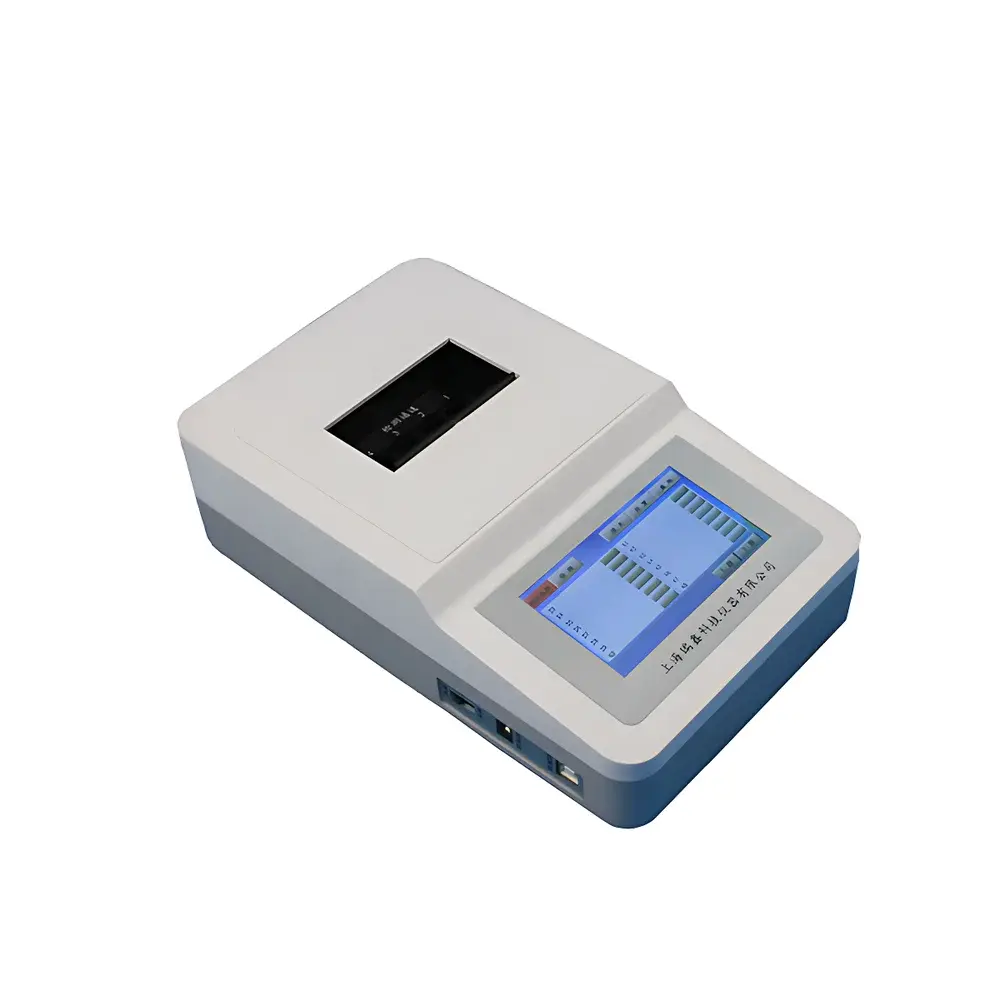
Ruixin SPb-BJ2 Sodium Benzoate Rapid Detection Analyzer
| Brand | Ruixin |
|---|---|
| Origin | Shanghai, China |
| Manufacturer Type | Authorized Distributor |
| Country of Origin | China |
| Model | SPb-BJ2 |
| Price Range | USD 4,200 – 7,000 (FOB Shanghai) |
| Functionality | Single-Analyte Dedicated Instrument |
| Sample Format | Single-Sample Mode |
| Optical Wavelength | 540 nm |
| Assay Time | ≤ 180 seconds |
| Photometric Repeatability | ≤ 0.2% (at 540 nm) |
| Detection Channels | 1 |
Overview
The Ruixin SPb-BJ2 Sodium Benzoate Rapid Detection Analyzer is a portable, single-wavelength photometric analyzer engineered for quantitative determination of sodium benzoate in food matrices using the spectrophotometric method based on diazotization-coupling reaction. Operating at a fixed wavelength of 540 nm—optimized for maximum absorbance of the azo dye complex formed between sodium benzoate derivatives and sulfanilic acid/nitrite under acidic conditions—the instrument implements a validated colorimetric assay compliant with GB 5009.28–2016 (National Food Safety Standard for Determination of Sodium Benzoate and Potassium Sorbate in Foods) and aligned with AOAC Official Method 2005.03 principles. Designed for field-deployable operation, it integrates an embedded optical self-calibration system that eliminates manual zero/100% transmittance adjustment, ensuring measurement consistency across environmental fluctuations typical in mobile labs, regulatory inspection vehicles, or decentralized testing sites.
Key Features
- Portable architecture with integrated rechargeable lithium-ion battery (up to 8 hours continuous operation), enabling fully autonomous use in non-laboratory environments including food markets, cold-chain logistics hubs, and border inspection checkpoints.
- 4.3-inch high-resolution TFT color touchscreen with intuitive Chinese-language UI; supports stylus- and keyboard-based Chinese character input for sample labeling, operator ID, and institutional metadata entry—critical for audit-ready documentation under GLP-compliant workflows.
- Embedded thermal printer delivers immediate hard-copy reports per test channel, including quantitative result (g/kg), sample name (in Chinese), date/time stamp, analyst ID, and testing unit—fully traceable per ISO/IEC 17025 documentation requirements.
- Dual-mode photometric display: simultaneous real-time readout of absorbance (0.000–4.000 AU, resolution 0.001) and transmittance (0.00–100.00%, resolution 0.01%), facilitating method transfer validation and cross-platform data reconciliation.
- Optical stability ≤ 0.3% over 3 minutes (drift test per ISO 10993-12), ensuring reliable performance during sequential batch analysis without recalibration.
- Onboard data storage retains ≥ 1,000 test records with timestamped metadata; exportable via USB 2.0 or RS-232 serial interface to LIMS or centralized food safety surveillance platforms.
Sample Compatibility & Compliance
The SPb-BJ2 is validated for aqueous extracts from solid and semi-solid food samples—including beverages, sauces, jams, pickled vegetables, and confectionery—following standardized extraction protocols per GB/T 5009.28. It is not intended for raw meat, high-fat dairy, or highly pigmented matrices without prior cleanup (e.g., SPE or liquid-liquid extraction). The analyzer meets electromagnetic compatibility (EMC) requirements per GB/T 18268.1–2010 (equivalent to IEC 61326-1) and conforms to safety standards GB 4793.1–2007 (IEC 61010-1). While not FDA 21 CFR Part 11-certified out-of-box, its audit trail functionality (operator login, timestamped results, print-log correlation) supports GMP/GLP-aligned deployment when paired with documented SOPs and external electronic signature controls.
Software & Data Management
No proprietary PC software is required for basic operation; all calibration, measurement, and reporting functions are executed onboard. However, optional Windows-compatible data management software (v2.1+) enables batch export to CSV/Excel, statistical summary generation (mean, SD, CV%), and integration with municipal or provincial food safety monitoring networks via TCP/IP-enabled gateways. All stored results include immutable metadata fields: test ID, operator code, instrument serial number, ambient temperature/humidity (if external sensor connected), and reagent lot number (manually entered). Audit logs record every calibration event, power cycle, and firmware update—supporting ISO/IEC 17025 clause 7.7 traceability requirements.
Applications
- Routine screening of sodium benzoate levels in processed foods during production line QC checks (e.g., beverage bottling plants, sauce manufacturing facilities).
- Regulatory enforcement by municipal market supervision bureaus conducting unannounced inspections at wholesale markets or e-commerce fulfillment centers.
- Field verification in mobile food safety laboratories deployed during large-scale public events (e.g., Olympic Games catering oversight, national food expos).
- Verification of label claims compliance for “preservative-free” or “low-additive” product lines during third-party certification audits.
- Training platform for food science students and junior QA technicians due to its transparent optical path design and real-time parameter visualization.
FAQ
What is the detection limit and linear range for sodium benzoate?
The instrument achieves a limit of detection (LOD) of 0.05 g/kg and a linear dynamic range of 0.0–2.0 g/kg (R² ≥ 0.999) when used with the supplied reagent kit and recommended sample preparation protocol.
Does the SPb-BJ2 require daily calibration with standard solutions?
No—its built-in optical self-calibration system performs automatic baseline correction at startup; however, periodic verification using certified reference material (CRM) at 0.5 g/kg and 1.5 g/kg is recommended weekly per ISO/IEC 17025 clause 7.6.3.
Can the device be connected to a central food safety database?
Yes—via RS-232 or USB-to-serial adapter, it supports Modbus RTU or custom ASCII protocol transmission to SCADA systems, cloud-based dashboards, or provincial food safety surveillance platforms compliant with China’s National Food Safety Information System (NFIS) API specifications.
Is the thermal printer compatible with standard replacement rolls?
Yes—it accepts industry-standard 58 mm wide thermal paper rolls (core diameter ≤ 25 mm); no proprietary consumables are required.
What power sources are supported during extended field use?
Three options: internal Li-ion battery (8 h), AC 220 V ±10% 50 Hz adapter, or DC 5 V USB-C input—enabling seamless operation in vehicles equipped with cigarette-lighter inverters or solar-charged power banks.



