
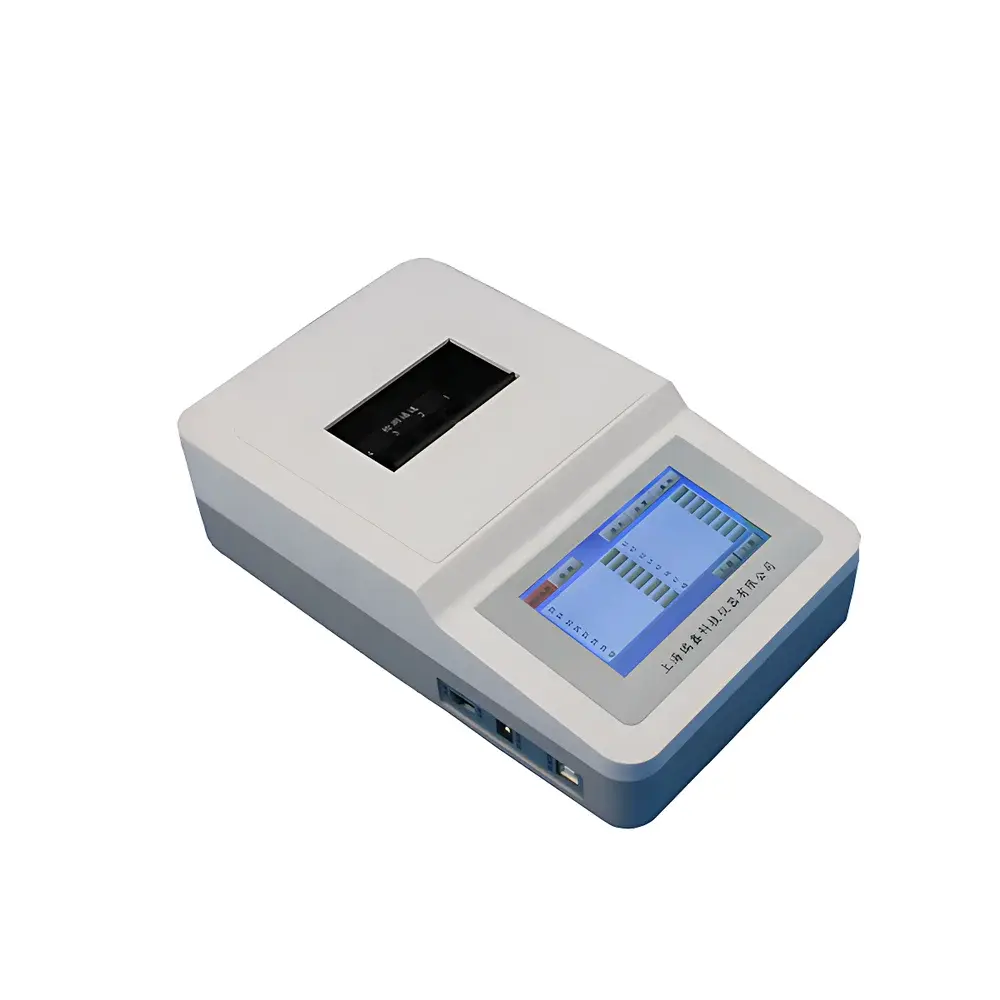
Ruixin SPb-DB2 Formaldehyde Sulfoxylate (Rongalite) Rapid Detection Analyzer
| Brand | Ruixin |
|---|---|
| Origin | Shanghai, China |
| Manufacturer Type | Authorized Distributor |
| Regional Category | Domestic (PRC) |
| Model | SPb-DB2 |
| Price Range | USD 2,800–4,200 (FOB Shanghai) |
| Functionality | Single-Analyte Dedicated Instrument |
| Sample Type | Solid/Liquid Food Matrices (Homogenized Extracts) |
| Optical Wavelength | 410 nm |
| Assay Time per Sample | ≤ 180 s |
| Photometric Repeatability (Transmittance) | ≤ 0.2% RSD |
| Detection Channels | 1 |
Overview
The Ruixin SPb-DB2 Formaldehyde Sulfoxylate (Rongalite) Rapid Detection Analyzer is a dedicated photometric instrument engineered for the quantitative determination of formaldehyde sulfoxylate—commonly known as “Rongalite” or “diao bai kuai”—in food matrices. It operates on the principle of visible-spectrum absorbance photometry at a fixed wavelength of 410 nm, where the analyte forms a chromogenic complex with a proprietary reagent system under controlled acidic conditions. The instrument implements the reaction kinetics and calibration methodology specified in the Chinese agricultural standard NY5172–2002, “Determination of Formaldehyde Sulfoxylate in Foods,” and aligns with technical guidelines issued by the former General Administration of Quality Supervision, Inspection and Quarantine (AQSIQ). Designed for field-deployable use in food safety inspection stations, cold-chain logistics hubs, and third-party testing laboratories, the SPb-DB2 delivers trace-level quantification (LOD: 1.0 mg/kg; linear range: 0–200 mg/kg) without requiring HPLC or GC-MS infrastructure.
Key Features
- Integrated 4.3-inch high-resolution color TFT touchscreen with full Chinese GUI—enabling intuitive navigation, real-time data visualization, and on-device annotation via stylus or predictive soft keyboard.
- Self-calibrating optical path architecture: automatic zero and reference (100% T) alignment upon power-on—eliminating manual baseline adjustment and reducing operator dependency.
- Dual-mode photometric display: simultaneous readout of absorbance (0.000–4.000 AU, resolution 0.001) and transmittance (0.00–100.00%, resolution 0.01%), supporting method validation and cross-platform comparability.
- Built-in thermal printer: generates compliant test reports containing sample ID (user-defined Chinese name), measured concentration (mg/kg), assay date/time, analyst ID, and institutional stamp field—fully traceable per GLP documentation requirements.
- Multi-source power architecture: rechargeable Li-ion battery (≥6 h continuous operation), AC 220 V input, and DC 5 V external supply—ensuring uninterrupted deployment in mobile labs, rural inspection posts, or off-grid facilities.
- Onboard data management: automatic storage of ≥1,000 test records with timestamp, channel ID, and raw photometric values; searchable by date range, sample name, or concentration threshold.
Sample Compatibility & Compliance
The SPb-DB2 is validated for use with aqueous extracts prepared from common adulteration-prone foodstuffs—including starch-based products (e.g., rice noodles, tofu skin), dried seafood, wheat gluten, and bleached sugar. Sample preparation follows standardized homogenization, extraction, and derivatization protocols outlined in NY5172–2002. While not certified to ISO/IEC 17025 for accredited testing, the instrument’s photometric performance meets the repeatability (≤0.2% RSD) and stability (≤0.3% drift over 3 min) criteria required for screening-level compliance under China’s GB 2760–2014 food additive regulations. Its 410 nm fixed-wavelength design ensures immunity to interferences from common food pigments (e.g., anthocyanins, carotenoids) that absorb outside this narrow band.
Software & Data Management
Firmware supports bidirectional RS232 and USB 2.0 interfaces for secure data export to LIMS or regulatory reporting platforms. Raw absorbance values, calculated concentrations, and metadata are exported in CSV format with UTF-8 encoding—preserving Chinese characters in sample identifiers. Audit trail functionality logs all user actions (e.g., calibration events, report generation, parameter changes) with timestamps and operator IDs—supporting basic 21 CFR Part 11 readiness when deployed within controlled QA environments. No cloud connectivity or remote firmware updates are implemented; all configuration remains local and tamper-evident.
Applications
- Routine surveillance of informal food processing units for illegal bleaching agent use.
- Pre-shipment verification at border inspection agencies handling imported dried goods.
- Internal quality control in noodle, vermicelli, and bean curd sheet manufacturing facilities.
- Field-based rapid response during foodborne illness outbreak investigations involving suspected chemical adulteration.
- Educational use in food science curricula for teaching spectrophotometric assay development and validation principles.
FAQ
What regulatory standards does the SPb-DB2 comply with?
It implements the analytical protocol defined in NY5172–2002 and conforms to AQSIQ-recommended operational parameters for formaldehyde sulfoxylate detection in foods.
Can the instrument be used for other analytes besides formaldehyde sulfoxylate?
No—it is a single-analyte platform optimized exclusively for the 410 nm chromophore generated by the Rongalite–reagent reaction; no wavelength tuning or method libraries are supported.
Is external calibration required before each batch of tests?
No—the integrated self-calibration system performs optical path normalization automatically at startup; only reagent blank verification is recommended per test session.
What is the minimum detectable concentration in real-world food samples?
The validated limit of detection (LOD) is 1.0 mg/kg in homogenized matrix extracts, consistent with NY5172–2002 validation data.
Does the device support networked data transmission to central monitoring systems?
Yes—via RS232 or USB, enabling integration with local LIMS or centralized dashboards; however, it lacks built-in Wi-Fi, Ethernet, or cellular modems.






