
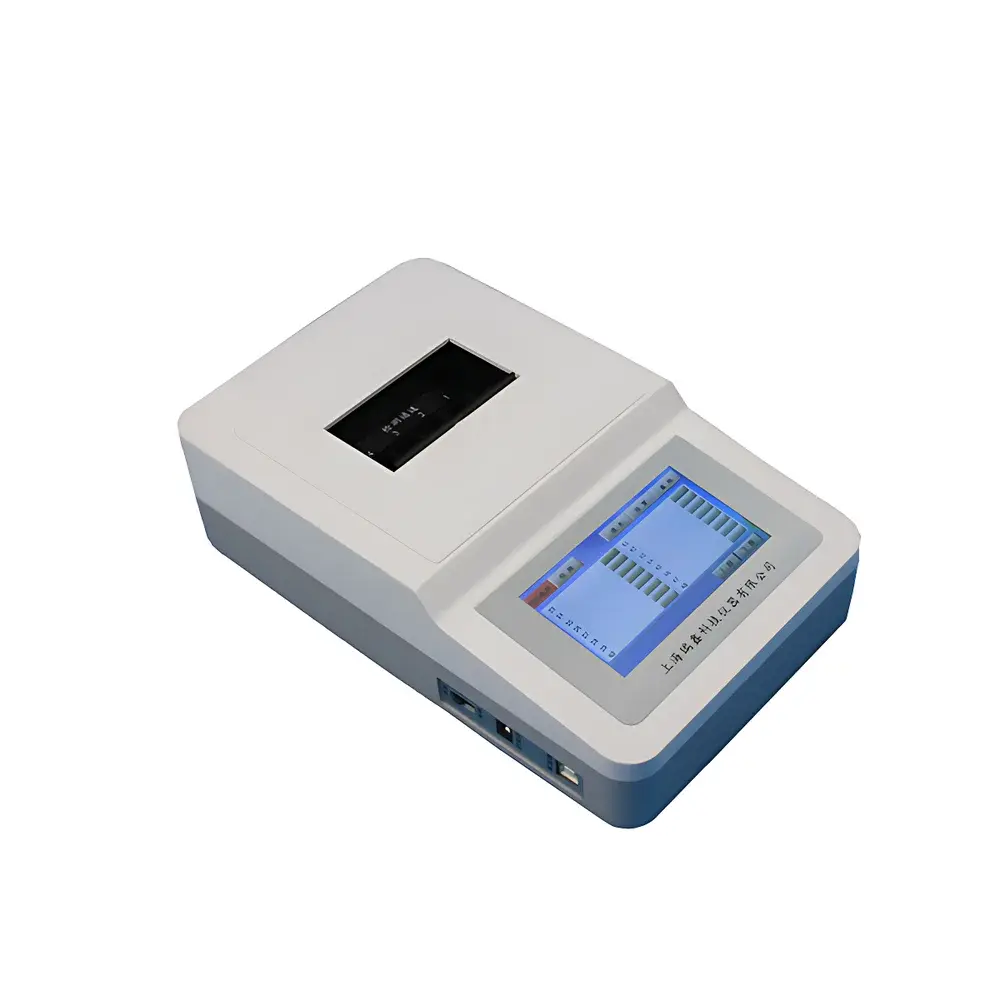
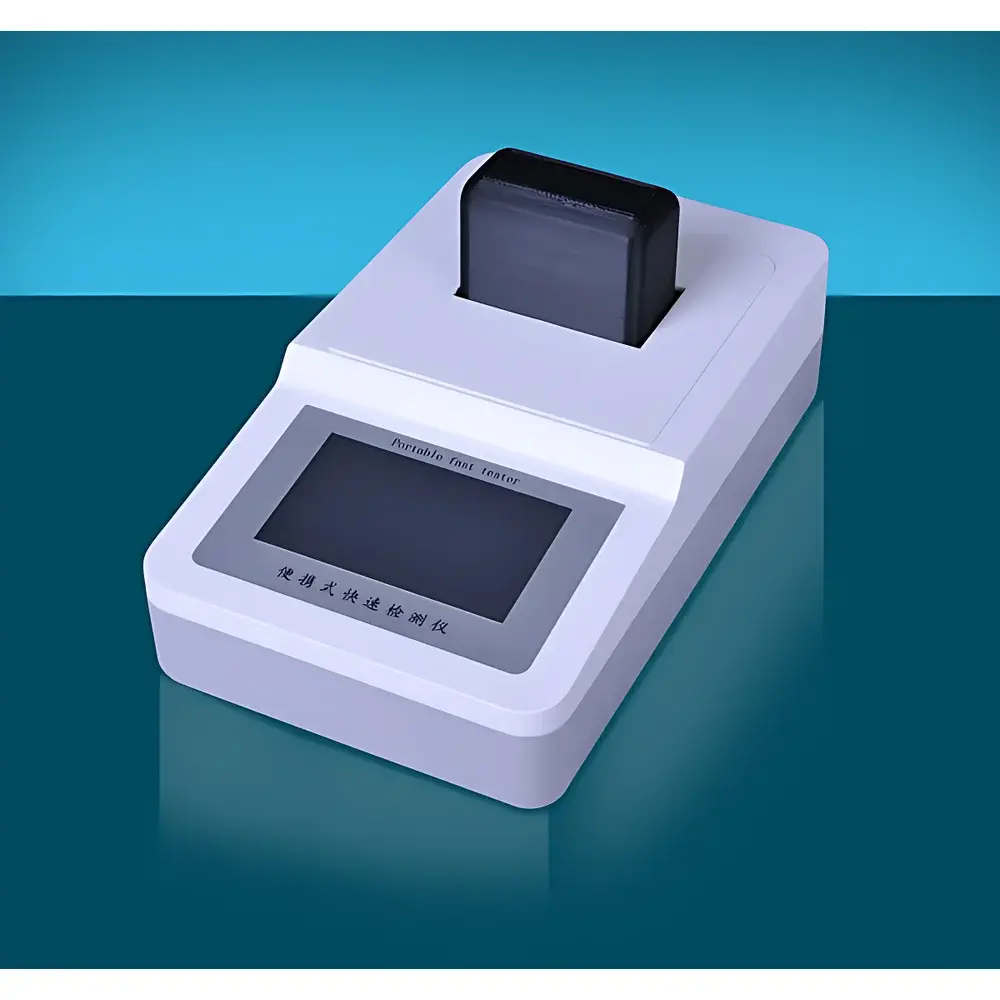
Ruixin SPb-EY2 Sulfur Dioxide (SO₂) Food Safety Rapid Analyzer
| Brand | Ruixin |
|---|---|
| Origin | Shanghai, China |
| Manufacturer Type | Authorized Distributor |
| Country of Origin | China |
| Model | SPb-EY2 |
| Price | USD 795 (FOB Shanghai) |
| Functionality | Single-Analyte Quantitative Detection |
| Sample Type | Single-Sample Dedicated Use |
| Optical Wavelength | 540 nm |
| Assay Time | ≤3 min per sample |
| Photometric Repeatability | ≤0.2% (Transmittance) |
| Detection Channels | 1 |
| Absorbance Range | 0.000–4.000 |
| Transmittance Range | 0.00–100.00% |
| Transmittance Resolution | 0.01% |
| Absorbance Resolution | 0.001 |
| Photometric Accuracy | ±2.0% (Transmittance) |
| Baseline Stability | ≤0.3% over 3 min |
| SO₂ LOD | 1.0 mg/kg |
| SO₂ Linear Range | 0–500 mg/kg |
| Communication Interfaces | RS-232, USB |
| Power Supply | Internal rechargeable Li-ion battery (7.4 V/2600 mAh), AC 220 V ±10%, DC 5 V input |
Overview
The Ruixin SPb-EY2 Sulfur Dioxide (SO₂) Food Safety Rapid Analyzer is a dedicated photometric instrument engineered for quantitative determination of residual sulfur dioxide in food matrices—primarily fruits, dried vegetables, wine, and processed seafood—according to the principle of formaldehyde titration coupled with spectrophotometric detection at 540 nm. It implements the core methodology defined in GB 5009.34–2003, China’s national standard for SO₂ analysis in food, and aligns with internationally recognized colorimetric assay protocols referenced in AOAC Official Method 990.17 and ISO 20483:2013 (Determination of SO₂ in foodstuffs by distillation and spectrophotometry). Designed for field-deployable operation, the SPb-EY2 integrates optical path auto-calibration, embedded thermal printing, and dual-mode photometric display (absorbance and transmittance), enabling trace-level quantification (LOD: 1.0 mg/kg) across a linear dynamic range of 0–500 mg/kg with high reproducibility (≤0.2% CV) and short assay turnaround (≤3 minutes per sample).
Key Features
- Optical self-calibration system eliminates manual zeroing and 100% transmittance adjustment—ensuring consistent baseline integrity across repeated field deployments.
- 4.3-inch high-resolution TFT color touchscreen with full Chinese GUI, supporting stylus- and keyboard-based Chinese character input for sample labeling, operator ID, and institutional metadata entry.
- Integrated micro-thermal printer delivers compliant hard-copy reports containing analyte concentration (mg/kg), Chinese sample name, test date/time, analyst ID, and laboratory identification—fully traceable per GLP documentation requirements.
- Dual photometric readout: simultaneous display of absorbance (0.000–4.000, resolution 0.001) and transmittance (0.00–100.00%, resolution 0.01%), facilitating method validation and cross-platform data correlation.
- Triple power architecture: internal rechargeable Li-ion battery (7.4 V / 2600 mAh, >8 h continuous operation), AC 220 V input, and universal DC 5 V port—enabling uninterrupted use in mobile labs, market inspection vans, or remote processing facilities.
- RS-232 and USB interfaces support bidirectional data exchange with LIMS, Excel-based QA databases, or centralized monitoring platforms; firmware supports time-stamped audit logs for regulatory review.
Sample Compatibility & Compliance
The SPb-EY2 is validated for solid and semi-solid food samples requiring distillative SO₂ liberation prior to colorimetric reaction with formaldehyde and pararosaniline. Compatible matrices include but are not limited to: dried apricots, sulfited shrimp, wine must, candied ginger, and starch-based snacks. All operational parameters—including wavelength accuracy (540 ±2 nm), photometric repeatability (≤0.2%), and stability (≤0.3% drift over 3 min)—are verified against NIST-traceable neutral density filters and certified reference materials (CRMs) per ISO/IEC 17025 calibration guidelines. While designed to meet GB 5009.34–2003, its measurement uncertainty profile satisfies prerequisite criteria for inclusion in FDA-regulated import screening workflows and EU Commission Regulation (EC) No 333/2007 Annex I compliance verification.
Software & Data Management
No external software installation is required—the SPb-EY2 operates via embedded real-time OS with non-volatile memory storing ≥10,000 test records with full metadata (sample ID, concentration, timestamp, operator, instrument serial number). Data export is performed via USB mass storage mode (CSV format) or RS-232 ASCII transmission using configurable baud rates (9600–115200 bps). Audit trail functionality logs all calibration events, parameter changes, and report generation actions with immutable timestamps—supporting basic 21 CFR Part 11 alignment when paired with institutional electronic signature policies. Firmware updates are delivered via encrypted USB key and include version-controlled changelogs compliant with ICH Q5A quality assurance standards.
Applications
- Routine SO₂ residue screening in food manufacturing QC laboratories operating under HACCP or ISO 22000 frameworks.
- On-site surveillance by municipal food safety regulators during wholesale market inspections or cold-chain audits.
- Contract testing laboratories performing accredited SO₂ analysis for third-party certification (e.g., China CMA, CNAS).
- Research applications involving SO₂ migration kinetics in packaged foods or comparative efficacy studies of alternative preservatives.
- Training platforms for food science students and technical inspectors due to intuitive workflow design and direct result visualization.
FAQ
Does the SPb-EY2 require daily recalibration?
No—its optical path auto-calibration system performs full-range baseline correction at startup, eliminating daily zero/100% adjustments. A full verification using CRM is recommended every 30 days or after transport-induced shock.
Can the instrument be used for SO₂ analysis in wine without sample pretreatment?
No—GB 5009.34–2003 mandates distillative separation prior to colorimetric detection. The SPb-EY2 measures only the final reacted solution; distillation equipment is required as a separate module.
Is the thermal printer compatible with standard label stock?
It accepts 57 mm wide thermal paper rolls only; adhesive-backed labels are not supported due to mechanical feed constraints.
What is the warranty coverage and service support structure?
The unit carries a 12-month parts-and-labor warranty from shipment date. Ruixin-certified service centers operate in Shanghai, Guangzhou, and Chengdu; remote diagnostics and firmware patches are provided via secure FTP portal.
How does the instrument handle matrix interference from ascorbic acid or nitrites?
The formaldehyde–pararosaniline reaction is selective for SO₂ under controlled pH and temperature conditions specified in GB 5009.34–2003. Interference from common reductants is minimized through standardized distillation and timed color development—method validation data available upon request.



