
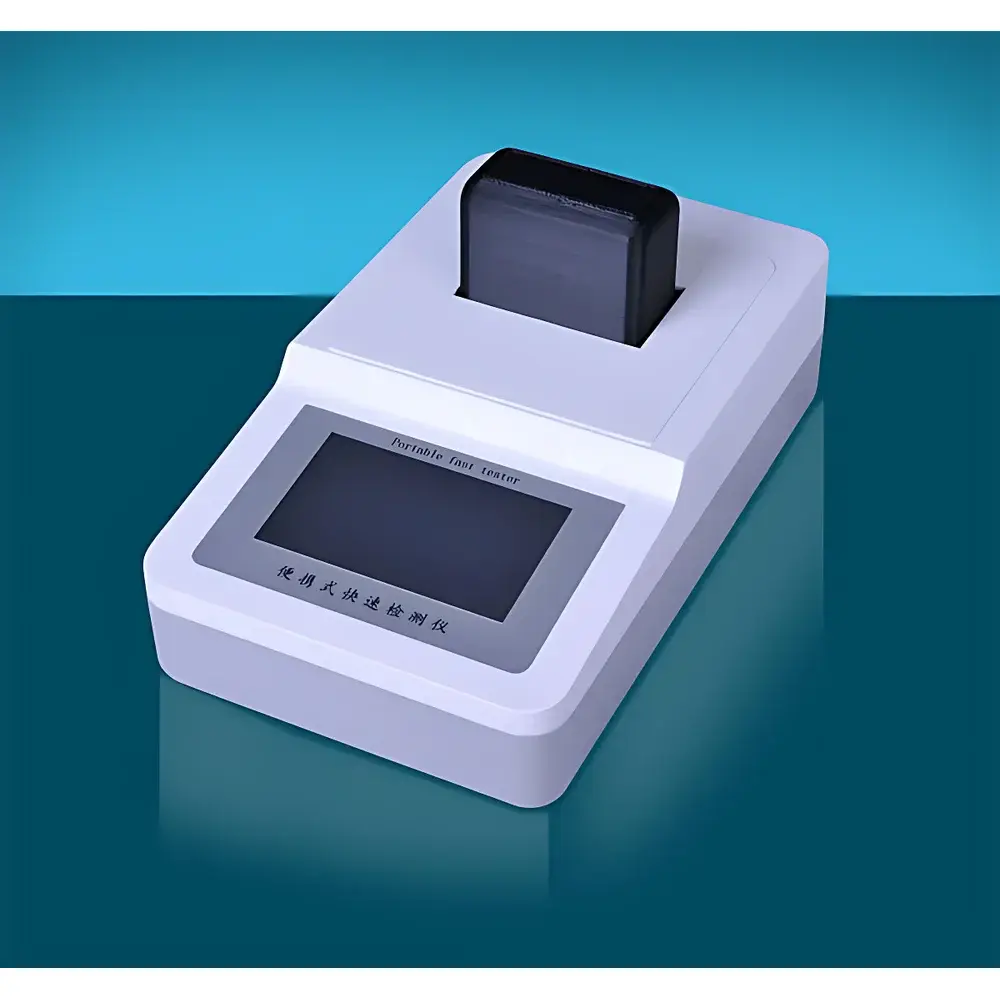
Ruixin SPb-JS2 Rapeseed Erucic Acid Analyzer
| Brand | Ruixin |
|---|---|
| Origin | Shanghai, China |
| Manufacturer Type | Authorized Distributor |
| Country of Origin | China |
| Model | SPb-JS2 |
| Function Type | Single-Analyte Dedicated Analyzer |
| Sample Type | Rapeseed Only |
| Wavelength Range | 380–680 nm |
| Detection Time | ≤3 min |
| Repeatability | ≤0.2% |
| Optical Channels | 1 |
| Absorbance Range | 0.000–4.000 |
| Transmittance Range | 0.00–100.00% |
| Transmittance Resolution | 0.01% |
| Absorbance Resolution | 0.001 |
| Photometric Accuracy (Transmittance) | ±2.0% |
| Stability (3 min) | ≤0.3% |
| Limit of Detection (Erucic Acid) | 0.5% (w/w) |
| Interface | USB |
| Power Supply | AC 220 V |
Overview
The Ruixin SPb-JS2 Rapeseed Erucic Acid Analyzer is a compact, single-purpose spectrophotometric instrument engineered for rapid, on-site or laboratory-based quantification of erucic acid content in raw rapeseed (Brassica napus and Brassica rapa). It operates on the principle of visible-spectrum absorbance measurement following the standardized colorimetric reaction specified in GB/T 23890–2009, the Chinese National Standard for Determination of Erucic Acid in Rapeseed by Spectrophotometry. The method relies on the formation of a chromogenic complex between erucic acid derivatives and a specific reagent under controlled acidic conditions, with absorbance measured within the 380–680 nm spectral window—optimized for sensitivity and selectivity toward the target analyte. Designed for regulatory compliance in grain quality control, the SPb-JS2 delivers quantitative results in under three minutes without requiring solvent extraction, derivatization, or chromatographic separation. Its optical architecture incorporates an integrated self-calibration system that automatically corrects baseline drift at startup, eliminating manual zeroing and 100% transmittance adjustment—a critical feature for field-deployable reliability and inter-operator consistency.
Key Features
- Portable benchtop form factor (dimensions and weight optimized for transport to grain elevators, procurement stations, and regional testing centers)
- 4.3-inch high-resolution color TFT touchscreen with full Chinese GUI, supporting touch-pen and intelligent pinyin input for sample ID, operator name, and batch metadata
- Embedded thermal printer enabling immediate hardcopy output of absorbance values, transmittance percentages, calculated erucic acid concentration (% w/w), date/time stamp, and instrument ID
- Dual-mode photometric display: simultaneous real-time readout of absorbance (A) and percent transmittance (%T), facilitating method validation and cross-platform data alignment
- Automated result calculation and storage: concentration values are computed using pre-loaded calibration curves traceable to GB/T 23890–2009; up to 1,000 test records retained internally with timestamp and operator tag
- Optical self-alignment system ensures long-term photometric stability (≤0.3% drift over 3 min) and eliminates routine recalibration dependency
- USB interface compliant with USB 2.0 standards for secure data export to external PCs running Windows-based LIMS or Excel-compatible spreadsheets
Sample Compatibility & Compliance
The SPb-JS2 is validated exclusively for intact or ground rapeseed samples meeting the particle size and moisture specifications outlined in GB/T 23890–2009. It does not support oil extracts, meal pellets, or blended seed lots without prior homogenization and standardization per the method’s grinding and sieving protocol. While the instrument itself is not certified to ISO/IEC 17025 or accredited under CNAS, its operational workflow aligns with the technical requirements of national grain safety monitoring programs in China, including those administered by the State Administration for Market Regulation (SAMR) and the National Grain and Strategic Reserves Administration (NGSRA). Data integrity is supported via time-stamped records and non-erasable internal memory, satisfying basic GLP documentation expectations for routine screening. The 0.5% w/w detection limit meets the threshold criteria for distinguishing low-erucic-acid (LEAR) cultivars (40%), as defined in GB 13541–2021 (Rapeseed Quality Standard).
Software & Data Management
The embedded firmware provides local data management without cloud dependency. All measurements are stored with immutable metadata: test ID, sample ID (user-defined), operator ID, date/time, absorbance value, %T, calculated erucic acid content, and pass/fail flag relative to configurable thresholds (e.g., ≤2.0% for LEAR compliance). USB data export generates CSV-formatted files containing column headers compatible with audit-ready reporting. No remote connectivity, OTA updates, or network authentication protocols are implemented—ensuring data sovereignty and minimizing cybersecurity exposure in offline environments typical of rural grain infrastructure. Audit trails are limited to chronological record logs; FDA 21 CFR Part 11 electronic signature or role-based access control is not supported.
Applications
- Routine screening of incoming rapeseed lots at oilseed processing plants to verify LEAR compliance prior to crushing
- Field verification during harvest procurement to enforce contractual erucic acid clauses with farmers
- Quality assurance checks in provincial grain inspection institutes performing statutory surveillance per GB 2715–2016 (Food Safety Standard for Cereals)
- Educational use in agricultural colleges for teaching standardized spectrophotometric assay principles in food chemistry labs
- Supporting traceability systems in origin-certified rapeseed supply chains (e.g., “Double-Low” branding initiatives)
FAQ
Does the SPb-JS2 require external calibration standards for daily use?
No. The built-in optical self-calibration system performs automatic baseline correction at power-on. However, periodic verification using NIST-traceable neutral density filters or factory-supplied reference standards is recommended every 90 days for metrological confidence.
Can the instrument analyze rapeseed oil directly, rather than whole seeds?
No. The method and hardware are validated solely for solid-phase rapeseed matrix per GB/T 23890–2009. Oil analysis requires separate GC-FID or GC-MS methods per ISO 12966-2.
Is the USB interface compatible with Linux or macOS operating systems?
The device enumerates as a standard USB mass storage class device. File transfer is supported on any OS recognizing FAT32-formatted USB drives; no proprietary drivers are required.
What is the expected service life of the light source and detector?
The LED-based optical module is rated for ≥10,000 hours of operation under typical intermittent usage. No user-replaceable consumables are specified beyond standard cleaning of the cuvette holder and optical windows.
Does the analyzer meet international export requirements such as CE or RoHS?
The SPb-JS2 carries CCC (China Compulsory Certification) marking. CE, RoHS, or UKCA conformity declarations are not issued by the manufacturer or distributor; third-party certification would be required for EU or UK market placement.





