Ruixin SPb-LL2 Brilliant Blue Detection Analyzer
| Brand | Ruixin |
|---|---|
| Origin | Shanghai, China |
| Manufacturer Type | Authorized Distributor |
| Country of Origin | China |
| Model | SPb-LL2 |
| Price Range | USD 4,200 – 7,000 (FOB Shanghai) |
| Functionality | Single-Analyte Quantitative Detection |
| Sample Format | Dedicated Single-Sample Cartridge/Well |
| Optical Wavelength | 630 nm |
| Assay Time | ≤ 180 seconds |
| Photometric Repeatability | ≤ 0.2% CV |
| Detection Channels | 1 |
Overview
The Ruixin SPb-LL2 Brilliant Blue Detection Analyzer is a compact, field-deployable photometric analyzer engineered for rapid, quantitative determination of Brilliant Blue FCF (E133) in food matrices—including beverages, confectionery, dairy products, and processed snacks. It operates on the principle of single-wavelength absorbance photometry at 630 nm, where the intensity of light absorbed by the dye–reagent complex is linearly proportional to its concentration within the validated range (0–200 mg/kg). Designed in accordance with fundamental spectrophotometric principles outlined in ISO 750:2018 (Foodstuffs — Determination of synthetic colorants), the instrument delivers trace-level sensitivity with a limit of detection (LOD) of 5.0 mg/kg—meeting regulatory thresholds established by China’s GB 2760-2024 and harmonized with EU Commission Regulation (EU) No 1129/2011. Its portable architecture, integrated lithium-ion battery, and ruggedized enclosure enable uninterrupted operation in mobile food inspection units, roadside checkpoints, or decentralized laboratory environments without reliance on fixed infrastructure.
Key Features
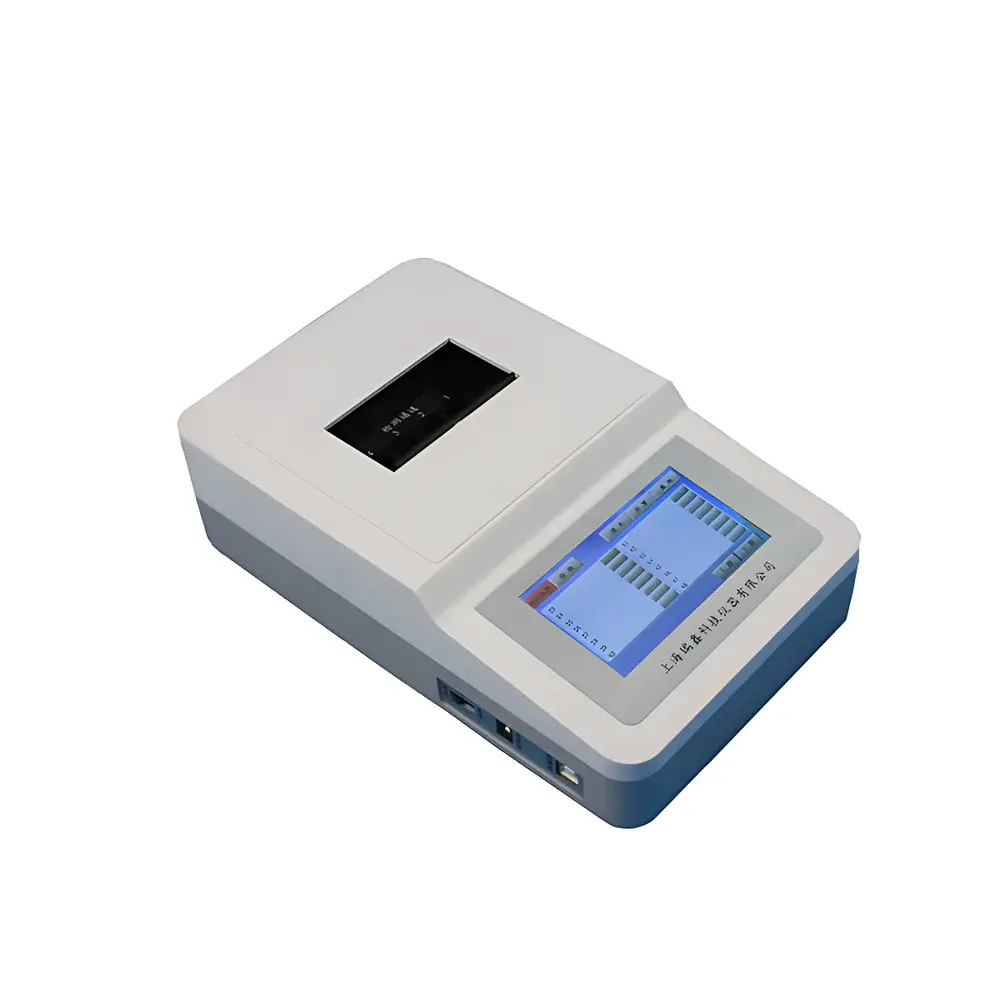
- Portable form factor (285 × 210 × 120 mm; weight < 2.3 kg) with built-in rechargeable Li-ion battery supporting ≥ 8 hours of continuous operation.
- 4.3-inch high-resolution TFT-LCD capacitive touchscreen with full Chinese GUI—enabling intuitive navigation, real-time parameter adjustment, and on-device data annotation via virtual QWERTY keyboard or stylus input.
- Self-calibrating optical path system: automatic zero and reference (100% T) calibration upon power-on eliminates manual baseline adjustment and ensures long-term photometric stability (drift ≤ 0.3% over 3 min).
- Dual-mode photometric display: simultaneous readout of absorbance (A, range 0.000–4.000, resolution 0.001) and transmittance (%T, range 0.00–100.00%, resolution 0.01%), facilitating method transfer and cross-platform validation.
- Embedded thermal printer: generates audit-ready reports per test, including analyte concentration (mg/kg), sample ID (user-defined Chinese name), date/time stamp, operator ID, and testing institution—fully compliant with GLP documentation requirements.
- Onboard data management: stores up to 1,000 test records with timestamped metadata; supports recall, export, and chronological filtering directly from device interface.
Sample Compatibility & Compliance
The SPb-LL2 is optimized for use with standardized extraction protocols specified in GB/T 5009.35–2023 (National Standard of the People’s Republic of China for Determination of Synthetic Colorants in Foods). It accepts pre-treated liquid extracts loaded into disposable cuvettes or micro-well strips compatible with common food safety rapid test kits. While designed specifically for Brilliant Blue quantification, its fixed 630 nm configuration precludes multi-analyte flexibility—ensuring minimal spectral interference and maximal specificity per assay. The instrument meets electromagnetic compatibility (EMC) Class B per GB/T 18268.1–2010 and conforms to safety standard GB 4793.1–2019 (IEC 61010-1). All firmware and data handling routines support audit trails required under China’s SAMR Food Safety Supervision Regulations and are compatible with provincial-level Food Safety Monitoring Network platforms via RS232/USB serial integration.
Software & Data Management
No external PC software is required for routine operation; all functions—including calibration, measurement, reporting, and data review—are executed natively on the embedded ARM-based controller. Raw absorbance values and calculated concentrations are stored in non-volatile memory with immutable timestamps. Data export is supported via USB mass-storage mode (FAT32 formatted drive) or direct RS232 transmission to centralized LIMS or municipal food safety dashboards. The communication protocol is ASCII-based with configurable baud rates (9600–115200 bps), enabling seamless integration with legacy inspection databases. Firmware updates are performed via USB without service intervention, and version logs are retained for regulatory traceability.
Applications
- Routine surveillance of Brilliant Blue levels in soft drinks, jellies, ice cream, and flavored milk during production line QC checks.
- Field verification by market supervision authorities during unannounced inspections at wholesale markets, convenience stores, and school canteens.
- Compliance screening prior to product release in contract manufacturing facilities operating under GB/T 22000–2023 (ISO 22000) food safety management systems.
- Training and capacity-building in regional food testing centers where low-cost, operator-independent instrumentation is prioritized over high-throughput benchtop spectrophotometers.
FAQ
What regulatory standards does the SPb-LL2 support for Brilliant Blue testing?
It aligns with GB/T 5009.35–2023, GB 2760–2024, and ISO 750:2018 methodologies for synthetic colorant quantification.
Can the instrument be used for other dyes or analytes?
No—it is a dedicated single-wavelength platform calibrated exclusively for Brilliant Blue at 630 nm; no wavelength tuning or filter exchange capability is provided.
Is the thermal printer report suitable for official inspection documentation?
Yes: each printed report includes mandatory fields per SAMR Directive No. 12/2021—sample ID, concentration result, analyst signature field, date/time, and institutional seal placeholder.
How is photometric accuracy maintained over time?
Through factory-traceable NIST-equivalent calibration references, auto-zeroing optics, and periodic user verification using supplied standard solutions (0, 50, and 150 mg/kg Brilliant Blue controls).
Does the device support FDA 21 CFR Part 11 compliance?
While it provides audit-trail-capable data storage and operator authentication via PIN, full Part 11 compliance requires integration with a validated third-party LIMS that manages electronic signatures and change control—functionality not embedded in the standalone unit.