
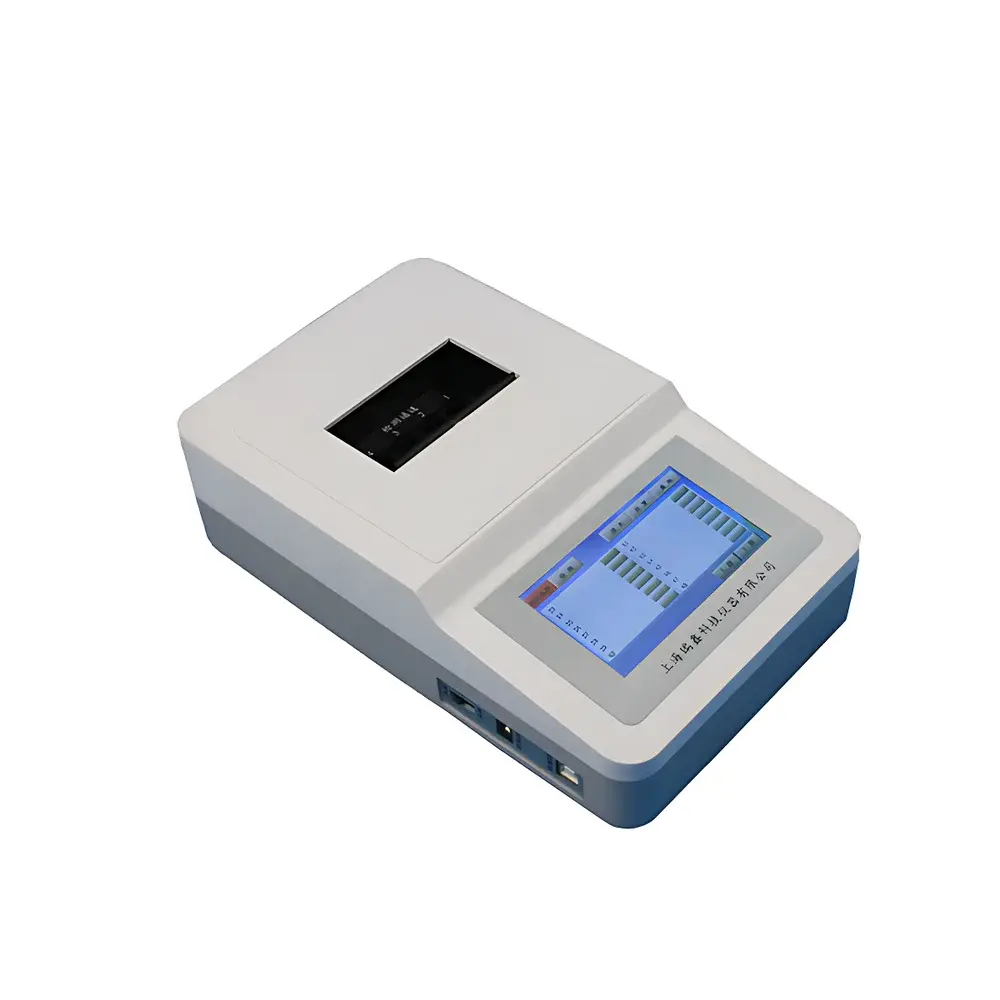
Ruixin SPb-PS2 Borax Rapid Detection Analyzer
| Brand | Ruixin |
|---|---|
| Origin | Shanghai, China |
| Manufacturer Type | Authorized Distributor |
| Country of Origin | China |
| Model | SPb-PS2 |
| Price Range | USD 2,800 – 4,200 (FOB Shanghai) |
| Function Type | Single-Analyte Dedicated Instrument |
| Sample Type | Single-Sample Format |
| Optical Wavelength | 540 nm |
| Detection Time | ≤ 3 minutes |
| Photometric Repeatability | ≤ 0.2% (Transmittance) |
| Measurement Channels | 1 |
Overview
The Ruixin SPb-PS2 Borax Rapid Detection Analyzer is a compact, field-deployable photometric analyzer engineered for the quantitative determination of borax (sodium tetraborate) in food matrices—including dairy products, starch-based foods, meat products, and preserved vegetables. It operates on the principle of visible spectrophotometry, utilizing a fixed-wavelength optical path at 540 nm to measure the absorbance of a colored chromogenic complex formed between borate ions and curcumin under acidic conditions. The instrument is designed to meet the operational requirements of regulatory field laboratories, mobile food safety inspection units, and quality control teams requiring rapid, on-site screening with laboratory-grade reproducibility. Its architecture integrates embedded optical self-calibration, eliminating manual zero/100% transmittance adjustment and ensuring measurement stability across environmental fluctuations typical in non-climate-controlled environments.
Key Features
- Portable form factor with integrated rechargeable lithium-ion battery (up to 8 hours continuous operation), enabling deployment in mobile inspection vehicles, rural markets, border checkpoints, and decentralized testing sites.
- 4.3-inch high-resolution color TFT touchscreen with full Chinese GUI—supports intuitive navigation, touch-pen input, and intelligent Chinese character entry for sample labeling and operator annotation.
- Onboard thermal printer delivers immediate hard-copy reports per test channel, including analyte concentration (mg/kg), sample name (in Chinese), test date/time, operator ID, and institutional stamp field.
- Self-calibrating optical system performs automatic baseline correction at power-on, reducing operator dependency and minimizing drift-related errors over extended use.
- Dual-mode photometric display: simultaneous real-time readout of absorbance (0.000–4.000, resolution 0.001) and transmittance (0.00–100.00%, resolution 0.01%), supporting method development beyond borax detection.
- Optical accuracy: ±2.0% transmittance deviation; photometric stability: ≤0.3% drift over 3 minutes; repeatability: ≤0.2% RSD (n=10, same sample).
- Multiple power options: internal battery, AC 220 V adapter, or external DC 5 V supply—ensuring uninterrupted operation in diverse infrastructure conditions.
Sample Compatibility & Compliance
The SPb-PS2 is validated for use with homogenized liquid or extracted solid food samples following standardized pre-treatment protocols (e.g., acid hydrolysis and curcumin derivatization). It complies with national food safety standards including GB 5009.287–2023 (Determination of Borax in Foods by Spectrophotometry) and aligns with international screening expectations under Codex Alimentarius Guideline CXG 216–2022. While not intended for definitive quantification in GLP-certified reference labs, its performance meets ISO/IEC 17025:2017 criteria for field screening instruments when operated within defined scope and documented calibration intervals. Data integrity is supported via timestamped local storage and audit-ready export logs.
Software & Data Management
The device stores up to 1,000 test records locally with full metadata (sample ID, concentration, operator, time stamp, instrument serial number). Data export is enabled via RS232 serial interface or USB mass-storage mode, compatible with Windows-based LIMS platforms and centralized food safety monitoring networks. Optional firmware updates support enhanced data encryption and CSV-formatted batch reporting. Though not FDA 21 CFR Part 11 compliant out-of-the-box, the system supports ALCOA+ principles (Attributable, Legible, Contemporaneous, Original, Accurate) through immutable record generation and operator authentication fields.
Applications
- Routine surveillance testing by municipal market supervision bureaus during routine inspections and random sampling campaigns.
- Real-time verification in cold-chain logistics hubs and wholesale distribution centers prior to product release.
- On-site verification during food safety emergency response (e.g., suspected adulteration incidents).
- Training and capacity-building for frontline inspectors in resource-constrained regions where access to central laboratories is limited.
- Supplementary screening in QC labs performing parallel HPLC or ICP-MS confirmation—reducing analytical workload on high-cost instrumentation.
FAQ
What is the detection limit and linear range for borax using the SPb-PS2?
The instrument achieves a limit of detection (LOD) of 10.0 mg/kg and a linear working range of 0–500 mg/kg in representative food matrices after standard extraction.
Does the SPb-PS2 require external calibration standards before each use?
No—its built-in optical self-calibration eliminates daily zero/100% transmittance adjustments. However, periodic verification using certified borax reference standards (e.g., NIST SRM 3280) is recommended every 30 days or per organizational SOP.
Can the SPb-PS2 be integrated into an existing food safety information system?
Yes—via RS232 or USB, it supports bidirectional communication with centralized dashboards and regional food safety monitoring platforms compliant with China’s National Food Safety Risk Monitoring Information System (NFMRIS) architecture.
Is technical support available in English for international users?
Ruixin provides English-language user manuals, calibration protocols, and remote troubleshooting support through authorized global distributors. Firmware and software tools are localized for multilingual operation.
What maintenance is required to ensure long-term photometric accuracy?
Routine cleaning of the cuvette holder and optical window with lint-free wipes and isopropyl alcohol; annual verification of LED wavelength stability and photodiode linearity by certified service centers.




