
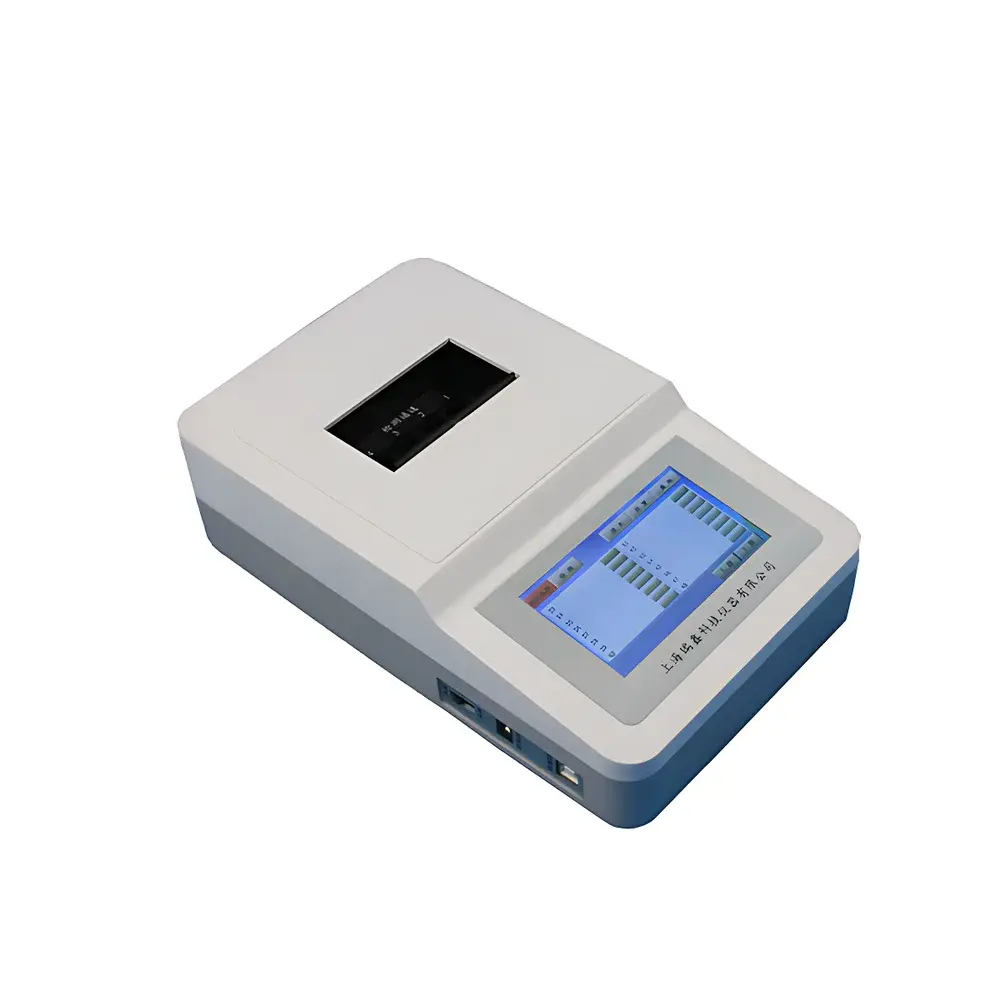
Ruixin SPb-XC2 Amaranth Rapid Detection Analyzer
| Brand | Ruixin |
|---|---|
| Origin | Shanghai, China |
| Manufacturer Type | Authorized Distributor |
| Country of Manufacture | China |
| Model | SPb-XC2 |
| Price Range | USD 4,200 – 7,000 (FOB Shanghai) |
| Functionality | Single-Analyte Quantitative Detection |
| Sample Format | Dedicated Single-Sample Cartridge/Tube |
| Optical Wavelength | 540 nm |
| Assay Time | ≤ 180 seconds |
| Photometric Repeatability | ≤ 0.2% (CV) |
| Detection Channels | 1 |
| Absorbance Range | 0.000–4.000 AU |
| Transmittance Range | 0.00–100.00% |
| Transmittance Resolution | 0.01% |
| Absorbance Resolution | 0.001 AU |
| Photometric Accuracy (Transmittance) | ±2.0% |
| Baseline Drift (3 min) | ≤0.3% |
| Amaranth LOD | 5.0 mg/kg |
| Amaranth Linear Range | 0–200 mg/kg |
| Communication Interfaces | RS-232, USB 2.0 |
| Power Options | Integrated Li-ion Battery (≥6 h operation), AC 220 V ±10%, DC 5 V input |
Overview
The Ruixin SPb-XC2 Amaranth Rapid Detection Analyzer is a dedicated photometric instrument engineered for the quantitative determination of amaranth (E123), a synthetic azo dye prohibited in many food matrices under national and international food safety regulations—including China’s GB 2760–2024, the EU’s Regulation (EC) No 1333/2008, and Codex Alimentarius standards. It operates on the principle of single-wavelength absorbance spectroscopy at 540 nm—the characteristic absorption maximum of amaranth in acidic aqueous solution—enabling direct quantification via Beer–Lambert law-based calibration. Designed for field-deployable compliance screening, the SPb-XC2 delivers laboratory-grade repeatability (≤0.2% CV) in ≤3 minutes per sample without requiring optical recalibration or manual zero/100% adjustment, thanks to its integrated optical self-alignment system. Its compact form factor, internal rechargeable battery, and ruggedized enclosure support continuous operation in mobile food inspection units, regulatory field laboratories, and point-of-sale verification environments.
Key Features
- 4.3-inch high-resolution color TFT touchscreen with full Chinese GUI—supports intuitive navigation, touch-pen annotation, and intelligent Chinese character input for sample labeling and operator logging.
- Embedded thermal printer enabling immediate hard-copy generation of compliant test reports: including analyte concentration (mg/kg), Chinese sample name, date/time stamp, operator ID, and testing institution.
- Automated photometric calibration sequence upon power-on—eliminates manual “zero” and “100% T” procedures while maintaining traceable baseline stability (drift ≤0.3% over 3 min).
- Dual-mode display: simultaneous real-time readout of absorbance (0.000–4.000 AU, resolution 0.001) and transmittance (0.00–100.00%, resolution 0.01%), facilitating method transfer and cross-platform validation.
- Onboard data management: automatic storage of ≥1,000 test records with timestamped metadata; local recall, sorting by date/sample ID, and export via USB mass storage mode.
- Multi-source power architecture: seamless switching between integrated Li-ion battery (≥6 h continuous use), AC 220 V mains, or external 5 V DC supply—ensuring uninterrupted operation across inspection scenarios.
Sample Compatibility & Compliance
The SPb-XC2 is validated for use with liquid extracts prepared from solid food matrices—including chili powder, sauces, confectionery, and beverage concentrates—following standardized pre-treatment protocols aligned with GB/T 5009.35–2023 (Determination of Synthetic Colorants in Foods). Each assay requires a single 1 mL aliquot of clarified extract, introduced into a disposable cuvette or integrated reaction cell. The instrument meets essential metrological requirements for rapid screening instruments under ISO/IEC 17025:2017 Annex A (method validation parameters), and supports audit-ready documentation for GLP-compliant food safety monitoring programs. While not certified to IEC 61000-4 electromagnetic immunity standards, it conforms to Class II electrical safety (GB 4793.1–2019) and carries China Compulsory Certification (CCC) mark for domestic deployment.
Software & Data Management
Firmware v2.1 embeds a secure local database with encrypted record storage and time-stamped audit trails. Data export is supported via USB flash drive in CSV format—compatible with LIMS integration and routine statistical process control (SPC) analysis. RS-232 serial interface enables bidirectional communication with centralized food safety surveillance platforms (e.g., China’s National Food Safety Risk Monitoring Information System), supporting automated upload of detection results, instrument status logs, and calibration history. All exported files include digital signatures compliant with GB/T 35273–2020 (Personal Information Security Specification) for traceability and data integrity assurance.
Applications
- Routine surveillance of amaranth adulteration in dried spices, particularly ground chili products where illegal dye addition masks poor quality or microbial spoilage.
- On-site verification during market inspections by municipal Market Supervision Bureaus and provincial CDC laboratories.
- Pre-shipment screening in food processing facilities exporting to ASEAN, GCC, or African markets with strict azo-dye restrictions.
- Teaching and method development in food science curricula—leveraging dual absorbance/transmittance output for spectrophotometry fundamentals instruction.
- Integration into modular food safety detection kits deployed in mobile inspection vehicles equipped with centrifuges, vortex mixers, and extraction reagents.
FAQ
What regulatory standards does the SPb-XC2 support for amaranth testing?
It aligns with GB/T 5009.35–2023, AOAC Official Method 2012.13 (for azo dyes), and supports verification against EU Commission Regulation (EU) No 1129/2011 limits.
Can the instrument be calibrated using NIST-traceable standards?
Yes—calibration is performed using certified amaranth reference solutions (10–200 mg/kg in 0.01 M HCl), traceable to CNAS-accredited CRM providers.
Is remote firmware update capability available?
Firmware updates are delivered via USB stick; over-the-air (OTA) updates are not supported due to security constraints in regulated food inspection environments.
Does the device meet FDA 21 CFR Part 11 requirements?
While it provides electronic records and operator authentication, full Part 11 compliance (e.g., digital signatures, audit trail encryption) requires supplementary procedural controls implemented at the organizational level—not embedded in device firmware.
What is the expected service life of the optical source and detector?
The 540 nm LED light source and silicon photodiode detector are rated for ≥50,000 measurements under normal operating conditions, with no user-serviceable replacement parts required within the first 3 years.






