
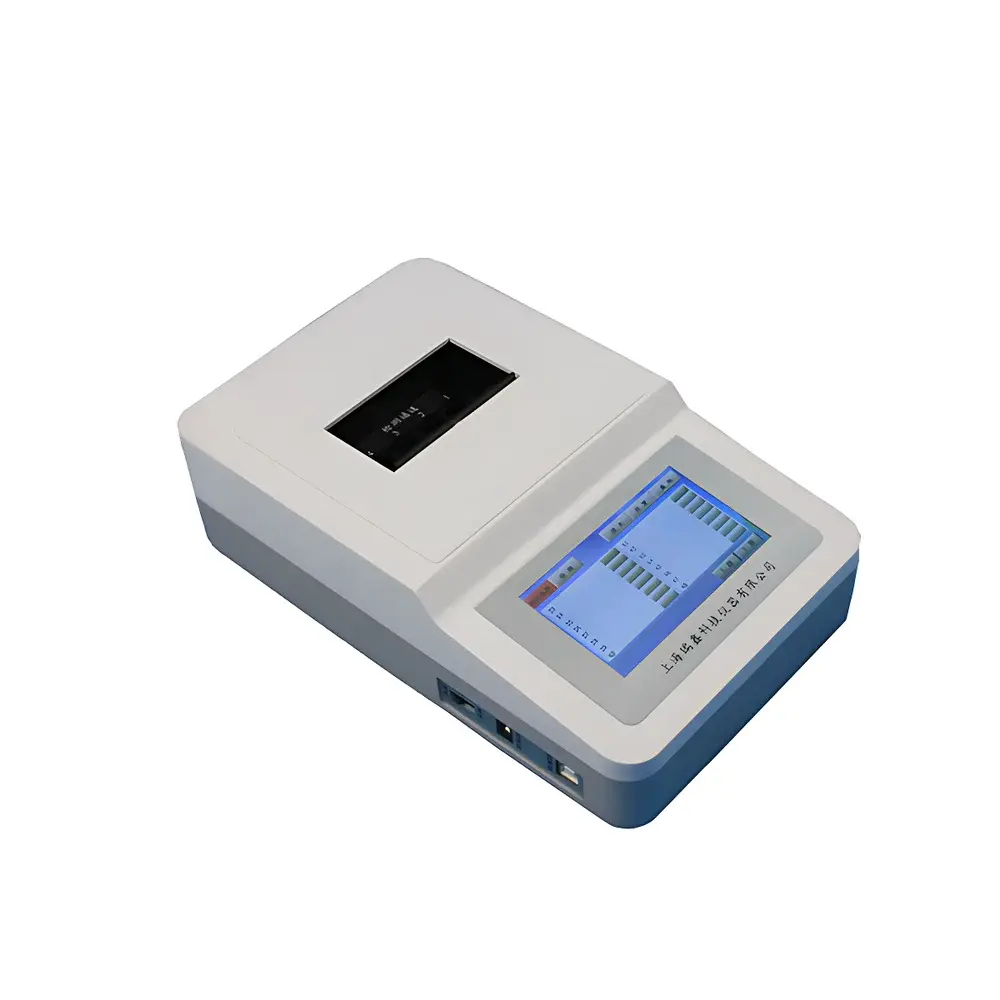
Ruixin SPb-ZA2 Histamine Rapid Detection Analyzer
| Brand | Ruixin |
|---|---|
| Origin | Shanghai, China |
| Manufacturer Type | Authorized Distributor |
| Country of Origin | China |
| Model | SPb-ZA2 |
| Price Range | USD 4,200 – 7,000 (FOB Shanghai) |
| Functionality | Single-Analyte Quantitative Detection |
| Sample Format | Dedicated Single-Sample Cuvette-Based Assay |
| Optical Wavelength | 540 nm |
| Assay Time | ≤ 180 seconds |
| Photometric Repeatability | ≤ 0.2% CV |
| Detection Channels | 1 |
| Absorbance Range | 0.000–4.000 AU |
| Transmittance Range | 0.00–100.00% |
| Transmittance Resolution | 0.01% |
| Absorbance Resolution | 0.001 AU |
| Photometric Accuracy (Transmittance) | ±2.0% |
| Baseline Stability (3 min) | ≤0.3% |
| Histamine LOD | 1.0 mg/100 g |
| Histamine Linear Range | 0–100 mg/100 g |
| Communication Interfaces | RS-232, USB 2.0 |
| Power Supply | Internal Rechargeable Li-ion Battery (7.4 V, 4400 mAh), AC 220 V ±10%, DC 5 V Input |
Overview
The Ruixin SPb-ZA2 Histamine Rapid Detection Analyzer is a dedicated photometric instrument engineered for quantitative determination of histamine in food matrices using standardized colorimetric assays based on the diazotization-coupling reaction. Operating at a fixed optical wavelength of 540 nm—optimized for maximum sensitivity and selectivity in the histamine-azo dye complex—the analyzer implements a single-beam, cuvette-based absorbance measurement principle compliant with AOAC Official Method 2005.02 and aligned with ISO 19040:2016 (Foodstuffs — Determination of biogenic amines — HPLC method, used as reference for validation of rapid screening tools). Designed for field-deployable operation without compromise to analytical integrity, the SPb-ZA2 integrates optical self-calibration, thermal drift compensation, and real-time photodiode signal stabilization to ensure consistent performance across ambient temperature fluctuations (10–35 °C) and variable power sources.
Key Features
- Portable architecture with integrated 7.4 V / 4400 mAh rechargeable lithium-ion battery enabling ≥8 hours of continuous operation—ideal for mobile food safety inspection units, roadside checkpoints, and cold-chain audits.
- 4.3-inch high-resolution capacitive touch LCD display with full Chinese GUI, supporting direct Chinese character input via on-screen keyboard or stylus for sample labeling, operator ID, and institutional metadata entry.
- Embedded thermal printer producing traceable, audit-ready reports containing: analyte concentration (mg/100 g), sample name (Chinese/English), test date/time (ISO 8601 format), operator ID, laboratory/unit name, and instrument serial number.
- Automatic optical path calibration at startup—eliminates manual zeroing and 100% transmittance adjustment—reducing operator dependency and inter-user variability.
- Dual-mode photometric display: simultaneous real-time readout of absorbance (0.000–4.000 AU, resolution 0.001) and transmittance (0.00–100.00%, resolution 0.01%), facilitating method development and cross-validation with spectrophotometric reference instruments.
- Onboard data management: automatic timestamped storage of ≥1,000 test records with recall-by-date, sample ID, or operator filter; exportable via USB to CSV or XML for LIMS integration.
Sample Compatibility & Compliance
The SPb-ZA2 is validated for use with pre-extracted homogenates from fish, fermented sausages, cheese, soy sauce, and other high-histamine-risk commodities per national standards GB 5009.208–2016 (China) and harmonized with Codex Alimentarius GL 213–2003 (Guidelines for Histamine in Fishery Products). Each assay requires a 100 µL sample extract loaded into a standard 10 mm pathlength quartz or high-transmission plastic cuvette. The system supports only the Ruixin-certified histamine-specific reagent kit (Cat. No. RX-HIS-KIT-SPb), ensuring lot-to-lot consistency and minimizing matrix interference. Instrument design conforms to IEC 61010-1:2010 (Safety Requirements for Electrical Equipment for Measurement, Control, and Laboratory Use) and electromagnetic compatibility per EN 61326-1:2013.
Software & Data Management
Firmware v3.2 includes GLP-compliant audit trail functionality: all critical events—including calibration initiation, result modification (if permitted under admin lock), report printing, and data export—are time-stamped and logged with user authentication. USB mass-storage mode allows direct transfer of encrypted .csv files to external PCs; RS-232 interface supports Modbus RTU protocol for integration into centralized food safety monitoring networks (e.g., provincial-level Food Safety Information Platforms). Optional cloud gateway module (RX-CloudLink v1.1) enables TLS 1.2-secured data transmission to web-based dashboards compliant with GDPR and China’s PIPL requirements for personal information handling.
Applications
- Routine screening of histamine in raw and processed seafood prior to distribution—supporting HACCP Critical Control Point verification.
- Field verification of cold-chain integrity during transportation audits, where elevated histamine serves as an indicator of temperature abuse.
- Regulatory surveillance by municipal market supervision bureaus (MMSB), CDC laboratories, and customs inspection agencies conducting rapid triage before confirmatory LC-MS/MS analysis.
- Quality assurance testing in fermented food manufacturing facilities (e.g., kimchi, natto, salami) to ensure compliance with EU Regulation (EC) No 2073/2005 microbiological criteria.
- Training and capacity building in regional food safety labs where robustness, ease of maintenance, and minimal consumables dependency are operational priorities.
FAQ
What regulatory standards does the SPb-ZA2 support for histamine testing?
It aligns with GB 5009.208–2016 (China), AOAC 2005.02 (screening tier), and provides data suitable for preliminary assessment under EC No 2073/2005 Annex I Chapter 2. Confirmatory testing remains required for enforcement actions.
Can the instrument be used for analytes other than histamine?
No. The SPb-ZA2 is a single-analyte platform with fixed 540 nm optics and firmware-locked calibration curves. It does not support method customization or multi-analyte cartridges.
Is the internal battery replaceable by the end user?
Battery replacement requires authorized service center intervention due to sealed enclosure design and UL/cUL safety certification constraints.
How is measurement traceability ensured?
Each unit ships with NIST-traceable photometric verification kit (certified neutral density filters at 0.5, 1.0, 2.0 AU); calibration logs and factory certificate of conformance are included in the documentation package.
Does the device meet FDA 21 CFR Part 11 requirements?
While it supports electronic signatures and audit trails, full Part 11 compliance requires deployment within a validated IT infrastructure—including secure network configuration, access control policies, and periodic electronic record review protocols—as defined in the site-specific Validation Master Plan.
Related Products




