
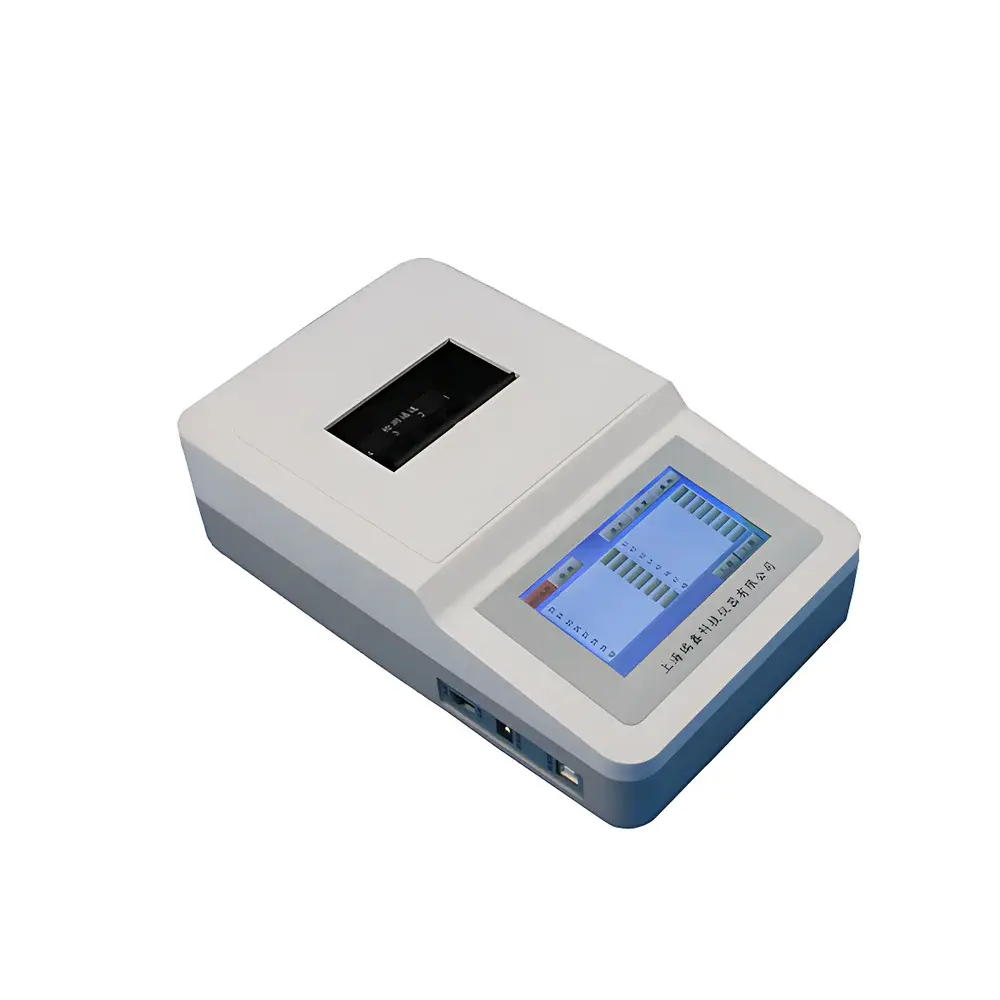
Ruixin SPb-ZT2 Sucrose Analyzer
| Brand | Ruixin |
|---|---|
| Origin | Shanghai, China |
| Manufacturer Type | Authorized Distributor |
| Country of Manufacture | China |
| Model | SPb-ZT2 |
| Price Range | USD 4,200 – 7,000 (FOB Shanghai) |
| Functionality | Single-Analyte Detection |
| Sample Format | Dedicated Single-Sample Cuvette Format |
| Optical Wavelength | 410 nm |
| Assay Time | ≤ 180 s per sample |
| Photometric Repeatability | ≤ 0.2% RSD |
| Detection Channels | 1 |
Overview
The Ruixin SPb-ZT2 Sucrose Analyzer is a compact, field-deployable photometric instrument engineered for rapid, quantitative determination of sucrose concentration in liquid food matrices—primarily fruit juices, soft drinks, syrups, and dairy-based beverages. It operates on the principle of fixed-wavelength absorbance photometry at 410 nm, where sucrose—after enzymatic or acid hydrolysis to glucose and fructose—is quantified via colorimetric reaction with reagents such as anthrone or resorcinol, generating a chromophore with defined molar absorptivity at this wavelength. The device is not a general-purpose spectrophotometer but a purpose-built, single-parameter analyzer calibrated exclusively for sucrose using traceable NIST-traceable reference standards. Its optical architecture incorporates an integrated self-calibration system that automatically corrects baseline drift upon power-on, eliminating manual zeroing and 100% transmittance adjustment—thereby reducing operator-dependent variability and ensuring measurement consistency across mobile and laboratory environments.
Key Features
- Portable form factor with built-in rechargeable lithium battery (up to 8 hours continuous operation), enabling use in mobile food safety inspection vehicles, roadside checkpoints, and decentralized field labs.
- 4.3-inch high-resolution TFT color touchscreen with full Chinese GUI; supports stylus and on-screen QWERTY input for direct annotation of sample names, operator IDs, and institutional metadata.
- Embedded thermal printer delivering compliant test reports per channel—including numeric sucrose concentration (% w/v), Chinese-labeled sample ID, date/time stamp, analyst name, and testing unit.
- Dual-mode photometric display: simultaneous readout of absorbance (0.000–4.000 AU, resolution 0.001) and transmittance (0.00–100.00%, resolution 0.01%), supporting method validation and cross-platform data reconciliation.
- Optical stability ≤ 0.3% over 3 minutes (drift specification), meeting minimum performance thresholds for routine QC in ISO/IEC 17025-accredited food testing laboratories.
- Compliant with common food regulatory assay protocols requiring endpoint absorbance measurement at 410 nm, including modifications of AOAC Official Method 982.14 and GB 5009.8–2016 (China National Food Safety Standard for Sucrose Determination).
Sample Compatibility & Compliance
The SPb-ZT2 accepts standard 10-mm pathlength glass or disposable plastic cuvettes. Sample preparation requires prior clarification (e.g., centrifugation or filtration) and optional enzymatic pretreatment (invertase + glucose oxidase/peroxidase) depending on matrix complexity. It is validated for aqueous solutions with sucrose concentrations between 0.0% and 12.0% (w/v), with limit of detection (LOD) at 3.0% (w/v) under standard assay conditions. The instrument complies with electromagnetic compatibility (EMC) requirements per GB/T 18268.1–2010 (equivalent to IEC 61326-1) and meets basic safety standards per GB 4793.1–2007 (IEC 61010-1). While not certified to FDA 21 CFR Part 11 out-of-the-box, its audit trail functionality—including timestamped result storage, operator ID logging, and immutable report generation—supports alignment with GLP and GMP documentation practices when deployed within controlled QA/QC workflows.
Software & Data Management
Data are stored internally (≥ 1,000 test records) with time-stamped, non-editable entries. Results export via RS232 serial interface or USB mass storage mode to CSV-compatible spreadsheets. Optional integration with Ruixin’s Food Safety Monitoring Network (FSMN) platform enables real-time upload to centralized dashboards, supporting regional surveillance, trend analysis, and automated alerting for out-of-specification results. Firmware updates are delivered via USB drive; no cloud dependency or subscription model is required. All data fields—including raw absorbance values, calculated % sucrose, and user annotations—are retained in native format without compression or proprietary encoding.
Applications
- Routine verification of label claims for sucrose content in prepackaged beverages and confectionery syrups.
- On-site screening at wholesale distribution centers to detect adulteration or dilution in bulk juice concentrates.
- Regulatory enforcement testing by municipal market supervision bureaus (e.g., SAMR-affiliated units) during routine inspections.
- Internal quality control in small-to-midsize beverage manufacturers lacking full-spectrum HPLC infrastructure.
- Training and proficiency testing in food science education programs where cost-effective, standardized sucrose assays are required.
FAQ
Does the SPb-ZT2 require external calibration standards for daily use?
No—its onboard optical self-calibration system performs automatic dark-current and reference compensation at startup. However, periodic verification using certified sucrose reference solutions (e.g., 5.0% and 10.0% w/v) is recommended every 24 hours in high-throughput settings.
Can the instrument measure other sugars besides sucrose?
Not natively. The 410 nm optical configuration and factory calibration curve are specific to the sucrose-derived chromophore. Cross-reactivity with maltose or lactose is negligible under standardized assay conditions, but dedicated analyzers are required for those analytes.
Is the thermal printer compatible with third-party label formats?
The embedded printer uses fixed-format thermal paper (57 mm width); custom templates are not supported. Report layout adheres to Chinese food inspection reporting conventions and cannot be modified via UI.
What power sources are supported during field deployment?
Three options: internal Li-ion battery (USB-C rechargeable), AC 220 V ±10% 50 Hz adapter, or external 5 V DC power bank (via micro-USB port)—enabling uninterrupted operation in areas with unstable grid supply.
How is data integrity ensured during network transmission?
All transmitted records include SHA-256 checksums and sequential packet numbering. FSMN gateway authentication uses TLS 1.2 encryption; local storage remains fully isolated unless explicitly initiated by user command.





