
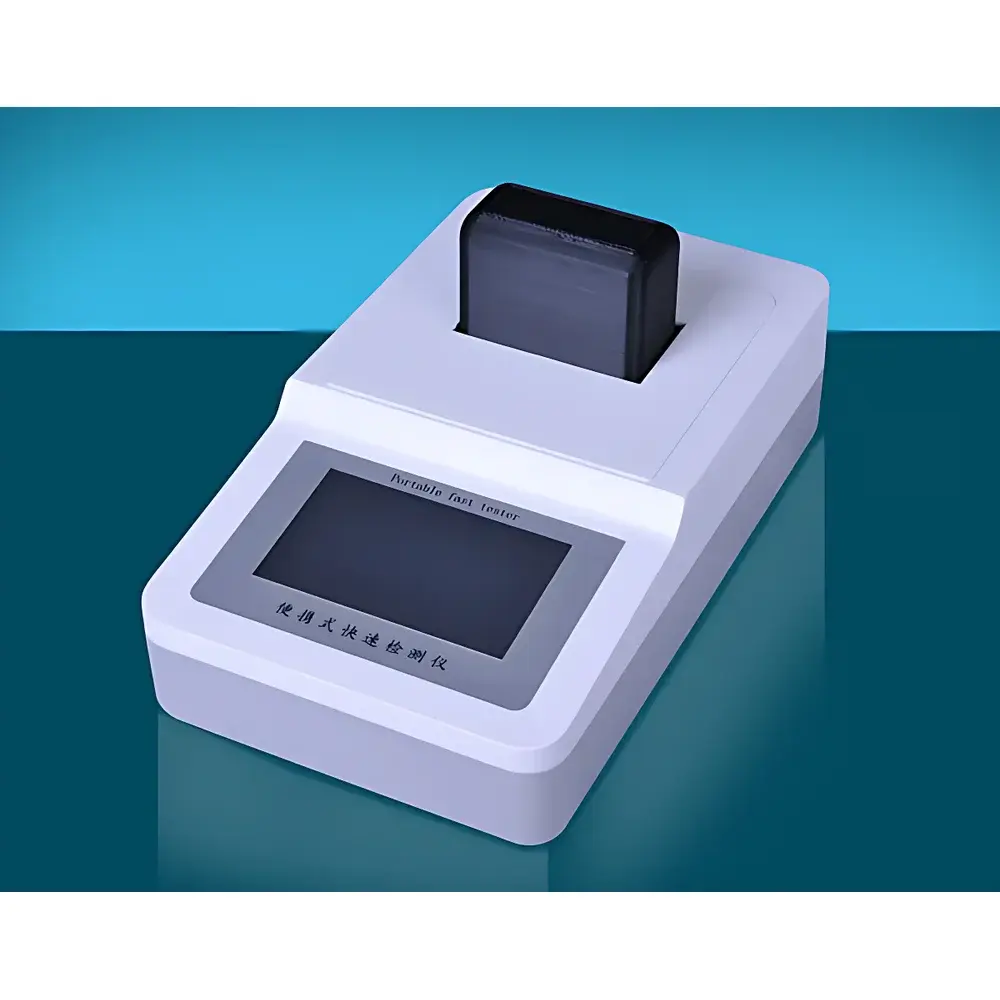
RuiXin SZ-CL Portable Residual Chlorine Analyzer
| Brand | RuiXin |
|---|---|
| Origin | Shanghai, China |
| Model | SZ-CL |
| Instrument Type | Portable |
| Measurement Parameter | Residual Chlorine |
| Detection Range | 0.05–10.00 mg/L |
| Accuracy | ≤5% |
| Repeatability | ≤2% |
| Resolution | 0.01 mg/L |
| Limit of Detection (LOD) | 0.02 mg/L |
| Display | 4.3-inch color TFT touchscreen |
| Absorbance Range | 0.000–4.000 |
| Transmittance Range | 0.00–100.00% |
| Transmittance Resolution | 0.01% |
| Absorbance Resolution | 0.001 |
| Photometric Accuracy | ±2.0% (transmittance) |
| Photometric Repeatability | ≤0.2% |
| Baseline Stability | ≤0.3% (over 3 min) |
| Communication Interface | USB |
| Power Supply | AC 220 V / DC 5 V / Rechargeable Li-ion battery |
| Integrated Thermal Printer | Yes |
| Data Storage & Recall | Yes |
| Data Export Capability | Yes |
Overview
The RuiXin SZ-CL Portable Residual Chlorine Analyzer is a field-deployable photometric instrument engineered for rapid, on-site quantification of free residual chlorine in aqueous matrices. It operates on the principle of colorimetric analysis using the N,N-diethyl-p-phenylenediamine (DPD) method—standardized in ISO 7393-2, ASTM D1253, and US EPA Method 334.0—where residual chlorine oxidizes DPD to form a stable magenta-colored complex measurable at 515 nm. The analyzer integrates a precision optical path with a high-stability LED light source and silicon photodiode detector, delivering reproducible absorbance measurements under variable ambient conditions. Designed for operational flexibility, the SZ-CL functions equally effectively in mobile environmental monitoring units, municipal water quality field teams, swimming pool maintenance vehicles, and routine laboratory settings—without requiring external calibration infrastructure or dedicated bench space.
Key Features
- 4.3-inch high-resolution color TFT touchscreen with full Chinese GUI, supporting intuitive navigation and direct Chinese character input via on-screen keyboard or stylus for unambiguous sample annotation.
- Pre-programmed multi-point calibration curves optimized for low-, mid-, and high-range residual chlorine quantification (0.05–10.00 mg/L), eliminating manual curve derivation.
- Integrated thermal printer enabling immediate hard-copy generation of test reports—including date/time stamp, operator ID, sample ID, measured concentration, and method reference.
- Onboard data management system with non-volatile memory capable of storing ≥500 test records, each timestamped and retrievable by sequential index or parameter filter.
- Dual-mode power architecture: supports continuous operation via AC 220 V mains, regulated DC 5 V input, or internal rechargeable lithium-ion battery (≥8 hours typical runtime).
- Robust aluminum alloy housing rated IP65 for dust resistance and limited water ingress protection—suitable for outdoor deployment in humid or splash-prone environments.
Sample Compatibility & Compliance
The SZ-CL is validated for use with clarified or filtered samples from potable water, secondary treated wastewater, recreational pool/spa water, surface water, and sterilized medical effluent streams. Turbidity interference is minimized through built-in compensation algorithms aligned with ISO 7027 guidance. All measurement protocols comply with regulatory frameworks governing disinfectant residual verification, including WHO Guidelines for Drinking-water Quality (4th ed.), EU Directive 98/83/EC, and China’s GB/T 5750.11–2023. Instrument firmware supports audit-ready data logging with immutable timestamps and user-defined operator codes—facilitating GLP-aligned recordkeeping and partial alignment with FDA 21 CFR Part 11 requirements when paired with controlled access procedures.
Software & Data Management
Data export is enabled via standard USB 2.0 interface, compatible with Windows-based desktop applications for CSV-formatted batch download and traceable report archiving. Internal firmware includes automatic zero-point validation prior to each measurement cycle and real-time error flagging for out-of-range absorbance, expired reagent prompts, or insufficient sample volume detection. No proprietary software installation is required; exported datasets retain native metadata (e.g., calibration lot ID, ambient temperature during measurement, photometer warm-up status) to support metrological traceability in QA/QC workflows.
Applications
- Routine verification of chlorine residual at drinking water distribution points and household taps per national regulatory thresholds.
- Dynamic dosing control feedback in chlorination systems at water treatment plants and booster stations.
- Compliance monitoring for public swimming pools and hot tubs under local health department ordinances (e.g., CDC Model Aquatic Health Code §6.003).
- Emergency response screening following natural disasters or infrastructure failures where rapid disinfectant efficacy assessment is critical.
- Educational laboratories conducting method validation exercises and comparative DPD methodology training.
FAQ
What measurement method does the SZ-CL employ?
It uses the standardized DPD colorimetric method (ISO 7393-2), measuring absorbance at 515 nm after reaction with free chlorine.
Can the instrument measure combined chlorine or total chlorine?
No—the SZ-CL is configured exclusively for free residual chlorine; combined or total chlorine requires separate reagent protocols not supported by this model.
Is calibration traceable to NIST or equivalent national standards?
While the instrument itself is not NIST-traceable as a complete system, it accepts calibration standards prepared from NIST-traceable stock solutions (e.g., potassium permanganate or certified chlorine standard kits) per ISO/IEC 17025 laboratory practice.
How often must the optical system be cleaned or serviced?
The cuvette chamber and optical window require cleaning with lint-free wipes and deionized water after every 20–30 measurements or immediately following turbid or high-organic-content samples.
Does the device support remote data transmission over cellular or Wi-Fi networks?
No—data transfer is limited to local USB export; network connectivity is not embedded and requires third-party gateway integration.
Related Products







